

Fourth Estate/Andani Munkaila
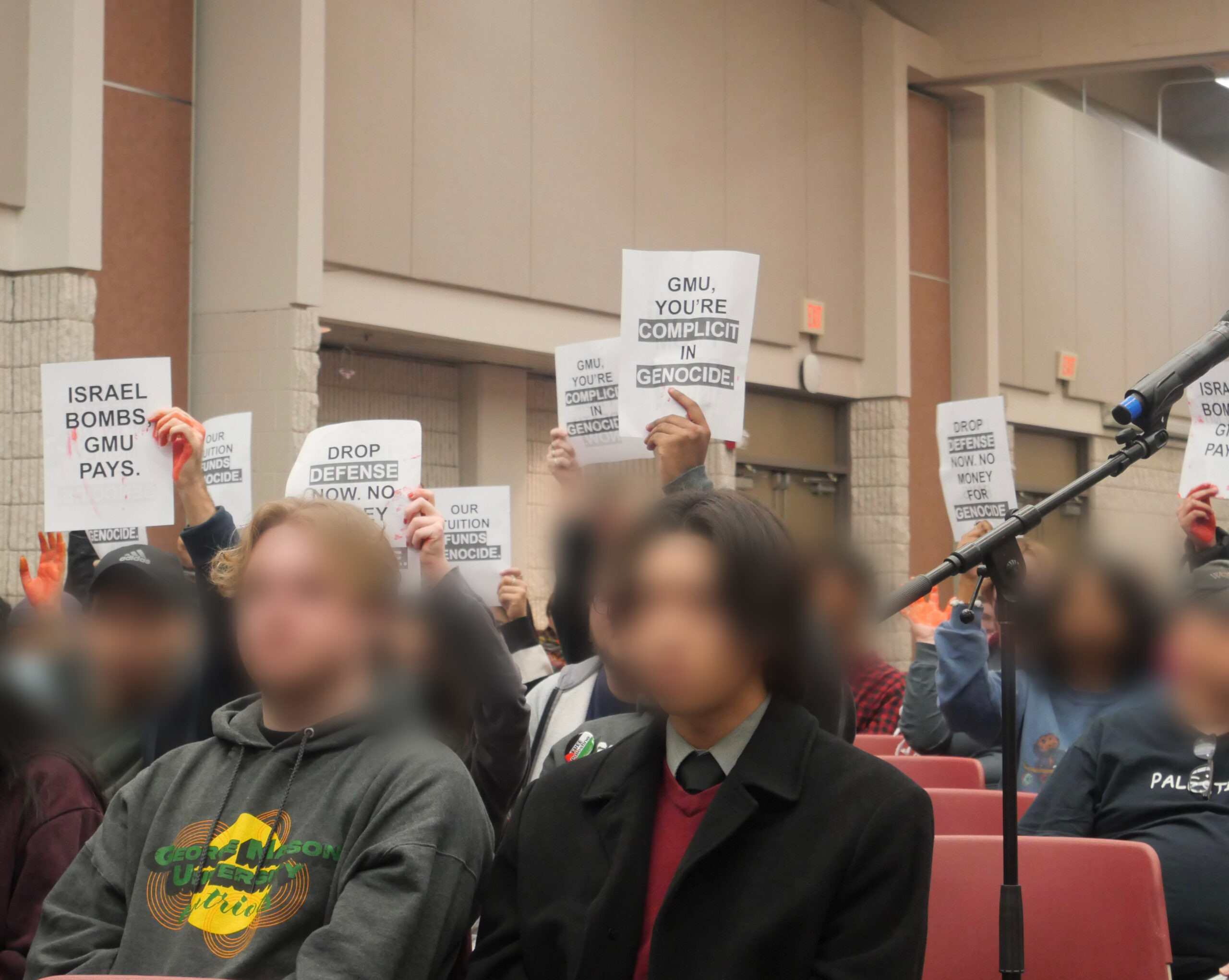
TRANSCRIPT OF FEB. 7 STUDENT TOWN HALL: GREGORY WASHINGTON’S OPENING PRESENTATION A full transcript of Dr. Washington’s 15-minute presentation from the Feb. 7 Student Town Hall addressing letters to the student body.BY ERICA MUNISAR, EDITOR-IN-CHIEF
Editor’s Note: Fourth Estate decided to deliver Gregory Washington’s 15-minute presentation from the as an unedited transcript for transparency towards the student body.
Thank you all for giving me the opportunity to address you today. I got five slides I’m going to push through so that I can leave as much time for questions and engagement as you possibly can.
As you all know, I’ve been getting a lot of emails from many of you and from many folks in our community, and so I want to take some time to address some of the questions that I’ve compiled upfront so that we make sure that those particular ones are answered because I get a lot.
So, why did we write letters? As you all know, I’ve written now probably some ten to 15 different letters on different issues. [Letters were sent to the student body by both the Office of the President and Office of the Vice President, however not all of the Vice President’s letters are available online.] We don’t just write those to opine on given issues. We write the letters for a reason, and I don’t sit and just write the letter myself. There’s a whole team of us, some 15 or 20 people, who together, we work to put out every single communication that comes across your desk.
So why do we write? We write it for four reasons. One, to provide information. There are times when that’s needed. Two, to provide guidance as we did during the COVID-19 Crisis. Three, to provide comfort and calm. We did that during the Russia-Ukraine crisis. We did it during the George Floyd tragedy, during the Brianna Taylor issues. [Fourth Estate could not verify a letter about Brianna Taylor.] And then [four], to provide education. We did that during the affirmative action ruling. Those are the reasons why we write them to begin with.
Four letters of recent time have caused some controversy, and I want to address them and address them directly. We wrote a letter on Oct. 10 about the unfolding war in Israel and Gaza, and that war was written as comfort and information. We wrote a follow-up letter to that on Oct. 17 that was written to address issues related to student protests. And I’m going to talk a little bit about that in detail here in a second. We wrote a third letter on Nov. 2 to introduce our 10-point plan [Fourth Estate determined that there are eight points according to the Patriot Plan for Community Safety and Well-Being.] to ensure student support and safety. And when we wrote the last one on Nov. 28 relevant to Islamophobia. So those were the communications.
Look, we are never ever against you. We’re always for you. That’s why we are here. We are actually here to support you. And while we may disagree and tell you some things that we disagree with, it does not mean that we are against who you are.
Our support of one group of students does not mean that we are against another group. Just because we write a letter in support of one group, it does not mean that we are against another group. If I write a letter in support of Jewish students, it does not mean that I’m against Muslim or Palestinian students. And if I write a letter in support of something that our Muslim students are dealing with, or our Palestinian students are dealing with, it does not mean that I’m against Jewish students. We only write letters in support. Read the letters. We have copies of them in the back so that you can actually read the detail.
Our support of one group of students does not mean that we support their government or any government. “I support one group of students,” doesn’t mean that we support the government or any other government? We’re in the business of supporting our students here. We’re not in the business of supporting or opining about governments. Again, that’s very clear in our letters.
Our support for each group is based on the needs of that group. [unintelligible] in that regard, it may not look the same in terms of our support for one group relative to our support for another, because the individual needs are different and the actual groups are different. And just because we tell you something that you have done this wrong, it still doesn’t mean we don’t support you. It means that we got a problem with something that you’re doing and that it needs to change. And ultimately, our goal is to protect and support all of the students in our institution.
Let me talk a little bit about some of the questions that I’ve received directly from you about the Israeli-Hamas conflict.
One, why did you not say anything about the atrocities committed by Israel on the Palestinians during this current conflict? Look, when my letter was written on Oct. 23 [Fourth Estate could not locate a letter from Oct. 23.], the Israeli bombing when terms would be seen at this point, had not started in my letter on Oct. 17. The Oct. 17 letter directly addresses the deaths of innocent Palestinians. It’s written in the letter.
Why did you not say anything about the atrocities committed by Israel? By the Palestinians since 1947? The issue’s a complicated one, [“No it’s not.” A protestor interjected.] extraordinary. Since 1947, there have been five wars going back [to] 1948, 1958,1967, 1973, 1982 [unintelligible.] This is an extraordinarily complex issue. [“Apartheid is not complicated.” A different protestor interjected.] You’ll get your opportunity to talk. You can make your statements then.
Why did you say the [Oct. 7] attack on Israel was a terrorist attack? Is it important to call out things for what they are? You can’t defend the indefensible. I called it a terrorist attack, because it was a terrorist attack. I did not call any student a terrorist. I called what Hamas did a terrorist attack. It was a terrorist attack.
Relative to this, look, we have to be able to have discussions about things when they happen, while they’re happening and in real time. And so it was very important for us as a campus, looking at what was happening on our campus at this specific point in time, and looking at what a number of our student groups were outwardly writing about this issue, to call attention to the fact that it was a terrorist issue and not indicative of anything that the university supports.
Again, I have letters back there from SJP that highlights what they wrote on Oct. 9 after the attack in Israel. Those of you who are students who have not read that should read it, so that you understand the context of why we say what we say, and why we do what we do. I am not the person that’s [going to] run from any type of conflict. I stand firm, I stand strong and I will tell you how I feel about an issue. [I am] just not built that way. Okay? And so before you step, understand that I will respond.
Why is the community angry at our students? We have received now hundreds of letters and calls, mostly angry, that we are allowing student protests and we are allowing our students to use hateful language. I have received numerous threats in the press. I’ve had calls from my job in the press for allowing our students to protest. That is a fact.
Why did you not say anything? [unintelligible] Why did you not speak about more about Islamophobia like you did about antisemitism? We addressed the antisemitism when we did because we had more than 70 incident reports that came to our offices [which] were about instances of antisemitism. And given the size of the two groups on campus, we felt that we needed to address it. We’ve had now two confirmed assaults on students. Those were both to students of Jewish descent. And so we felt the need to address that to the broader community.
Why is the campus not [unintelligible] for Justice in Palestine and the Muslim students in general? Well, we are supporting all of our students. How do we support? Look, I have been asked on numerous occasions to stop the student protests. Even when you’re protesting against me, I still support it because I support freedom of speech.
The reality of the situation is right now the university is under investigation by the Department of Education because we’ve allowed the protests to continue. Go read the letter. I have it in the back for you. The formal letter from the Department of of Education Office of Civil Rights [will] highlight this.
So before you say you’re not being supported, that’s a fact. That is a fact. We have been managing issues related to freedom of speech and freedom of assembly. We have been doing that in manner that we believe [is] in alignment with university values. That’s what you want your institution to do. The institution stands for certain principles, and as the leader of that institution, I stand on the principles in which the university has stood for. You know what that’s called? And I do it even when it’s in the face of adversity, that’s actually called leadership. That’s what you expect your leaders to do.
I’ve supported this community and shielded them from a very, very hostile community that actually wants to do you harm. I can’t go through all of the individual issues relevant to this, but it is true and I got the proof and the emails and the telephone calls to validate it.
So as I wrap up, look, we are here to support you. We are here for you. I know of no other way to support you outside of the ways in which we’re supporting all of you. I know some of you don’t like what’s happening. I don’t either. Okay?
In my leisure, I call in my letters for Palestinian self-determination, for Palestinian state. I support that, all right? I also support Israeli and Jewish safety and defense. I support both.
Just because you support one it doesn’t mean that you don’t have to support the other there’s no rules that say you have to support one and not the other. You can actually support both because in a lot of sense both are correct.
What’s happening now in Israel is an atrocity and we have to deal with it and we have to address it as a community. So I don’t want you to think that we’re against you, in any stretch of imagination or against any of it. We support all of them.
I will leave you with one word of advice before I open it up for questions: Don’t turn on each other.
I have received numerous reports of students [like] Jewish students who longer talk to their Muslim friends, or Muslim students who no longer talk and communicate with their Jewish friends. People who they used to connect with, people who they used to engage, those conversations are not happening now.
That’s a problem. I don’t know any other way to tell you. People are not their governments. People are people. And they should be judged and engaged based on who they are, and the content of their individual character. Not by who you think they represent. I know what that feels like. I’ve experienced that. People look at you and think that you are a certain way, that you are a certain type [and] that you do certain things. And I can tell you unequivocally that it is wrong.
And so on that note, I will open it up for questions.
TRANSCRIPT OF FEB. 8 STUDENT TOWN HALL: QUESTIONS AND ANSWERS FROM DR. WASHINGTON A summarized transcript of questions asked by 11 attendants revolving around the Israel-Hamas war, funding and security topics along with protest demonstrations from Students in Justice For Palestine at George Mason University.BY ERICA MUNISAR, EDITOR-IN-CHIEF
Editor’s Note: Fourth Estate published a summarized transcript of questions and answers from the Feb. 8 Student Town Hall. Due to the nature of the town hall, in which protestors and Dr. Washington rapidly exchanged responses over the period of an hour, including numerous follow-up questions, the responses were edited for clarity and do not reflect Dr. Washington’s full statements per question asked.
[Questioning portion of Town Hall begins at 1:17 p.m.]
Who are the approved members that can ask for identification in the new Concealment of Identity policy? What qualifies as a face covering, and how will this policy be enforced?
We put mechanisms in place to ensure that people are identified once they enter a venue or protest…
We’ve been using university staff from university life and from our risk and assessment team who’ve been checking the IDs, and they’ve been supported by the police. This came about by state law [Code of Virginia § 18.2-422]. We were required to do this… The individuals who are doing the checks are given very, very strict instructions as to what it implies…
Again, this is not a Mason rule, this is a state of Virginia law. You know why it was put in place? It was put in place because the Ku Klux Klan was wearing hoods to hide their identity when they were protesting and committing atrocities in the state of Virginia.
President Washington, three and a half months ago I was in your office as lead organizer with Students for Justice in Palestine… You claimed in conversations with myself as well as numerous Palestinian students over the past four months that you know more about what we call Palestine… because you have been to Israel more than five times… Do you feel you still have more knowledge than us because of your trips? When you have done so little?
I have never said that I know more than anybody… What I did tell you is that I knew things about the issue. I have never said that I know more than the people in this room. I would never say that… You are entitled to your own beliefs. You are not entitled to your own facts.
You recorded the conversation, play it for the people… and you will see that I did not say that… Just because some people think you heard something, it [does not] mean that is what I said.
Could you please consider a halt on the increases of tuition, or a halt to the student fees?
As you know, there are five R1 institutions in the state of Virginia. Of those five R1 doctoral institutions, Mason has the fourth lowest tuition. We live in the region that is by far the highest cost of living in the state, and in the top five highest cost of living regions in the whole country.
I have to balance what the tuition is relative to what resources we need in order to provide the faculty and staff to be able to teach and support them. The fact that our tuition is as low as it is, given the constraints that we have, and that we are still able to operate, is actually a testimony to success…
We’re working on ways to help those students who are most vulnerable… We’ve actually done a tremendous job in lowering the cost for those that are most vulnerable…We will continue to drop that number as much as we possibly can. And we have mechanisms in place to do more.
Our school has heavy ties with the military industrial complex… We live close to D.C. and people need to be employed, but it’s also something that really needs to be addressed, and I absolutely haven’t seen that from the administration.
Let me address that directly…
The companies that engage our campus, whether our our whole host of companies, they’re all the companies that ingratiate the Northern Virginia area, not just defense contractors. It’s Amazon, it’s Microsoft, it’s apple, it’s everybody… George Mason University is a public institution. Those corporations pay public taxes…
They engage with us for students. Those students graduate and they go work for those companies. A large percentage of students come to Mason to engage and get jobs from the very companies that you’re telling me to divest from.
Everybody doesn’t see the world the same way. And so, if you don’t want those companies involved with Mason, it is extraordinarily easy to stop it. You have agency. Don’t take jobs there, don’t apply there, don’t work there and guess what the companies will do? They will go to another university that’s willing to supply their talent.
We have 40,000 students. A significant percentage of those students would love to take a job at Raytheon. Just because you don’t think you should take a job there… what about those students who actually are trying to get jobs at those companies?
[Follow-up Question] It isn’t just about jobs or people’s individual choice to have jobs. It’s about community responsibilities.
I hear you, but the same companies that you will say “okay, well that company created a bomb that caused damage over [there],” that same company produces the weapon that will defend your freedom [Protestor interjections unintelligible]…
That same company provides the weapons that allow America to be what America is [Protestor interjections unintelligible]… And that is the good and the bad. And without it… we would be living in a very, very different position here in a country without that protection. Look, again, these are complex, complex issues.
I am a representative for Students for Justice in Palestine… It is also public knowledge that George Mason University is investing in American corporations [which are] profiting from the genocide of Palestinians in Gaza. $26 million, approximately 10% of the student investment fund, is funding the ongoing genocide to murder innocent civilians, men, women and children. You are complicit… It is on the George Mason University website.
We don’t know where that number came from. Don’t trust what you read on social media. What website? You’re going to have to show me that…
George Mason University does not actually invest money anywhere. There is a separate 501(c)(3) called George Mason University Foundation that actually does all of the investments for the campus. It’s a separate 501(c)(3) with a separate leader with a separate board. It does not answer to the Board of Visitors, and it does not answer to the President… It is not your tuition dollars.
[Follow-up Question] And your statement about these weapon manufacturers helping to protect our freedom… Do Palestinians not have that same right? By providing them weapons, we are giving them the power to kill more Palestinians.
They [Palestinians] have the same right… The weapons that are used, are used to not only support individuals… but they can also be used for harm. It’s not the weapons themselves that’s the problem here. It’s the individuals behind the weapon that’s pulling the trigger… You’re focused on something different than what the issue is…You’re going after the weapon and not the people.
But what I will tell you is that’s not a decision that your president makes… We’re not in the bombs making business and we’re not in a bomb supporting business. We don’t do any of those things. We’re in the student graduation and support business.
Hello, President Washington. Over the course of these four months…there have also been increasing cases of hate crimes against Palestinians, Arabs and Muslims here in the United States… [Your] students are all vulnerable to attacks just like these, and what exactly have you done to ensure their safety?
Part of the reason that you’ve seen an increased police presence is actually not to surveil or to intimidate you. It’s actually to protect you…
The 10 point plan [Fourth Estate determined there are eight points according to the Patriot Plan for Community Safety and Well-Being.] that we put in place, the Patriot Plan, is a big part of the reason why we haven’t had those same incidences on our campus that you’ve seen happening elsewhere
We do have police reports. We do have bias incident reports… We take this information seriously and we monitor it, so we have a pretty decent idea of what’s happening how students are being protected and our students alone. Can we stop every single incident from happening? No. But we have thwarted incidences from happening. I can tell you that.
[Follow-up question] Those counter-protesters went into people’s faces and literally verbally attacked [SJP Protestors], if not physically tried to attack them [as claimed by SJP Mason].
You’re not entitled to your own facts. Look, there was no student assaulted physically in the counter protest… Just because somebody says something to you, just because somebody calls you out in your name, or says something negative. That is known as physical assault. They actually have a right to say that under the same rationale and reason that you have a record saying what you want to say. And yes, they said some vile things. But you weren’t protected. And those individuals were escorted off of our campus to keep anything else from happening…
We do have video evidence… and I can tell you that no student was physically assaulted, at least not in anything that I saw. There was no report… Where’s the Chief? I know he’s here somewhere. Chief, did we get a physical report of anybody physically assaulted? [Chief of Police Carl Rowan says no], were you there? [Rowan says yes.] Okay…
You’re going to be in an environment where you might not feel intellectually safe, but you will be physically safe to the fullest extent that we can provide for you… Take a look at the data. It’s one of the safest campuses in the whole country.
It is our understanding that there are new policies regarding face masks and a requirement for students to show identification should they have [a mask on]… For disabled activists like me, face masks are vital in [the COVID-19 pandemic]… As someone who especially struggles with fine motor skills, pulling out my ID when prompted can be a struggle. Thus, I and many others are faced with the dilemma of either attending political actions…or forcibly [staying] at home… Why will you not support and protect disabled activists at GMU?
We don’t tell you that you can’t wear your face coverings. We just tell you that somebody has to identify who you are… That’s our way of meeting the spirit of the law while simultaneously allowing you to protest, and not doing what other institutions are doing when students show up in face masks and shut the whole protest down… You will see that we are actually supporting First Amendment speech more than you think.
We can actually develop an accommodation for you relative to that issue, and we have people here who can help you do that…
Let me say one other thing while i’m on this subject… There’s a reason why people are angry and you’re seeing such a pushback [with shut down protests by other institutions]… When our students marched across campus and you use slogans like from the river to the sea, we have other students who see that as the annihilation of their culture… When you have student groups who literally write letters in support of what Hamas did on Oct. 7, that angers people…
[“Once again, you didn’t answer the question and you fail to support your students. You are gaslighting your students.” An SJP Mason protestor interjected.]
How are you proposing that we as a community open this discussion going forward? There is quite a bit of unrest on campus.
We have faculty who are doing a series of teachings and lectures. I have sat down with groups of faculty on both sides on the Jewish side, and on the Muslim side and I have asked those to pull together courses and information to help people understand what is truly and really happening. [“This isn’t Jews versus Muslims.” a protestor interjected.]
When I say engage with one another, I mean engage with someone who believes differently from you on this very issue. Talk to them see their side of the issue. Help them see your side of the issue, but do so in a respectful and engaged manner. That’s how we all get better.
I’ve listened to you pretty much justify a lot of administration’s actions. I’ve also heard you phrase a lot of what’s going on in Palestine today as a Jewish versus Muslim conflict… You’ve also said that it’s a complex issue… So my question to you is, what part of Jewish safety necessitates settler colonialism?
[Speaker told Washington to look at him while he is speaking. “Look at me. Look at me. Don’t look around. Look at me.” said the speaker.]
Listen to me, we’re not going there. I will sit you down son, you will not disrespect me. You don’t tell me to look at you.
The reality is I believe and support both Israeli safety and security and Palestinian statehood. I believe that both are achievable in the context of what we have today. Right. The fact of the matter is that you got current leadership in Israel, and current leadership in Hamas [who] don’t want that…
I’m not making a political statement here to justify one thing or the other because I’m not qualified to do so. Remember, we don’t make statements for political ends or means. We make statements to do the four things that I highlighted, above, to instruct, to console, to comfort [and] to educate…
Mr. Washington, I’m dying to ask this question. What can you do on campus to ensure mental health?
We’ve added an increased support for a system called Timely MD, if you all have not signed up for it, it’s available to all of you as students. You should all set up an account if you have not done so already.
Then we increased support for CAPS… our psychological services that actually helps students in need. So we’ve increased dramatically the amount of support for those entities.
I have been in Jammu and Kashmir. I have been shot three to four times by the Indian military… I know exactly what the Palestinians go through on a daily basis… And honestly about your statements with Palestinians, I find it despicable… You’re not able to call it a genocide in against the Palestinians in Gaza… Thank you very much.
[Following a four minute speech from the attendant, attendants of the town hall cheered at the end of the statement. The town hall concluded at this time by 2:23.]
So on that note, I want to thank you all for coming. God bless. Have a great afternoon.
Fourth Estate/Madalyn Godfrey
What communication undergraduates can do to prepare for their first experience in the field.
BY MADALYN GODFREY, ASSISTANT OPINION EDITOR
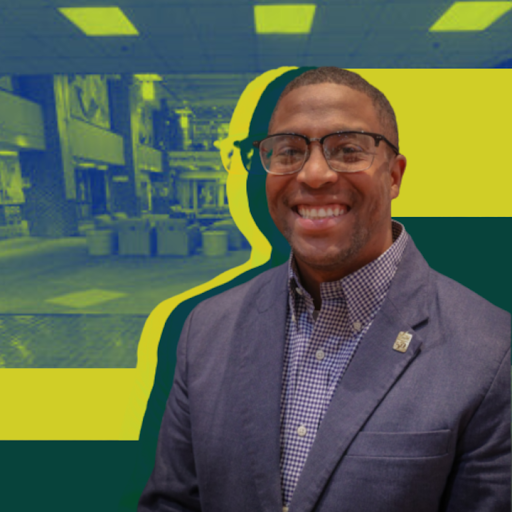
Mason Alumni and Career Services Employer Engagement Consultant Philip Wilkerson has helped countless undergraduate students with career development and professionalism for over ten years. Although no longer in a role that meets with students, Wilkerson continues taking time to share advice with undergraduate students, including sitting down over Zoom with communication students in COMM 309, or Writing Across the Media.
Wilkerson started his professional career with uncertainty after graduating from James Madison University and began his career working with school systems in Northern Virginia. From working with schools, Wilker was inspired to obtain his master’s degree from Mason which led him to work as a Career Counseling Intern for Career Services in August of 2011. His role as a Career Counseling Intern led him to his current role.
Through this experience working at Career Services, Wilkerson emphasizes the importance of students taking the initiative to build portfolios in college, especially for those going into the communication field.
“I would advise students to not wait to create meaning,” Wilkerson said. “…do not wait for a job or internship to create content that’d be relevant on their portfolio. There’s a lot of opportunities to get that content and that experience without a job… because what’s really difficult is that a lot of times experiences need experience to get their foot in the door.”
An example of Wilkerson’s initiative to create meaningful content is his podcast, Positive Philter, where he shares motivational topics with the world; however, Wilkerson encourages students to volunteer with Mason’s Student Media department in organizations such as Fourth Estate, WGMU and Mason Cable Network. He mentions how students can “leverage” those experiences to gain internships and jobs by volunteering.
In addition, Wilkerson also encourages students to become familiarized with “NACE competencies.”
“I think there is a gap between proficiency and what students think they’re proficient in,” Wilkerson said. “Really that education in making sure that students are confident in articulating their skills and abilities to employers…So one thing I would encourage students of faculty members is to really familiarize themselves with NACE competencies…different skills that are applicable to all world of work…so that as they enter the workforce, they’re comfortable and confident in their abilities and able to jump right in.”
While Wilkerson focuses on portfolio-building and competency development as two ways for undergrads to prepare for first career experiences, before signing off from Zoom, Wilkerson makes it a point to extend the invitation for all students to use him as a resource for career development.
“I’m happy to support you…Please view me as a resource here at Mason to help you and help you in your journey as you continue on,” Wilkerson said.
Students interested in connecting with Wilkerson for further advice on career development may reach out to him on LinkedIn.
Fourth Estate/Mitchell Richtmyre
The Patriots faltered defensively in their third consecutive loss.BY GABRIEL KING, SPORTS EDITOR
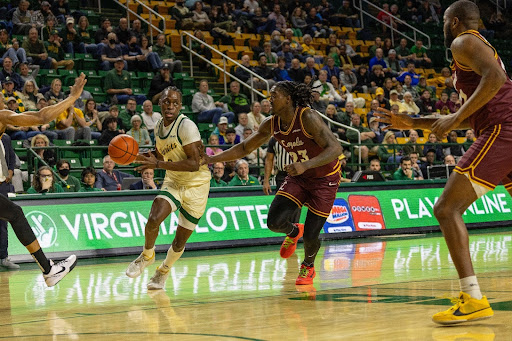
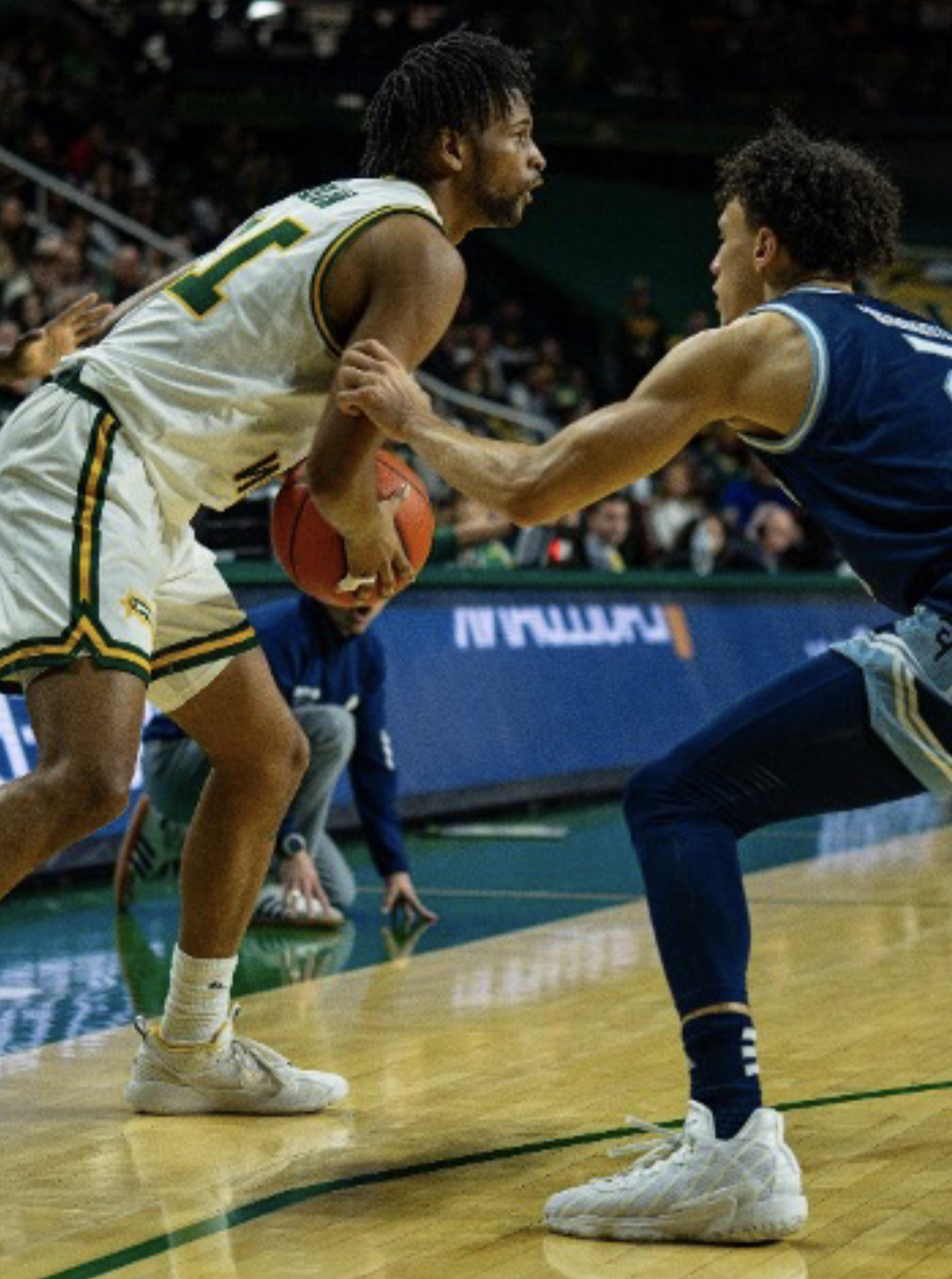
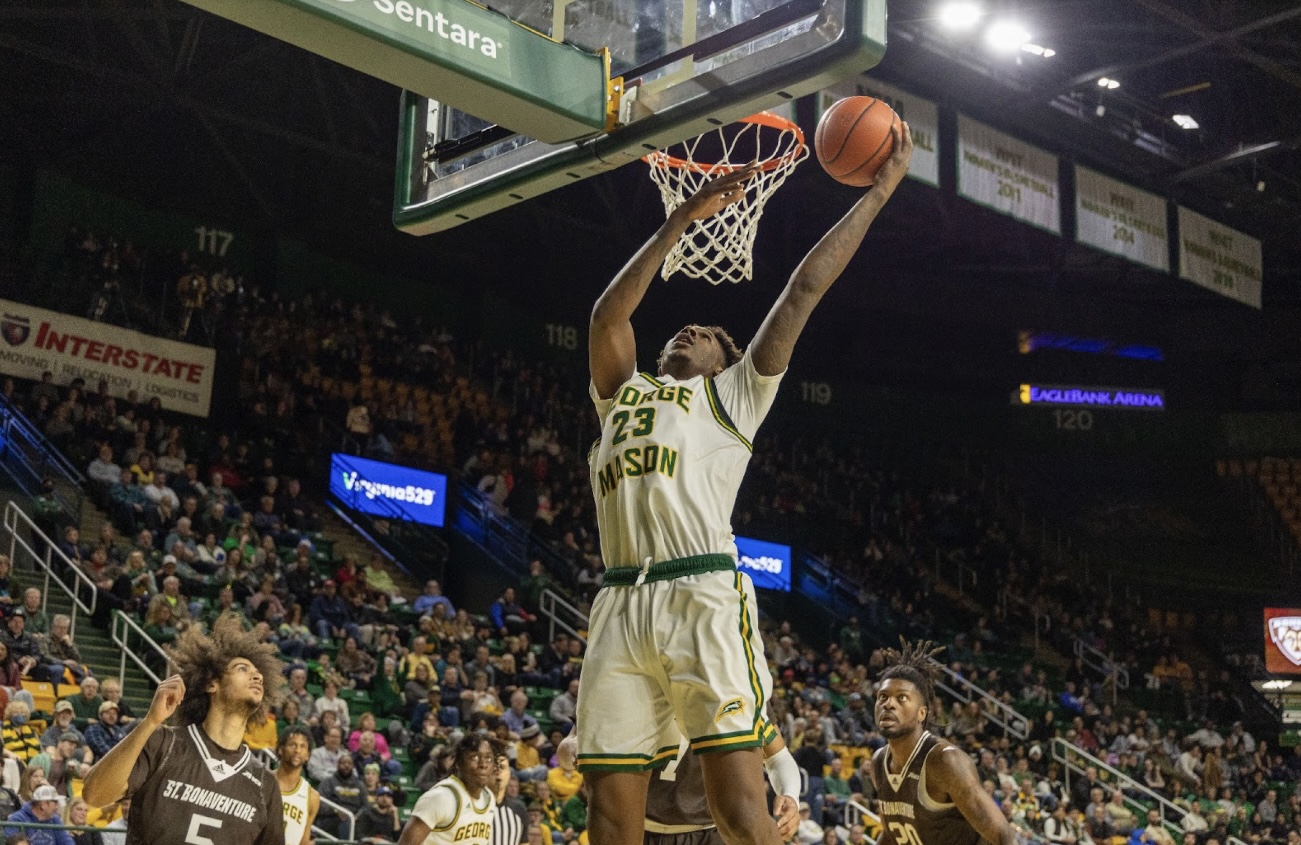
Mason men’s basketball fell to Loyola Chicago 85-79 on Wednesday night at EagleBank Arena. The Patriots (15-8, 4-6 Atlantic 10) led by eight at halftime, but were outscored by 14 in the second half. The loss is Mason’s third straight, all coming by single digits.
Despite shooting 59.5% from the field, turnovers and porous defense plagued the Patriots in the second half. The Ramblers (16-7, 8-2) shot 71.4% in the second half and scored 49 points in the second half, which was the most points the Patriots have allowed in a second half this season.
“We were just completely discombobulated defensively,” Head Coach Tony Skinn said of the team’s second half performance. Loyola capitalized on Mason’s defensive confusion, which proved to be the difference.
The Patriots took a three-point lead with 6:12 remaining on a 3-pointer from Baraka Okojie, but the Ramblers responded with an 8-0 run to gain control. Sheldon Edwards sparked Loyola’s late run with consecutive 3-pointers of his own. Edwards finished the game as the Ramblers’ leading scorer with a career-high 27 points.
Keyshawn Hall led Mason with 20 points as he continued his stellar season. Darrius Maddox added 18 points, including a buzzer-beating 3-pointer to end the first half, and Okojie scored 15 points, with 10 of those coming from the free throw line.
This is Mason’s second three-game losing streak in the last month, with those six losses coming by an average of 5.5 points. Despite the recent struggles, the Patriots remain optimistic about the remainder of the season. “We’ve obviously lost a couple close nail biters… [but] there’s no need to fret,” Skinn said.
The Patriots’ fortunes may reverse shortly, as they are ranked 265th, out of 362, in the KenPom luck rankings, which project Mason to be better than their current record.
Along with the projected improvement, the Patriots see that they are close to a breakthrough. “We’ve just got to stay together and try to come in everyday and keep working towards winning. We know we can turn it around in an instant because we know we can compete in close games like this,” Hall said.
With the hopes of a top four finish in the A-10 dwindling, the Patriots must turn it around quickly. Mason currently sits ninth in the A-10, three games back of VCU for fourth place.
“At the end of the day, we’re not going to have a defeatist spirit. We’ve had a good season thus far,” Skinn said. The Patriots will return to action on Saturday at Davidson for a pivotal conference game. They will then come back home for their second game of the year against George Washington on Feb. 13. The Revolutionaries won the first matchup 75-62 in January.
Fourth Estate/ Tiffany Boggs
Multiple members of Student Government predict time-efficiency for Town Hall.BY ERICA MUNISAR, EDITOR-IN-CHIEF
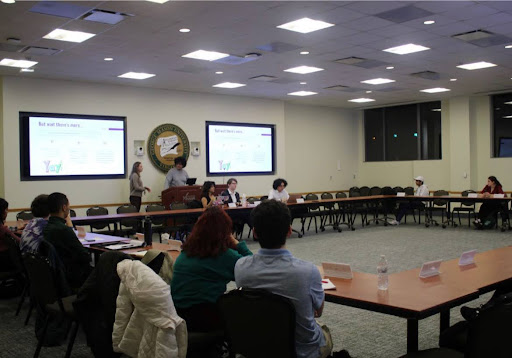
Ahead of a Student Town Hall hosted by University Life Wednesday at 1 p.m., questions regarding the efficiency of the Town Hall were raised in the Student Senate on Feb. 1. This included comments from multiple members of Mason Student Government that President Gregory Washington may speak for too long during the Town Hall which is set to last for one hour.
The main conversation of last Thursday’s session was followed by two email chains between former Secretary of Administrative and Financial Affairs Gabriel Curtis and Vice President Rose Pascarell.
Discussion of the Town Hall began during the debate of R. #41 A Resolution to Promote the Town Hall, sponsored by Senator Caden Garafalo.
In one email chain on Jan. 31, which was publicly broadcasted on the boards during the discussion, Curtis requested increased time-efficiency for the one-hour Town Hall, proposing four measures: Arranging a follow-up Town Hall if Dr. Washington is more than 10 minutes late, having Washington send his opening address via email beforehand and limiting the president’s introduction to five minutes, allowing direct public questions to Dr. Washington and limiting his responses to three minutes with the help of a Mason Student Government moderator.
Curtis shared to Fourth Estate that he had sent the email after members discussed Town Hall concerns in a previous Administrative and Financial Affairs Committee meeting, in which he believed the best course of action was to make Rose Pascarell aware of the concerns.
Rose Pascarell responded directly to the email two hours later saying “I find the tone of this message disrespectful as it relates to President Washington.”
“When I asked if student government wanted to host this when I came to speak to student senate last semester, the answer I received in writing was ‘no.’ I still worked with the former speaker to find a time and location that made sense, but this event, at student government’s own choosing, is not run or organized by student government.” Pascarell said.
Later during the session, Student Body President Paul Wyche explained the claim from Pascarell, saying that Mason Student Government declined to specifically host a Town Hall as an organization in the past. “On the ‘no’ in writing remark, I believe that at the Student Senate meeting that Rose Pascarell was at, there was a stark statement made that SG did not want to host a town hall. They want University Life to host it. I personally thought that it would have been fine for SG to host the town hall.” Wyche said.
President Wyche shared a further address to the chamber regarding the email from Curtis. “Do I believe that the email was entirely disrespectful as implied in the response? Not necessarily. Would I have sent the email that Secretary Curtis sent? Probably not. I like to say things a little nicer than [they should be].” Wyche said.
At the end of announcements, Curtis revealed that he was given handwritten sanctions by President Wyche following the email. One demand was for Curtis to apologize to Pascarell for the email. Curtis was additionally told not to speak on behalf of Mason Student Government, and that all emails to administrators must be sent during regular business hours and approved by the President, Vice President or Chief of Staff.
Curtis responded to the sanctions by promptly resigning from his position during the announcements portion of Student Senate. At the end of his announcement, a standing ovation was given by the chamber for the duration of 20 seconds.
Other members of the chamber questioned the necessity of the Town Hall requiring a Mason360 sign up. “I have no idea if they will stop you at the door for not signing up on Mason360. The worst thing is I have way too many concerns about this town hall.” Senator Garafalo said in his author statement. “Gregory Washington tends to go on tangents and give a prolonged introduction. We want to limit the time of his responses.”
Apart from controversy surrounding the upcoming Town Hall, a series of resolutions and appointments were made.
Senior Maaz Abbasi, Freshman Grace Martinez-Cora and Freshman Lee Turner were appointed as Student Senators, each approved with 20 votes in affirmation and one abstention.
Sophomore Simeon Omorodion was appointed as Undersecretary of Public Relations for Website Management with 21 votes in affirmation and one abstention.
R. #40 A Resolution to Support the Mental Health Language Playbook, authored by Senator Zara Saemi, was passed with 22 votes in the affirmation and one abstention. “This resource defines the do’s and don’ts for mental health. It helps people navigate struggles and use effective language for well-being and mental health.” Senator Saemi said in her author statement.
Following long debate and amendments, R. #41 A resolution to Promote the Town Hall was passed with 20 votes in the affirmation and one abstention.
Fourth Estate/Viviana Smith
The “Gender Inclusive Restrooms” project from the LGBTQ+ Resources Center to increase the inclusivity and accessibility of restrooms on Mason’s Fairfax Campus.BY VALENTINA FALA, STAFF WRITER
A “Gender Inclusive Restrooms” project has been ongoing at Mason for more than 10 years. The project, which started in the spring of 2011, began when the LGBTQ Campus Climate Task Force was created by University Life to investigate the situation of LGBTQ+ students on campus including but not limited to infrastructure needs. It was paused since COVID-19 first hit, but recently the project has become a topic of interest for Mason Student Government.
According to the LGBTQ Campus Climate Task Force Report in 2012, the purpose of the task force’s creation was “to discover how free [the LGBTQ+ community] felt to be themselves on this campus and what Mason’s programs and departments might do to promote a campus community that is fully welcoming, safe, respectful and inclusive for students, faculty, and staff of all sexual orientations, gender identities and expressions.”
Junior Bas Rawat, Speaker Pro Tempore and Former Chair of the Diversity & Multicultural Affairs committee, was one of the people interested in revisiting the initiative that involves gender-neutral bathrooms.
“A gender-neutral bathroom is typically a single-stalled restroom that anyone can use. It is also meant to be accessible, as well as a family restroom,” Rawat said. “A lot of trans people/gender non-conforming students/faculty feel uncomfortable using gendered restrooms on campus.”
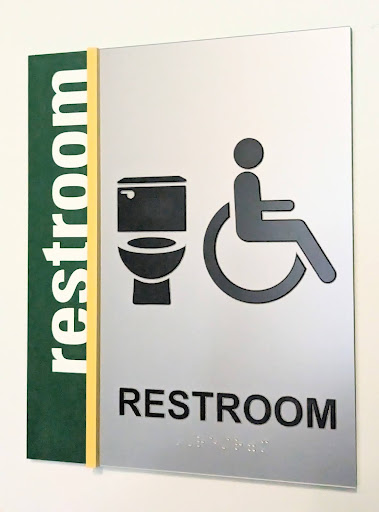
Josh Kinchen, the Director of the LGBTQ+ Resources Center, makes a clear difference between single and multi-stall restrooms. “The only slight and basic difference between a single stall restroom and a gender inclusive restroom is that we have an approved sign and ADA compliant sign.” Kinchen said.
According to Kinchen, the project includes restrooms with a new toilet symbol rather than two gender-conformed people, braille included. Additionally, there is an interactive Gender Inclusive Restrooms map, uploaded by the LGBTQ+ Resources Center, that shows up-to-date restrooms with these new signs.
Kinchen explains gender neutral restrooms would help transgender and non-binary students in feeling more comfortable and safe on campus. “Folks who don’t look the way that folks think that they should look have been accosted and assaulted in restrooms… we want to create space for everybody to be able to get all their needs met and just use the bathroom at peace.”
Additionally, Kinchen suggests that an increase of single-stall restrooms will improve Mason’s accessibility for those with disabilities. “Folks that have certain medical needs that they need specific privacy for [and] multi-stall restrooms aren’t really going to work for them.”
The initiative has had obstacles with pacing and funding. Kinchen explains that the campus is lacking in the amount of single-stall restrooms on campus, while some buildings do not have them at all. “There’s a major issue of cost… how do we find millions of dollars of funding to install, convert, [and] do all the things we need to do to make that a reality?” Kinchen said.
“The initiative’s goal is to create more inclusion on campus. Kinchen said, “It’s critical for folks to be able to use the facilities, use the restroom, be able to have space that is comfortable. Safe and private… we’re behind the baseline in terms of having those restrooms everywhere that we need them on campus.”
Fourth Estate/Erica Munisar
Changes in the Student Senate and an addition to the Executive Cabinet.BY AUSTIN EMERY, CLERK OF THE STUDENT SENATE
Editor’s Note: This article was written by the Clerk of Student Senate on behalf of Mason Student Government to relay information on recent legislation. Fourth Estate does not officially endorse formal activities or initiatives held by Mason Student Government.
On Jan. 25, the 44th Student Senate met in Merten Hall, room 1201 to vote on two pieces of legislation. The legislature also confirmed new members of the Student Senate and the Executive Cabinet. A new Chair of University Academics was also elected after Junior Nishok Chitvel resigned from the Student Senate. Freshman Griffin Crouch was elected as his successor.
Chair of University Academics Election
Freshman Griffin Crouch ran unopposed and won with 19 votes and one abstention.
R. #39 A Resolution to Support the Afghan Student Mentorship Program Documentary Screening
The resolution passed with 21 votes in affirmation and one abstention.
B. #27 A Bill to Allocate Funds for Mason Lobbies
The bill passed with 20 votes in affirmation and one abstention. It was amended once in committee and once in the general body meeting.
Appointment of June Johnson, Ty Carson, and Jawad Hosseini to the Student Senate
All three candidates were confirmed with 19 votes in affirmation and one abstention each.
Appointment of Manal Khalid to the Executive Cabinet
The candidate was confirmed with 22 votes in affirmation and one abstention.
In his candidate statement, Crouch spoke on his plans to revitalize University Academics, a department that two senators noted have been inactive lately. Crouch spoke about wanting to bring back “Dinner with Deans”, a recurring event where students can meet with all the deans for the university’s schools and colleges to talk about all sorts of academics-oriented issues.
The Student Senate voted to approve Resolution #39: A Resolution to Support the Afghan Refugee Mentorship Program Documentary Screening and Bill #27: A Bill to Allocate Funds for Mason Lobbies.
R. #39 formalizes the organization’s support for the Afghan Refugee Mentorship Program’s screening of their new documentary “Desperate” on Jan. 30.
B. #27 was amended to allocate $4,487 in transportation expenses and $562 for scarves for Mason Lobbies. Mason Lobbies is a big event scheduled for Feb. 15 where members of the Mason community are given the opportunity to travel to the State Capitol in Richmond to practice lobbying. Registration for the event closes this week on Jan. 31.
Sophomore Chair of Government and Community Relations Ilia Sheikholeslami amended B. #27 to allocate funds for three buses instead of just two. Despite the faculty advisor Lauren Kaplan insisting that the Student Senate should only allocate money for two, Sheikholeslami and the rest of the chamber voted in favor of the amendment. Sheikholeslami insisted that Student Involvement and University Life had arranged an agreement to fund the third bus, which would accommodate for a potentially higher turnout.
The Speaker sent two new pieces of legislation to committees so they could be voted on and revised before they are potentially sent back to the full Student Senate next week.
R. #40 A Resolution to Support the Mental Health Language Playbook is a resolution written by Senior Senator Saemi to spread awareness of the Mental Health Language Playbook, a guide backed by the Mental Health and Well-Being Task Force (MHWBT), a task force commissioned by former Provost Mark Ginsberg and University Life Vice President Rose Pascarell.
R. #41 A Resolution to Promote the Town Hall is a resolution written by Freshman Caden Garofalo for Student Government to officially recognize, support, and promote a town hall that University President Gregory Washington will attend to converse with students on Feb. 7 at 1-2pm in The HUB Ballroom.
The chamber also confirmed the appointment of three new student senators: Freshman June Johnson, Freshman Ty Carson, and Junior Jawad Hosseini. The three were all confirmed with 19 votes and one abstention each.
Lastly, the Student Senate confirmed the appointment of Manal Khalid to serve as the Undersecretary of Government and Community Relations for State and Local Affairs for the Executive Cabinet. She was confirmed with 22 votes and one abstention.
Mason Student Government meets every Thursday at 4:30 p.m. The next meeting is scheduled for Jan. 25, 2024 at 4:30 p.m. in Merten Hall, room 1201. All are welcome.
Photo Courtesy of Cullen Livingstone, Mason Dining Multimedia Coordinator
Mason Dining introduces new dining locations, events and inclusive food options.BY EILLEEN NGO-TRAN, STAFF WRITER
This academic year, Mason Dining introduced new innovations focused on sustainability and interesting dining events. New foods have been introduced to the student body such as vegetarian, vegan and allergy friendly options. Featuring new establishments, these options are strewn about campus, and are not just in typical spots with a higher foot traffic like the Johnson Center or Student Union Building. The innovations are continually added to improve, alter and increase options for students and customers with different dietary needs.
1. New Seats in Southside
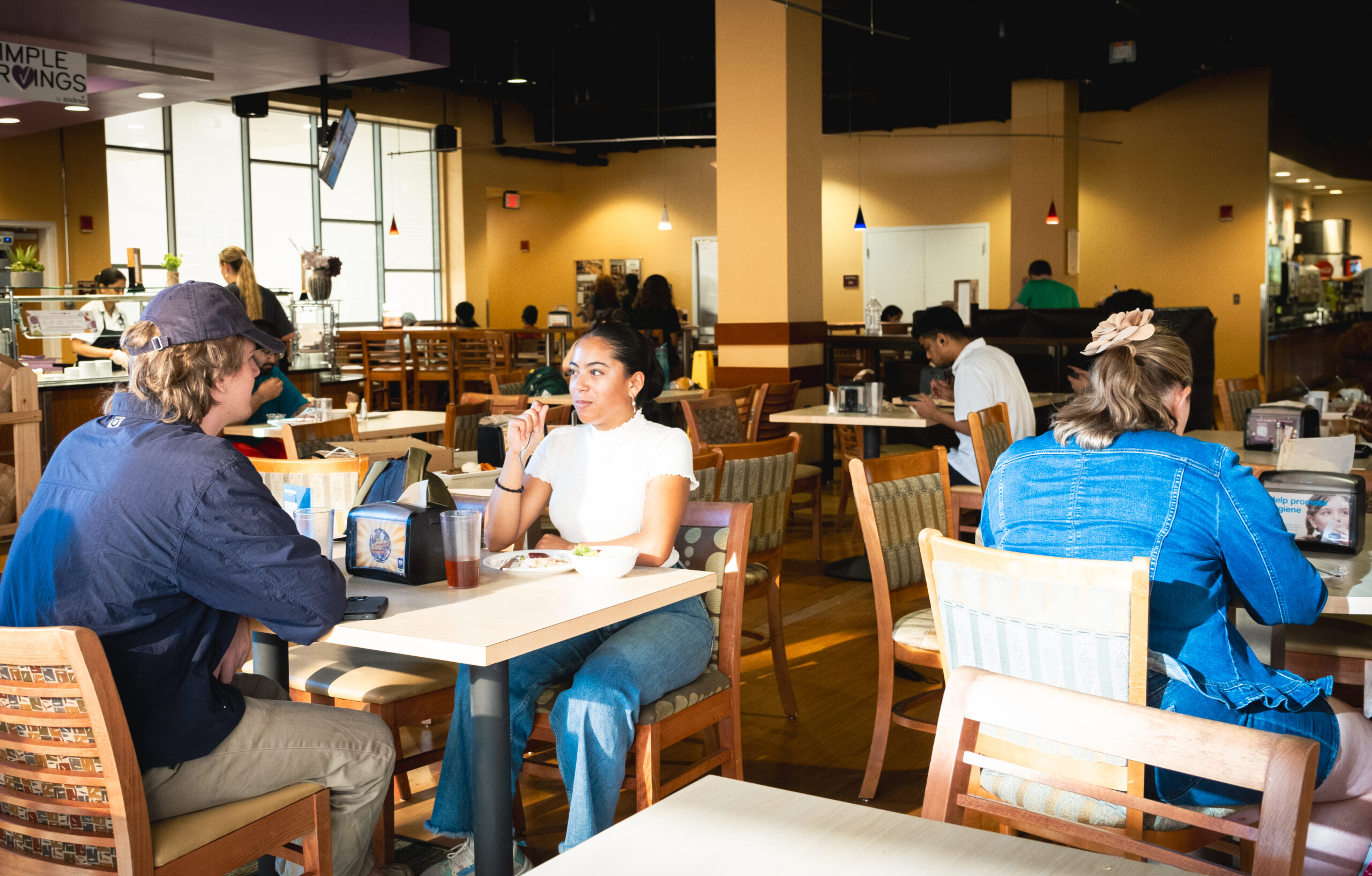
Being so close to the Johnson Center, according to Mason Dining Marketing Director Sofya Vetrova, Southside is one of the most visited dining halls on campus. The dining hall added 158 additional seats to increase capacity and comfortability to improve the dining experience of each patron.
2. More Beverage Options
Alongside more seating, there will be a wider range of beverages offered in the dining halls. The dining halls introduced Tractor Beverage Company beverages, offering organic refreshment options. Additionally, Mason Dining added improved coffee machines that have the ability to brew over thirty beverages, including hot cocoa and iced coffee while including alternative milk options.
3. Simple Zone, not Gold Rush
Located in Southside dining hall, the allergen-free pantry Gold Rush has been renamed and revamped as “Simple Zone”. This pantry provides items that are free from gluten, tree nuts and peanuts.
4. NuVegan
Located across from Starbucks on the ground floor of the Johnson Center, the soul food restaurant, NuVegan, offers entirely vegan menus with options ranging from vegan “fried chicken” to collard greens.
5. Crave
The late-night restaurant in The Hub serves the students who stay late on campus. They offer hearty meals such as cheeseburgers, crispy chicken tenders, loaded nachos and mozzarella sticks
6. The Spot
This plant-based vegetarian dining hall focuses on healthier and more sustainable meals filled with nutrition and flavor. Open Monday through Friday from 11a.m. to 3p.m., students with a dining plan may tap their Mason ID to dine in.
7. Mason Square Cafe in Arlington Campus
On the Mason Arlington Campus, Mason Square Cafe offers a build-your-own salad bar, “We Proudly Serve Starbucks” beverages and a comfortable space to study.
8. The Difference Baker
Located in the Nguyen Engineering Building, The Difference Baker attends to the sweet tooth with dietary restrictions. Catering to the seven of the top nine allergens, this bakery offers a variety of safer options for those looking for a sweet treat.
9. The Sweet Vegan on the ground floor of the JC
In the same corner as NuVegan, The Sweet Vegan is an option to get vegan sweets including ice cream and other non-dairy based desserts.
10. Simple Servings now offers sesame-free options
In addition to the other newly opened dietary-focused restaurants on campus, Simple Servings continues to tend to customers with food allergies or gluten intolerance. The station offers food which is free from the top nine allergens including peanuts, tree nuts, shellfish, wheat, soy, milk products, eggs, sesame and gluten-containing ingredients. Simple Servings is now offering sesame-free options to the list of allergens included. The dining location also focuses on creating meals that are an easy and healthy choice for customers who are focused on ingredients and portion sizes to cater to health concerns.
11. The Teaching Kitchen
The Teaching Kitchen is a cooking workshop taught by a culinary master that focuses on topics ranging from knife skills to enhancing sauces and emulsifiers. The classes and workshops are intended to improve the dimensions of culinary creativity. Students may follow Mason Dining on Instagram to hear more about the classes.
12. Crop Share
Mason Dining partners up with Potomac Vegetable Farms to allow the community to be more involved with the crop share, or the Community Shared Agriculture, in the area. Through this program, the Mason community can enjoy fresh produce while also building and enforcing a more local and equitable agricultural system.
13. Events in the dining centers
The dining halls have unique activities open to all students such as seafood boil, hunger games and Willy Wonka.
Mason Dining is open to feedback. Students and patrons are able to text “TellSouthside” or “TellIkes” to 82257 with comments or concerns about Mason Dining.
According to Vetrova, keeping innovations creative and accommodating on the GMU campus is critical in reinforcing the “strong beliefs of inclusivity, sustainability, healthy eating, and many others are incorporated into each of our initiatives.”
Each of the new locations or innovations are geared toward the goal of improving the dining experience for those at Mason. The goals of increasing variety through new beverage stations, being mindful of sustainability by providing plant-based options and promoting inclusivity by accommodating to allergies and dietary choices help to support Mason Dining’s goals.
“We continue to create a progressive and innovative dining environment where our community feels welcome, appreciated, and happy, and most importantly – well fed!” Vetrova said.
Photo Courtesy of Sara Azmi
Sara Azmi, founder of Mason’s Girl Up GMU, reflects on the club’s efforts and successes.BY TANYA MALIK, STAFF WRITER
Girl Up, founded by the United Nations, envisions a more equitable and just world for girls and women. Mason’s chapter, known as Girl Up at George Mason University, was founded by Alumni Sara Azmi and her sister, Alumni Sophia Azmi, in fall 2020. Azmi was the Vice President from 2020-2022 and has been the President since 2022.
Just like Girl Up itself, the GMU chapter focuses on raising awareness about women’s health, rights and education in the local Fairfax community.
As of February 2024, in an era of virtual platforms the community has grown massively. From hosting Zoom meetings with 30 members, the club now has over 450 members along with an Instagram following of over 950 followers.
This has allowed the club to make a significant impact through creating programs, fundraisers and opportunities to ensure that all girls have the opportunity to thrive and empower each other across GMU campuses in order to advance and exercise girls’ rights, skills and education.
Every semester, Girl Up GMU provides donations to local family shelters, such as the Patrick Henry Family Shelter and the Arlington Food Assistance Center. Girl Up also volunteers at Girls on the Run and does donation drives around campus, as well as creating initiatives such as the Flo Program, the Mentorship Program and the Ambassador Program.
Girl Up GMU also created an initiative on eating disorders in order to educate Mason students on the issue and ways they could help a friend in need. These programs have allowed the organization to gain recognition from faculty at Mason, current members, and Mason students.
The club has received multiple Mason organization awards. Those awards have included The Distinguished Quill Award for Student Organization of the Year two years in a row (2021-2022 and recently, 2022-2023), The Distinguished Quill Award for New Student Organization of the Year (2020-2021), and The Distinguished Quill Award: Collaborative Spirit Award (2020-2021). In addition, Girl Up GMU was invited to the White House for Women’s History Month based on their community efforts in March 2023.
“This was an amazing experience where we could represent Girl Up GMU by collaborating with other like-minded female organizations with the same mission as us at the White House,” Azmi said.
Azmi recently graduated in December 2023, and she envisions the club to continue expanding its outreach and leading its current programs, gaining more members, and receiving constructive feedback from the community.
“My favorite aspect about this organization is seeing our hard work be noticed by the faculty, staff, community, members and students. I will sadly say goodbye to Girl Up, but luckily I have an amazing executive board that will take care of Girl Up. I hope the legacy of Girl Up lives forever,” Azmi said.
Students can learn about Girl Up GMU through their Instagram, where they can also view content on topics such as Women’s History Month, mental health checks and more. Students can also become new members of the club through this Google Form.
Photo Courtesy of University Life, RCA Photography
Founder of Mason’s Pats for Patriots shares how the program spreads kindness on campus.BY KAYLYN BARNHART, CULTURE EDITOR
When was the last time you expressed gratitude to a colleague? A professor? A neighbor? This program at Mason encourages you to do just that; and it only costs your time.
Mason’s Pats for Patriots is a program by the Center for the Advancement of Well-Being and Mason Chooses Kindness. The program gives words of appreciation to students, faculty, staff and alumni throughout the Mason community who have done something kind, generous or thoughtful towards others. Small acts of kindness, and not just the grand acts, are encouraged by the program to create a lasting campus culture of positivity and support.
While being a part of the Mason Chooses Kindness committee, Philip Wilkerson III who also works as an Engagement Consultant at Mason’s Career Services, pitched the idea of Pats for Patriots and was given a chance to pursue it. In October 2021, he and a team launched the program with the purpose of celebrating everyday moments of kindness.
“When you feel like you’re appreciated… you’re able to be more productive and enjoy learning and school. The importance of kindness is quite often understated and undervalued,” Wilkerson said.
While nominating someone for a “pat”, contributors fill out a form online stating the kindness done by the nominee. They will then receive a virtual card showing appreciation for their act.
As of February 2024, the program has received more than 800 nominations from the Mason community, according to Wilkerson. Their goal is to reach 2,000 nominations by July 2024. He encourages everyone to utilize this program as a small platform to continuously spread kindness.
“One of the things about kindness that I’ve noticed is that when kindness is particularly [being shown] to that person, it’s thoughtful…it makes the person feel seen,” Wilkerson said. “Curate your kindness, and make sure your kindness is customized.”
Pats for Patriots collaborates with Mason Chooses Kindness to celebrate World Kindness Day and Spring into Well-Being each year where they host fun events promoting acts of kindness. “Kindness actually does support so much in building a strong and inclusive community,” Wilkerson said.
In January 2024, Inside Higher Ed featured Pats for Patriots in an effort to show what Mason is doing to spread kindness initiatives on campus. It was also featured in the Employee Experience Magazine’s recent February 2024 issue. “The program has not only gotten recognition across campus, but also nationwide,” Wilkerson said.
Even off campus, Wilkerson plans on pushing the kindness initiative forward. He will be presenting in a live webinar event hosted by the National Association of Colleges and Employers on Feb. 29 where he will speak on the impact of kindness on a culture along with sharing more about Pats for Patriots and the Mason Chooses Kindness initiative.
“The happiest thing for me was to be able to start something [Pats for Patriots] at George Mason. [I have been able to] watch it grow, watch it take a life of its own and to really see what kindness can do when you turn it into a system.”
For those who would like to thank someone at Mason for being kind, or to learn more about Pats for Patriots, visit their page here.
Photo Courtesy of University of Miami Athletics
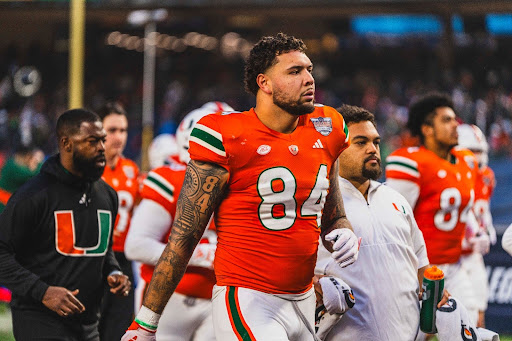
The veteran pass-catcher will suit up for the 2024 season.BY TRISTEN SCHAEFER, STAFF WRITER
It’s official. The University of Miami football team will have their newly-added veteran tight end, Cam McCormick, for the 2024 season, which will be his ninth year of college football eligibility. You read that right. McCormick was recently granted his ninth year of NCAA eligibility by the ACC, giving him one final opportunity to make his mark on college football.
While the college sports landscape is ever changing, the COVID-19 pandemic affected it in a way that we have never seen before. COVID-19 shut down professional, college and youth sports for almost all of the 2020 season’s sports, which cost Mason athletes and thousands of other college athletes the opportunity to represent their school that season.
The year was not completely lost, as many of these athletes were granted an additional year of eligibility in college athletics. The additional eligibility increased activity in the college sports transfer portal more than ever before. Mason athletics and hundreds of other college sports programs saw a portion of their athletes transfer elsewhere while simultaneously bringing in transfers from other universities. For ninth-year graduate transfer McCormick, that extra year presents one final opportunity for these transfer students to make their mark on college sports.
McCormick began petitioning for two additional years of eligibility back in September of 2023, but instead was granted one extra year, his record-breaking ninth year. The 25-year-old’s road to a ninth season in college football has been as unique and trying as they come.
McCormick began his college football journey in the fall of 2016 at the University of Oregon, but sat out his freshman season as a redshirt. He played the entirety of the 2017 season and was healthy going into 2018 with the Ducks.
In the first game of the 2018 season, McCormick suffered a severe ankle injury that cost him the rest of his second season. The multiple surgeries and rehab for his ankle forced him to sit out of the 2019 season as well.
In 2020, the world was struck by the COVID-19 pandemic and it brought almost everything, including sports, to a standstill. The NCAA suspended play for the entire season, which robbed McCormick of that season too and later gave the affected athletes an extra year of eligibility.
This lost year to COVID-19 granted thousands of college athletes an extra year of eligibility, which is one of the main reasons that McCormick and many others have been able to play for a season or even multiple seasons after they graduated.
Following the pandemic, McCormick returned to the field for the 2021 season; another season with the Ducks that would unfortunately be cut short. The tight end suffered a torn Achilles in the second game of the season, which would rob him of the rest of the season.
McCormick returned to the field in 2022 and played his second full college season. He caught three touchdowns that season for the Ducks. He later transferred to the University of Miami ahead of the 2023 season.
He underwhelmed in his first season at “The U”, compiling only 62 yards receiving on the season. While most assumed 2023 might have been his “last hoorah”, it was not. The 6-foot-5, 230-pound tight end will suit up for the 2024 Miami Hurricanes with hopes of having his best season to date.
While McCormick has earned a bachelor’s and a master’s degree in his lengthy college stint, his dream to play in the NFL has not faltered. Even after six surgeries, four head coaches and the various trials and tribulations that came along with it, he remains resilient.
His persistence and patience throughout this process will likely inspire many college athletes with similar circumstances. McCormick’s story demonstrates that an opportunity for extra eligibility can be whatever you make of it, and he doesn’t plan to squander it.
Fourth Estate/Andani Munkaila
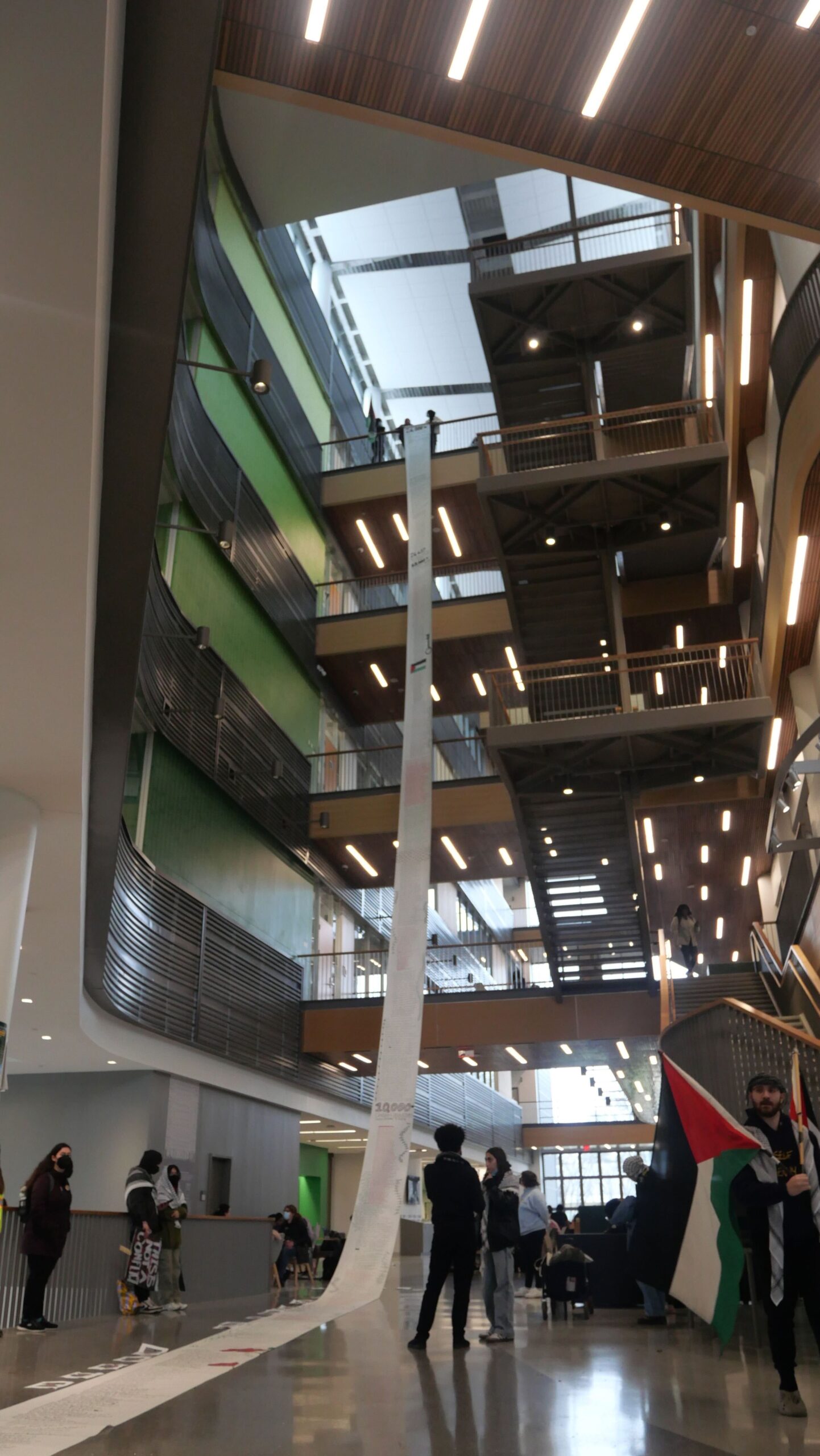
SJP Mason unrolls large list of at least 5,000 names of deceased Palestinians during recent protest, expanding from the sixth floor balcony of Horizon Hall down to the second floor south entrance.BY ANDANI MUNKAILA, SOCIAL MEDIA AND GRAPHICS EDITOR
On Jan. 31 around 11:30 a.m, Students for Justice in Palestine at GMU, or SJP Mason, led a school-wide walk out and protest starting at Student Union Building I and ending at Horizon Hall.
Later during the protest, SJP Mason would unroll a large banner extending from the sixth floor balcony of horizon hall down to the southern entrance of the building.
The banner, which at the top said in large words, “26,000+ Palestinians Martyred By The Israeli Occupation Since Oct. 7 2023,” was claimed to contain at least 5,000 names of deceased Palestinians according to a SJP Mason protest organizer.
In an Instagram post by SJP Mason, they announced their plan to meet at the Student Union Building I. “Take a stand by walking out of your classes, workplaces, or any activity you’re engaged in,” SJP Mason said. “Let your absence be a powerful statement, urging our university to address and acknowledge the atrocities taking place.”
The protestors then moved from the SUB I Quad to Horizon Hall.
Before entering Horizon Hall, an SJP Mason protest organizer said, “We want everyone to just follow us inside. We’re not going to be chanting or disturbing in any way.”
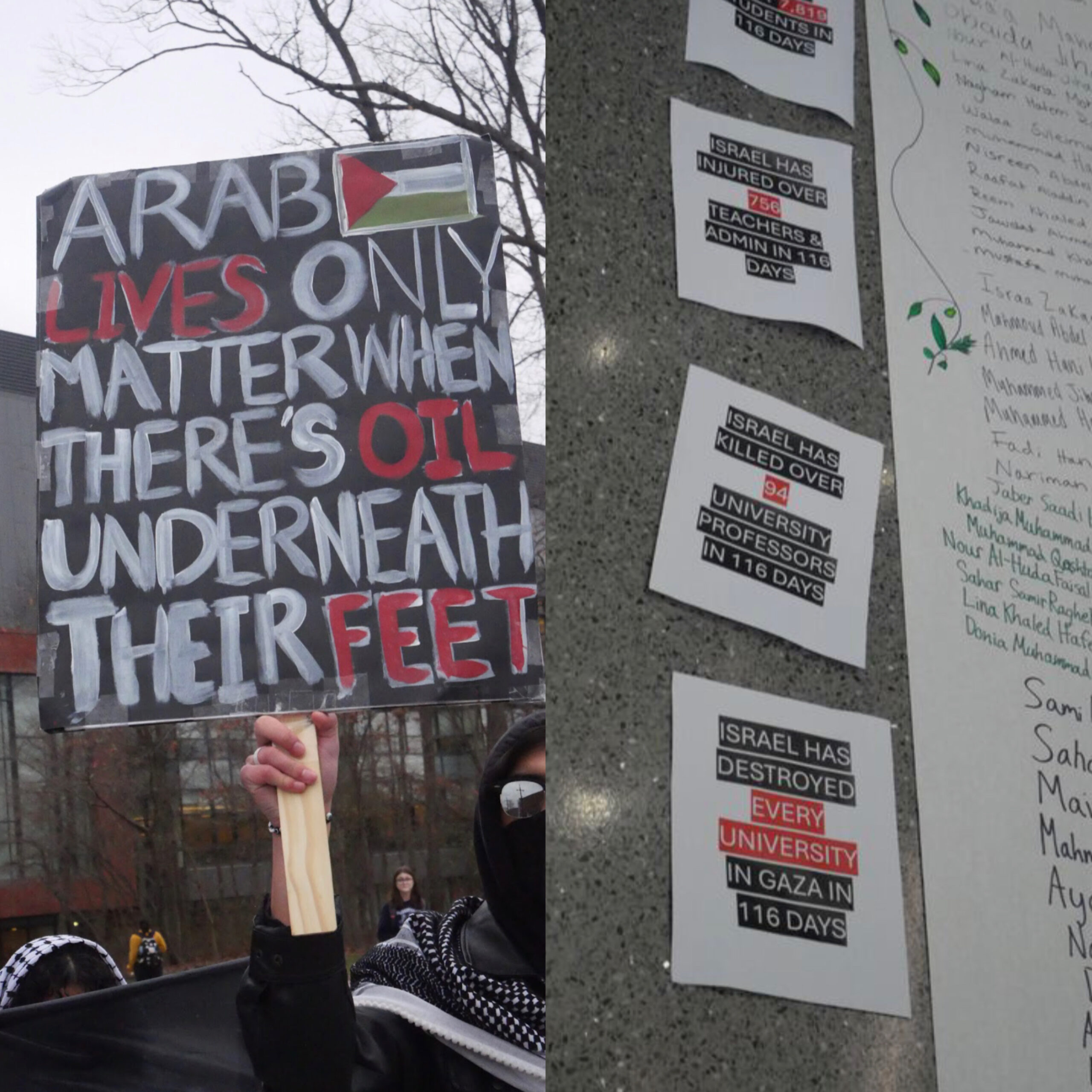
Among the crowd, protesters could be seen holding various signs, some stating that Israel has “destroyed every university in Gaza in 116 days” and “Arab lives only matter when there’s oil under their feet.”
Fourth Estate/Andani Munkaila
After entering Horizon, an SJP Mason protest organizer began a speech and said that thousands of students have died as of January 2024. “As of January 2024 there have been a number of [4,327] student deaths and 7,819 others have been injured. As students, we must recognize that this is an assault on the pursuit of knowledge as education is a form of resistance, and the most peaceful one at that,” the SJP Mason protest organizer said.
The protest organizer then began to read the names of students who had passed away in Gaza. They said one child, aged five, “had just finished kindergarten, and was looking forward to starting first grade. He was killed alongside his parents and siblings. His cousin wrote, ‘Let the world know that we buried the body of my cousin without a head. His head is still under the rubble.’”
A long banner, said to be filled with at least 5,000 names, later descended from the balcony of the highest floor of Horizon Hall down to the 2nd floor expanding short of the south exit.
After the speech, the SJP Mason protest organizer ended the protest, leaving their crowd with the words, “We will never back down. We will never give up, until Palestine is free.”
SJP later hosted a Vigil on Feb 1. at the Horizon Amphitheatre.
Photo Courtesy of Yonathan Mesfun
Mason Alumni Starts Successful Nail Business.BY MADDIE GIERBER, STAFF WRITER
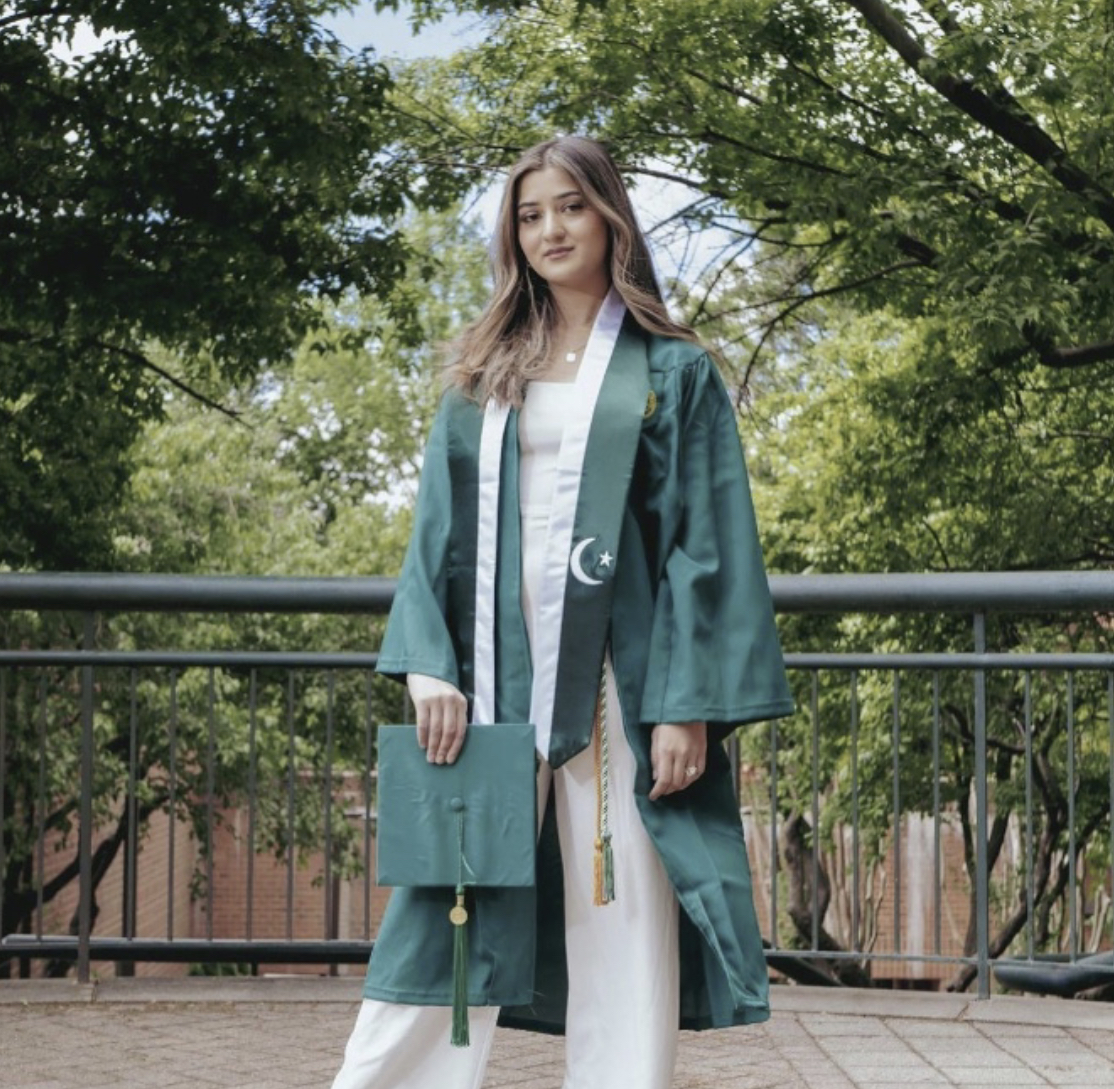
Graduating college during a pandemic is difficult enough, but Asra Abbas embraced the challenge by not only embarking on her career in the legal field but also establishing her own successful nail business.
Abbas had always enjoyed creative hobbies like henna and nail art, but it wasn’t until the pandemic in 2020 that she began sharing her nail art and gained enough traction to launch her business.
Abbas, who graduated from Mason in 2023 with a degree in Integrative Studies, has been interested in a career in law since her childhood in Pakistan, where she often spent time with her parents in their law office. However, her desire to pursue law was discouraged due to the safety concerns of being a female lawyer in Pakistan.
Abbas knew from a young age that her future would be in law, especially after experiencing the legal process of immigrating to the United States. She says this experience reinforced her determination to assist others in this same process.
“Immigration law has always held a special place for me given my experiences as an immigrant,” Abbas said.
Although her professional and personal interests may seem vastly different, Abbas says nail art provided a creative outlet that helped balance her demanding scheduling. It also taught her skills that she was able to carry over into her professional life, from financial literacy and client management to maintaining a strong work ethic.
Abbas began her journey as a professional nail artist in 2020 after the pandemic brought widespread layoffs to her company. Her art grew into an official business: Nailed It by Asra.
Abbas’ artistry skills were primarily self-taught, but she says she learned valuable lessons about management from her business classes at Northern Virginia Community College.
“Applying the skills I learned in these courses directly to my own business proved to be extremely beneficial and helped me grow and manage it effectively,” Abbas said, who also has her Virginia nail technician’s license.
Since launching Nailed It, Abbas has been able to serve over 500 clients and generate profits of up to $5,000 a month, allowing her to graduate debt-free.
Abbas attributes her success to networking, which provides her with both client connections and opportunities to learn from other business owners. Her studio’s convenient location near Mason’s Fairfax campus helps attract fellow students as clients, and Abbas participates in online giveaways and collaborations with other beauty industry professionals so she can reach a wider customer base and hone her marketing strategies.
“Engaging with a diverse range of professionals and clients has broadened my understanding of various business dynamics and has expanded my knowledge base,” Abbas said.
Now that she has graduated Mason and is focused on developing her career in law, Abbas is transitioning her business format from serving individual clients to educating aspiring nail technicians.
“This shift in focus will also allow me to contribute to the development of aspiring learners in a more meaningful and impactful manner,” Abbas said, who also hopes her services will benefit beginner nail technicians who do not have access to full-fledged beauty programs. She will continue serving her most regular clients while developing personalized classes for budding nail artists.
Establishing a new business while starting her law career is an ambitious endeavor, but Abbas attributes her success to meticulous time management and a consistent schedule that prioritizes her education while allowing her time to recharge.
“I carefully limited the number of clients I attended to each day, working strictly part-time and always made sure to have Sundays off to avoid burnout,” Abbas said. By ensuring she completed her homework before leaving campus each day, Abbas could focus on clients in her spare time.
As she prepares for law school, Abbas is grateful for the growth and confidence she gained from her business.
“Having my own business has been a transformative experience, instilling in me a stronger work ethic and driving me to chase my goals relentlessly.”
Although Abbas faced doubts while starting Nailed It, she encourages others interested in starting their own business to embrace the challenge if they are truly passionate about it.
“Life is filled with risks, but unless you take the leap you’ll never know what’s possible. The rewards can be far greater than you ever imagined.”
Fourth Estate/Mitchell Richtmyre
The Patriots won a defensive battle to extend their win streak.BY GABRIEL KING, SPORTS EDITOR
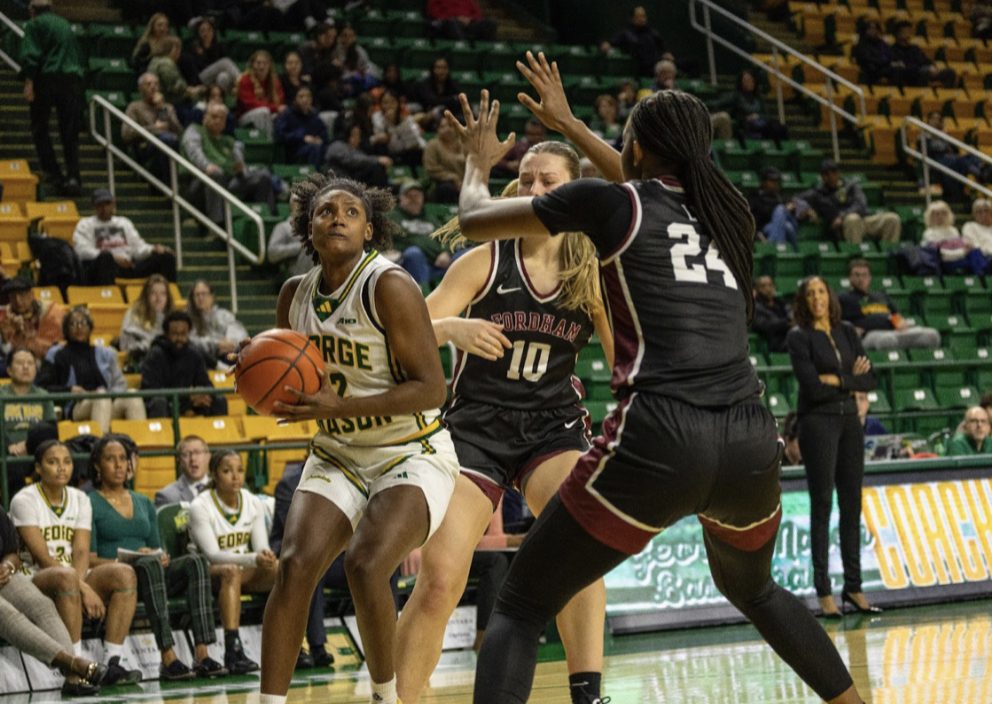
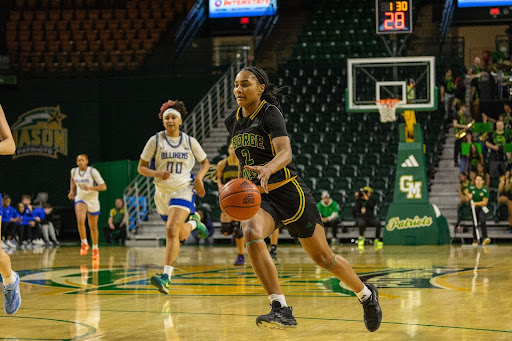
Mason women’s basketball defeated Fordham 54-47 on Wednesday night at EagleBank Arena. The Patriots (17-3, 8-1 Atlantic 10) relied on stifling defense and strong free throw shooting to close out the victory.
“It wasn’t pretty, but it’s good to be on this side of ugly,” Head Coach Vanessa Blair-Lewis said. “All in all, our players stepped up and they won a game without playing their best.” Both teams shot an identical 34.5% from the field, leading to a close, low-scoring game.
The Patriots struggled in the first half, shooting 10-33 and committing eight turnovers. Fordham (7-14, 2-8) used a full-court press early and often, which forced Mason out of their rhythm. The Rams led by one at halftime, which was the Patriots’ first halftime deficit since Jan. 2 against Rhode Island.
Despite the slow start, Mason would begin the third quarter on a 9-0 run to retake the lead, which they held for the rest of the game. Ta’Viyanna Habib sparked the run with consecutive three-pointers. Habib finished the game with 13 points.
“We lacked energy in this game, at the start. Hitting those shots created energy, so it was really important,” Habib said. The run to begin the third quarter reenergized the Patriots, as they outscored the Rams 19-8 in the quarter.
Fordham made a late push, going on a 9-2 run in the fourth quarter to cut Mason’s lead to six with 1:15 left. Taylor Donaldson led the Rams, as she finished with 24 of their 47 points. However, late free throws from Nekhu Mitchell and Taylor Jameson secured the victory for the Patriots.
The strong finish leaves the Patriots with room for improvement heading into the second half of the season. “There’s so many things that we still need to work on to get better at,” Blair-Lewis said. “It’s kind of where you want to be going into tournament time.”
With the win, Mason moved into a tie with Richmond for second place in the A-10 standings, and half a game behind current leader Saint Joseph’s. A top-four finish would secure a double bye in next month’s Atlantic 10 Tournament for the Patriots.
On a national level, the Patriots sit squarely on the NCAA Tournament bubble, as ESPN’s Charlie Creme projects Mason as the fifth team out of the field. An already strong résumé will be boosted if the Patriots can continue their dominance of conference opponents.
The schedule gets tougher for Mason in February, beginning with a road game at Loyola Chicago on Saturday. The Patriots will return home on Feb. 8 to host Saint Joseph’s in a showdown of two of the A-10’s best teams.
Fourth Estate/Jordan Giles
The Patriots improve to 11-1 at home with an overall record of 15-5.BY CARSON ALGER, ASSISTANT SPORTS EDITOR
Mason men’s basketball defeated the Rhode Island Rams 92-84 in the annual homecoming game on Jan. 27 at EagleBank Arena. The Patriots started the game slow with the Rams leading the score 14-4 in the middle of the first half, but later picked it up with the first half ending 42-40 in favor of URI.
“My trust level is pretty high with these guys,” Head Coach Tony Skinn said. Mason was able to grow the trust more as the first-year coach viewed the team comeback from a 10-point deficit early in the game.
Graduate student guard Darius Maddox recorded a career-high 24 points for Mason. Maddox finished the game shooting 50% from three and 8-13 from the field. “He shot the lights out tonight,” Skinn said.
Graduate student guard Jared Billups continued his strengths with great defense and being a great all-around player with six points and 12 rebounds.
Freshman guard Baraka Okojie also finished with a career-high of 18 points, two assists, and three rebounds. Okojie explained his experiences in his role at Mason, “being a point guard, knowing when to pass, when to be a scorer, when to slow down, I’m still learning but I feel like I’m doing a great job.”
Sophomore guard Keyshawn Hall finished the game with 22 points, four rebounds, and four assists. The sophomore guard started the game slow due to foul trouble. Hall was able to pick it up in the points department with his game in the post and trips to the free-throw line.
The Rhode Island Rams game was really surrounded around making shots beyond the arc. The team shot 48.1%, from three, but struggled to a low 54% from the free-throw line. The Rams key pieces to the game were David Green with 29 points, Cam Estevez with 15 points, Jaden House with 13 points, and David Fuchs with 12 points.
The Patriots strengths were the opposites of their opponents as they shot well from the free-throw line with a 75.8% but struggled from behind the arc with a 31.8%.
The Patriots were able to lean on their home fans in EagleBank Arena as 7,000 were in attendance for the annual homecoming game. Baraka Okojie said, “I’d never played in an atmosphere like that, using them as energy on offense and defense, the crowd was our 6th man.” Keyshawn Hall said, “I loved the energy. I wish we could have every home game like that.”
The win gives the Patriots a two-game win streak. The Patriots will continue their A-10 schedule with road games Jan. 31 at Saint Joesph’s and Feb. 3 at Massachusetts. Mason will return to EagleBank Arena on Feb. 7 against Loyola Chicago at 7 p.m.
Fourth Estate/Erica Munisar
New Semester, New LeadershipBY AUSTIN EMERY, CLERK OF THE STUDENT SENATE
Editor’s Note: This article was written by the Clerk of Student Senate on behalf of Mason Student Government to relay information on recent legislation. Fourth Estate does not officially endorse formal activities or initiatives held by Mason Student Government.
On Jan. 18, the 44th Student Senate kicked off the new semester with a two hour meeting in Merten Hall, room 1201. In this meeting, the chamber elected a new Speaker and a new Chair of Diversity and Multicultural Affairs.
Junior Colin McAulay was the Speaker at the start of Thursday’s meeting, but resigned shortly afterwards. Similarly, Junior Bas Rawat was the Chair of DAMA and Speaker Pro Tempore at the same time. Rawat stepped down from Chair of DAMA during the meeting.
Speaker of the Student Senate Election
Senior Jack Fedak won against Junior Michael Grossman 19-0 with one abstention.
Chair of Diversity and Multicultural Affairs Election
Junior Maria Cuesta ran unopposed and won with 18 votes and one abstention.
During the election for Speaker of the Student Senate, Fedak and Grossman were asked about a variety of topics such as increasing retention within the Student Senate, improving onboarding for new members and responding to one Senator’s inquiry about alleged antisemitism at Mason.
The Speaker sent two brand new pieces of legislation to committees so they could be voted on and revised before they are potentially sent back to the full Student Senate next week.
Bill #27: A Bill to Allocate Funds for Mason Lobbies allocates about $2,991 for transportation and $1,562 for food for an event called Mason Lobbies. Mason Lobbies is an event scheduled for next month where members of the Mason community are given the opportunity to travel to the State Capitol in Richmond to practice lobbying. Those who are interested can register on Mason360 before Jan. 31.
Resolution #39: A Resolution to Support the Afghan Student Mentorship Program Documentary Screening seeks to formalize the organization’s support for the ASMP’s screening of their new documentary “Desperate” later this month.
Mason Student Government meets every Thursday at 4:30 p.m. The next meeting is scheduled for Jan. 25, 2024 at 4:30 p.m. in Merten Hall, room 1201. All are welcome.
Fourth Estate/Erica Munisar
Stories of women who had life-threatening experiences following abortion bans are shared at Mason Sci-Tech campus amidst at least 14 pro-Palestine protestor interruptions.
BY ERICA MUNISAR, EDITOR-IN-CHIEF
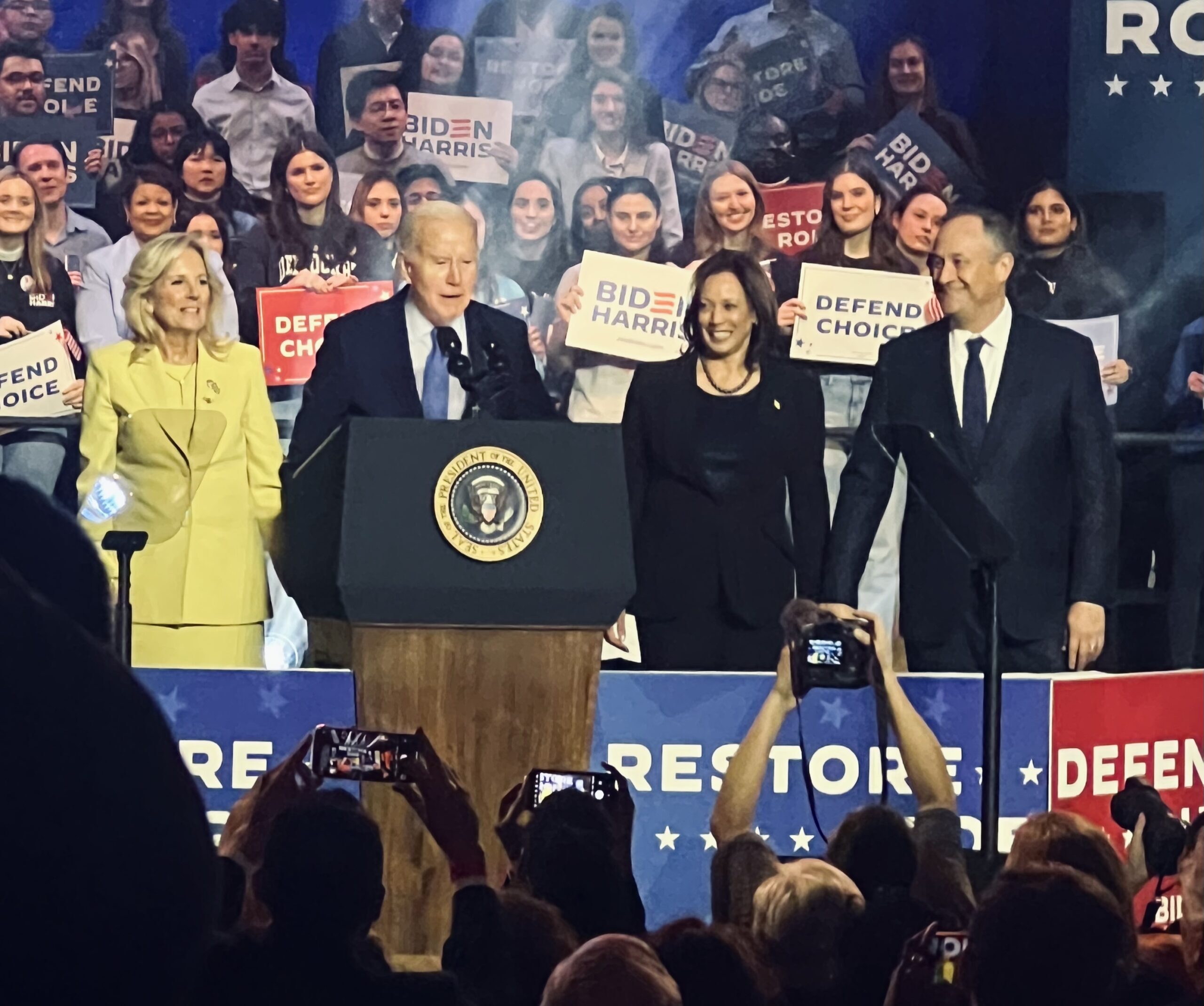
On Tuesday, Jan. 23, President Joe Biden hosted his campaign rally, Restore Roe, in Manassas, Virginia at George Mason University’s Science and Technology campus. The rally was hosted by the Democratic National Committee, and was not a university event.
Attendants were heard chanting “Four more years,” from the chamber throughout the rally.
The event took place one day after the anniversary of Roe v. Wade in 1973. Speakers featured sensitive stories of women who received abortions, followed by Biden and Harris campaign attacks towards Donald Trump and interruptions from at least 14 pro-Palestine protestors during Biden’s segment.
“Genocide Joe, how many kids…” one pro-Palestine protester shouted holding a Palestine flag before being abruptly cut off and removed from the rally, having their sentence muffled by the crowd’s responding chant of “Four more years.”
During Joe Biden’s 20-minute speech, 13 other protesters, one after another would stand up, shouting chants such as “Ceasefire now,” “Stop the genocide,” and “Free Palestine.” Some held painted protest signs in green, red and black before being removed from the event by security.
“This is gonna go on for a while. They got this planned.” Joe Biden said in a staggered speech, as the crowd continued to chant “Four more years.”
After the event, a large pro-Palestine protest could be seen outside the Hylton Performing Arts Center, joined by a strong police presence with officers lined up along the immediate street.
Joe Biden was joined by speakers Vice President Kamala Harris, First Lady Jill Biden, Second Gentlemen Doug Emhoff and guest Amanda Zurawski during the rally.
“Yesterday marked the 51st anniversary of Roe v. Wade.” Emhoff said, speaking first at the rally. “And I think about it, I have an 83 year old mother and we also have a 24 year old daughter. So how is it possible that my mother will have enjoyed more rights than our daughter?”
“That is simply unacceptable… and we’re going to hear some of these tragic, horrible stories tonight.” Emhoff said.
Jill Biden, speaking second in a bright yellow blazer, shared a story about a close friend who had experienced an abortion.
“Reproductive freedom affects us all,” Jill Biden said. “When I was in high school, one of my friends got pregnant. It was the late 60s and abortion was illegal in Pennsylvania… To end the pregnancy, she told me her only recourse was to undergo a psychiatric evaluation to declare her mentally unfit before the doctor would perform the procedure.”
“Secrecy, shame, silence, danger [and] even death, that’s what defined that time for so many women… and because of Dobbs, that’s where we’re finding ourselves back again.”
“The choice in this election is clear. Women put Joe and Kamala in the White House, and we will do it again.” Said Jill Biden.
Jill Biden was followed by Harris. “In states across our nation, extremists have proposed and passed laws that criminalize doctors and punish women. Laws that make no exception, even for rape and incest.” Harris said.
“This is in fact a health care crisis.” Harris said. “Today in America, one in three women live in a state with an abortion ban. Since Roe was overturned, I have actually met more than one [woman] who have had miscarriages in toilets because they were refused care. I have met women who were turned away because doctors were afraid they would be thrown in jail for providing care.”
“Extremists are trying to pass a national abortion ban… but what they need to know is that we will not allow it.”
Harris invited Amanda Zurawski from Austin, Texas, who shared her near-death experience in trying to receive access to a life-saving abortion following catastrophic pregnancy complications.
“The near-total abortion ban had gone into effect just after my water had broke.” Zurawski said.
“Ending the pregnancy would have been considered an illegal abortion, and my doctor would be at risk of loss of her license or even jail. I had to wait until I got so sick that my life was in danger, one of the rare exceptions where a doctor can intervene in Texas.”
“It took 3 days in a near crash into septic shock before my doctor could finally provide the health care I desperately needed… I crashed again with another bout of sepsis and was transferred to the ICU. My family flew in from across the country for fear that I wouldn’t pull through.” Zurawski said.
At the end of the rally, Biden made attacks towards Donald Trump, claiming his responsibility for abortion bans.
“My name’s Joe Biden. I’m Jill Biden’s husband and Kamala’s running mate.” Joe Biden said. “Jokes aside… Women are being turned away from emergency rooms, forced to travel hundreds of miles to get basic health care, [and] forced to go to court to plead.”
“It’s a direct affront to a woman’s dignity to be told by extreme politicians and judges to wait to get sicker and sicker before anything can happen, even to the point where as you heard your life had to be in danger… or the idea that a woman should have to carry a fetus after she’s been raped or the victim of incest. It’s outrageous.” Joe Biden said.
“And let there be no mistake, the person most responsible for taking away this freedom in America is Donald Trump. Trump says that he’s proud that he overturned Roe v. Wade. In the past year, Trump himself endorsed a federal [abortion] ban promising to lead the change.”
“Know this: If Congress is to pass a national abortion ban, I will veto it.” Joe Biden said.
The Biden and Harris campaign is expected to host more rallies leading up to Election Day in Nov. 2024.
Photo Courtesy of Mitchell Richtmyre
A balance attack helped the Patriots get back in the win column.BY GABRIEL KING, SPORTS EDITOR
Mason men’s basketball defeated St. Bonaventure 69-60 on Saturday afternoon at EagleBank Arena to end a three-game losing streak. The Patriots (14-5, 3-3 Atlantic 10) used a balanced attack and pressuring defense to come back from a late deficit.
“I think these guys showed a lot of grit tonight. That’s the A10, that’s what it’s going to look like. I’m just really happy with this group and with finding a way to just gut out a really good win against a really good team,” Head Coach Tony Skinn said. The victory is Mason’s first win since defeating Saint Louis on Jan. 6.
The Patriots were down by five with 7:30 remaining, but forced six turnovers in the final seven minutes to turn the game in their favor. “We always fall back on our defense, that usually always gets us going. That’s what we preach in practice. We’re a defensive-minded team and that’ll help us get momentum offensively,” forward Amari Kelly said.
“We didn’t turn the ball over at all towards the end of the game when they were full-court pressing us,” Skinn said. The late-game turnover differential proved to be the difference, as the Bonnies (11-6, 2-3) could not overcome their miscues.
Mason led for over thirty minutes, as they received scoring contributions from nine players. Kelly and Keyshawn Hall led the team with 13 points each. Darius Maddox added 10 points, including two three-pointers. The Patriots shot 7-21 from three as a team.
Freshman Austin Ball provided a lift off the bench for the Patriots in the first half. Ball scored a career-high eight points on 3-5 shooting in his breakthrough performance. “He came in there and he gave us life. He’s going to continue to get better,” Skinn said.
Despite the strong start for Mason, St. Bonaventure rallied to a late lead behind 17 points from Chad Venning and 14 from Mika Adams-Woods. After the Bonnies took a 52-47 lead, the Patriots ended the game on a 22-8 run to secure the victory.
After the weekend’s action, Mason moved into a tie with Massachusetts for 7th place in the A10 standings. St. Bonaventure fell to 10th after the loss. The Patriots will now enter a crucial stretch, as they look to improve their conference standing.
Mason has a week off before they play Rhode Island in this year’s homecoming game on Jan. 27. “It doesn’t matter who we play. On any given night anybody can get it in this league. We’ve just got to be able to take care of business at home,” Skinn said.
Photo Courtesy of Mitchell Richtmyre
The Patriots handled the Billikens to improve to 13-3.BY GABRIEL KING, SPORTS EDITOR
Mason women’s basketball defeated Saint Louis 91-61 on Wednesday night, Jan. 17, at EagleBank Arena. The Patriots started the game on a 10-0 run and never trailed in the game.
“I really felt that the girls were prepared today, from the beginning of the tip to the end,” Head Coach Vanessa Blair-Lewis said. Mason scored at least 20 points in all four quarters, including a 23-point first quarter, in which the Patriots shot 69.2% from the field.
Guard Paula Suárez started the scoring for Mason, tallying the game’s first four points. Suárez finished the game with 13 points and four assists. “I’m just trying to find good shots on the floor. I’m always looking to get my team involved,” Suárez said.
Forward Zahirah Walton continued her stellar rookie season, as she scored 21 points on 9-15 shooting, while also recording a career-high five steals. “I’m just making sure I dominate every game,” Walton said. Walton has earned A10 Rookie of the Week honors twice.
As a team, Mason was aggressive on the offensive end, scoring 42 points in the paint. This aggressive offensive attack quickly forced Saint Louis into foul trouble. Five Billikens had at least two fouls at halftime, which hampered their defensive gameplan. Head Coach Rebecca Tillet was ejected early in the fourth quarter for arguing a foul call.
The frequent fouls from the Billikens led to 27 free throw attempts for the Patriots. Mason capitalized on these attempts, making 21 of them. This allowed the Patriots to grow their lead early in the game, and never look back. Mason also shot at least 50% from the field for the third straight game.
“We’re not worried about where the shots are coming from. We’re not forcing things,” Blair-Lewis said of the team’s hot shooting. Mason leads the A10 with 77.3 points per game and is averaging 90.3 points per game over their current three-game win streak.
The victory was Mason’s third straight, all coming by at least 25 points. The Patriots were coming off victories over Duquesne and Davidson, by 26 and 38 points, respectively. After three dominant performances, Mason rose to 52nd in the NCAA NET rankings. This is the best ranking in the A10 and in program history.
Following three consecutive dominations of conference foes, the Patriots will now begin a two-game road trip with games at Massachusetts and George Washington. Mason will return to EagleBank Arena on January 28 at 3 p.m. against VCU for this year’s homecoming game.
Photo Courtesy of Zara Saemi
Zara Saemi shares her triumph over suicide with resilience and advocacy.BY ZARA SAEMI, STUDENT SENATOR
Editor’s Note: This article contains content about suicide. Students in need of assistance may reach out to GMU Counseling and Psychological Services for further resources.
My name is Zara Saemi. My mission is to share my story, spreading a message of strength to live life intentionally.
Night after night, morning after morning, I grappled with the relentless shadow that had made itself at home in my life. It haunted me and pilfered everything I had fought so fiercely to protect such as my peace and my very identity. I battled it with every fiber of my being, and I’ll confess, I lost many times.
The first time I lost my fight against the specter of suicide, I was just a fragile 14-year-old. My spirit shattered and felt that there was no more fight left within me. I tumbled to the cold, unforgiving ground, and in that moment, suicide emerged victorious. Like a prisoner, I was rendered incapable of facing anyone, forcing me into a desolate solitude and leaving me numb. I questioned whether anyone had ever experienced such agony.
Fast forward several years to when I turned 21, the malevolent force returned. I reached out to my university psychologist about the seven-year torment. The path to healing was lonely and arduous. It led to a second attempt, through the tumultuous year of 2020, where I lost nine more times. But, remarkably, I am still here, growing stronger in the face of adversity.
Every day, I rebuild my life. I discovered that I did not want to die, but wanted to halt the excruciating pain that had threatened to crush me. I stand as a testament to the resilience that can emerge from despair. Suicide lost.
You might wonder how I am faring now. At times, the fear lingers, casting a shadow and threatening to engulf me once more. However, I remind myself that I am no longer the person I once was. I have a set of principles within myself. Especially in the darkest hours, I confront, articulate and share my struggles as my story may inspire and unlock hearts.
Should the shadow dare to return, I stand ready, armed with unwavering determination. I am still here, extending love and hope to those who may have lost their way. I share my story to instill courage and to let you know that you are not alone.
Today, I proudly serve as a senator in the Mason Student Government, dedicated to raising awareness about suicide and depression. I joined the American Foundation for Suicide Prevention as a volunteer which has helped me in advocating for the cause that used to be a burden.
I utilize my voice to spark positive change, to unmask that shadow, and to make it known that you, too, can assemble your own crew to battle it. With advocates along my side, it may be a long journey, but I won’t rest until tangible change is achieved.
While I wish there were more resources specifically for suicide awareness and life after attempts, here are the resources that I deeply care about:
The American Foundation for Suicide Prevention has been a source of comfort for me as the organization advocates against suicide and transforms personal struggles into a desire to follow a purpose-driven life.
Another resource that has been a point of contact for both emotional support and emergencies is the 988 Suicide & Crisis Lifeline. Reaching out to them has provided me with a sense of comfort, helping me navigate through moments of distress as their empathetic responses remind me that my pain is not an insurmountable force.
While in the company of others grappling with similar levels of pain and trauma, I have also found camaraderie by attending various group therapies, including dialectical behavior therapy, which has been instrumental in my journey toward regulating my emotions. These sessions taught me the art of sitting with discomfort and fostering mindfulness instead of seeking quick fixes. As a result, the experience has instilled hope within me while simultaneously illuminating perspectives beyond my own.
Gradually gaining control over my trauma has proven to be a transformative journey that has allowed me to be able to unearth more about myself. Through this process, I’ve been equipped with the resources and methods needed to reinvent myself, positioning me to now share these resources with others in need.
Therefore, I hope that by sharing my story, I can serve as a powerful reminder that even though it might feel like the end, we all hold a depth beyond our trauma, extending any past experiences.
Fourth Estate/Andani Munkaila
Mason instructs the community to still attend their in-person classes following Jan. 16 snowstorm.BY JAYME KURLAND, CONTRIBUTOR
Amid unsafe conditions caused by the Jan. 16 snowstorm, the Mason community was instructed to still attend their in-person classes.
“George Mason University administrative offices will open at 12:00 noon Tuesday January 16th, due to Inclement weather. Only classes beginning at or after noon will be held as scheduled,” an email said, sent by Mason Alert.
Mason has seemingly struggled to decide when to call a snow day for years. Tuesday, Jan. 16 was no different.
On Jan. 11, the Washington Post Capital Weather Gang warned of the potential for the largest snowstorm in two years, which coincided with Mason’s first day of spring semester classes. As we all know, this prediction came true. On Jan. 15, weather conditions worsened across the DMV, with area public schools, universities and the federal government announcing all-day snow day closures.
Georgetown University, who had their classes beginning at noon, notified their community at 9 p.m. on Jan. 15 about their online instructional continuity plan and a “liberal leave” policy. On Jan. 16, the area was hit with over four inches of snow, with icy conditions reported in many of the surrounding areas according to the Washington Post. However, despite the conditions, Mason waited until 5 a.m. Tuesday to announce classes would resume in person at noon.
It is unclear why Mason waited so long to address the impending weather conditions. However, by waiting until the last minute, the University inconvenienced students, faculty and staff, forcing some to endure dangerous road conditions. In a campus-wide email sent that morning, Mason put the responsibility on students to “use good judgment and travel safely.” Yet, road conditions, not the driver, often dictate how safely one can travel.
Waiting until the 11th hour led to stressful mornings and quick planning for the Mason community as some may have assumed Mason would follow the closures of other institutions.
For Mason employees and students who are also parents, this meant figuring out childcare for children who are now out of school. For students with substantive commutes, holding class as scheduled may even mean that they miss class due to weather-related traffic or accidents, or in the worst case, risk being in an accident themselves. However, for students living in rural areas, their streets often remain unplowed, making their campus commute impossible.
Among Mason’s core values, the university states “We are careful stewards” at a university where “Our students come first.” However, the decision to remain open was neither careful nor did it put the safety of its students first.
Much of the student population commutes to Mason’s four campuses in Northern Virginia. Of the 40,000 Virginia-based students, excluding Mason Korea, 6,060 students were reported to live on campus in fall 2023.
Given the cost of housing close to campus, living nearby may be too expensive for students. Of these many off-campus students, some live in the suburbs outside of Fairfax, with others commuting from cities or towns outside the DMV, like Fredericksburg or Richmond. Students could have already been on the road when Mason sent their 5 a.m. notification.
Who is harmed by calling a snow day and moving classes to Zoom? In this era, we are all seasoned veterans of videoconferencing and are well-equipped to go virtual if needed. The precarity of not knowing whether classes will be in-person is stressful and frustrating and the directive to attend class in person is potentially dangerous.
Whenever possible, Mason must update its community sooner about closure decisions to give people time to make arrangements. No information was given on the Mason website or social media platforms until 5 a.m. that Tuesday morning through the Mason Alert.
By contrast, on the George Washington University campus advisories webpage, updates began on Sunday, Jan. 14, informing their campus community that the university was monitoring winter weather, leading to a school closure announcement the next day, a day before the snowstorm.
The Mason administrators who make decisions regarding closures need to prioritize the safety of students over the marginal benefits of having classes in person for half a day when the roads are icy, kids are out of school and much of the surrounding area is already closed. Be proactive, not reactive.