

BY ERICA MUNISAR, EDITOR-IN-CHIEF
In light of recent world events, Fourth Estate has decided to pursue coverage of all topics on campus including recent developments in Israel and Palestine.
Following our coverage, Fourth Estate staff have endured extensive reactions both online, in-person, outside of the writer’s works and into the personal lives of the staff throughout the semester. Allegations were additionally made against the staff pertaining to their actions in reporting and gathering information.
Shortly after allegations were launched, a meeting was held with Mike Hiestand, Senior Legal Counsel for the Student Press Law Center.
After reviewing the actions from staff during interviews held on March 14 and recent publications, Hiestand confirmed that no instances of “harassment” or “doxxing” have taken place from Fourth Estate staff, and that the staff have performed within their rights as reporters.
Hiestand additionally reflected that within a public session, reporters reserve the right to ask questions and utilize all information revealed within the session. This includes Student Government meetings.
“Those who voluntarily offer comments during a public session of the Student Senate, SGA Cabinet and the Board of Visitors have no ‘reasonable expectation of privacy’ — and thus no legal protection — that their names and comments won’t be publicly reported,” Hiestand said.
Fourth Estate commits to practicing fair and accurate journalism standards. All publications are subject to diligent copy editing and review for bias before publishing. Interviews are verified and accurately quoted from recorded conversations.
Fourth Estate continues to commit to reporting the facts in all situations on campus.
Such reporting may include when and where protests occur, quotes from protestors, chants made, content from published statements, personal testimonies, verification of claims and information volunteered within public sessions. Fourth Estate does not endorse any one view as a newspaper, and reporting of said information is not a reflection of an endorsement.
All organizations and parties have been, and are always invited to share their stories and perspectives to showcase the depth of the student body and occurrences at Mason.
During their tenure, each Editor-in-Chief reserves the right to decide the editorial direction of the newspaper, what coverage is made and all executive decisions.
Editor-in-Chief Erica Munisar oversees the finalization of all articles and approves the posting of each publication. Munisar takes full responsibility for all coverage and executive decisions made within the 2023-2024 academic year.
The Mason community is encouraged to provide feedback to Fourth Estate. Members of the community may send Letters to The Editor, inquiries and general questions to eic@fourthestate.com.
Signed,
Erica Munisar
2023-2024 Editor-in-Chief
Photo Courtesy of Gabriella Grabovska
Gabriella shares stories of Ukrainian culture, first-hand experiences of the Russian invasions and a message to the student body to not forget what happenedBY ERICA MUNISAR, EDITOR-IN-CHIEF
I’m Gabriella Grabovska and I use she/her pronouns. I’m majoring in Government and International Politics with a concentration in political behavior and identity politics, and a minor in Political Communication.
It’s a crazy long name, but I’m focusing on American elections through my studies. I’m an international student from Ukraine.
A fun fact is that I know four languages and I’ve been to 30 countries.
What is your personal relation to Ukraine?
I was born [in] Kyiv, Ukraine and I lived there for 17 years of my life before I moved to the US right before [my] classes at Mason started [in] August 2022.
Now, even though I’m in the US, my entire family lives in Ukraine [like] my parents, my grandparents [and] other relatives. I’ve traveled to Ukraine over winter break and I try to visit my family after every semester.
What experiences have you had in Ukraine since the 2022 invasion from Russia?
Not many people know, but Russia invaded Ukraine in 2014. That’s when it took over Crimea, and some parts of eastern Ukraine. Even though I was a child [at] nine years old, it was still terrifying, especially when it started with revolution. [It] was five minutes from where I lived.
Since the invasion in 2022, I’ve been really close to death. In the first three weeks of the full invasion, we got stuck in a small town in [the] Kyiv region. We didn’t have electricity, food, heat [or] water. It was also February and March, so it was really cold. We didn’t have any wi-fi connection. We couldn’t call our family to tell them that, “Hey, we’re alive.” We didn’t know what was happening in the news [with] no electricity [and] no TV.
It was terrifying, because we would just talk about “the plan”.
“Oh, what if Russians come into our house? What are we going to do?”
I had a plan of hiding between the mattress and the bed. We would hear explosions every couple minutes. We would wake up because there [was] a helicopter right outside of our window.
Once, my dad and I decided to walk to a different town… to get some connection. While walking, we heard some really loud noises, and those were helicopters and fighter jets. We had to fall on the ground, and I was wearing some really bright clothes [a red jacket].
We had to cover ourselves with soil and snow… That was terrifying, when you’re just staring at the ground, it’s freezing, but Russians are close to you… It was terrifying to see how little children in the same town get one potato for their birthday instead of a birthday cake. And pregnant women not having access to medicine, or anything that they needed.
We had to bury some of our food and jewelry in the ground because we knew that Russians could come in and kill us. If they didn’t kill us, they would have just robbed us.
And then I remember making the explosive cocktails. Just in case we see a tank right in front of our house, we can open the window and throw those…
We were the first family to decide to leave the town, because it was getting worse and worse every day. We knew that the tanks were coming closer. I remember sitting with a group of people from the same town [and] planning where to go. We were looking at old Soviet maps, because online maps were unavailable…
We made the decision to finally drive away from that place. We would have dreams about driving through the woods, and then all of the sudden seeing a Russian tank and dying [in the dream]. That was something real [for Ukrainians].
For some people it’s like… a movie. But this is something that we had to deal with every day. I remember my mom was crying all the time… and my dad had to be very strong and not show any emotion.
Sometimes, I remember before the full invasion we had so many plans. I remember just, “Oh, I don’t want to go do homework, or, I don’t want to go there. I don’t want to do this. I’m so tired.” But when you’re that close to death, you realize, “Oh, I wish I just had homework now. I wish I could open my phone and just scroll through Instagram.”
But we didn’t have that, and it was terrifying. We were the first family to risk it all and… drive away from the town.
Everybody would cut their bedsheets and put them as white flags on our car. I would also make signs [that said] “children” and stick them into different parts of the car. I would put it in Russian… so if Russian soldiers see it… they hopefully wouldn’t shoot.
But when we got to the Ukrainian checkpoint our soldiers asked, “So, why the hell did you put the white flags and ‘children’ signs on your car?” We were like, “Oh, just in case Russians see us so they don’t blow up our car.”
And [the] Ukrainian soldier said, “You did the worst thing you could have. Because, when Russians see the white flags, and when they see that there are children in the car, they blow up those cars first…”
And then we drove to western Ukraine, not knowing where we’re going [and] calling different people that we may know. [Eventually] one of our friends said, “Yeah, please come over. Stay here for as long as you need.” So for the next couple of months, we lived in western Ukraine with one of our family friends.
We moved back to Kyiv when we realized that it was safer after Russian ground troops left the Kyiv region.
How was your experience at the recent Ukraine protest in Washington, D.C. which marked two years since the 2022 invasion?
Photo Courtesy of Gabriella Grabovska
On Feb. 24 2024, there was a traditional rally in DC that I attended, as well as [a rally] last year, where people from all around the US came to support Ukraine and remind the world that the war is still happening [and] people are dying every single second…
And it was big… It was very inspirational because we had people that were from Ukraine and we had some government officials, even members of congress.
Jamie Raskin, representative from Maryland, was there and I had an opportunity to say thanks to him for supporting Ukraine and talk to him… as well as our Ambassador Oksana Markarova who does a lot for Ukraine as well.
Just seeing people there [who could] understand what you’re going through was very important.
A couple friends of mine from Mason joined me in the rally. I even taught them the traditional Ukrainian phrase…
We say “Glory to Ukraine,” so Слава Україні. And then, the other person has to respond “Glory to our heroes,” Героям Слава.
Right now, do you feel like current media coverage and general attention to Ukraine right now is sufficient?
No. Most moved on and forgot about Ukraine.
I understand that [there is] the psychological aspect of our minds. We just get used to everything. But how can you get used to horrors like that? How can you get used to the children dying and being r—d, and cities being attacked on a day-to-day basis?
The number of times that I got asked by other people, “Oh, is the war still going?” is just ridiculous. I understand [that] some people don’t care. But the basic knowledge about the war existed back in 2022 because the media talked about it.
… Unfortunately people have moved on and [the] media does not cover enough of it. Why doesn’t the media cover enough of Ukraine? [It is] because they see that the number of times that the article was read is now really, really low. The tendency of our people [to be] obsessed with breaking news is just not right…
People who are in Ukraine are constantly exposed to all the explosions and all the horrors of the war… [It is a] problem that the conflict has been long term, because our soldiers [and] the brave people of Ukraine started losing faith…
They get used to the war, and they’re tired. They are really tired. If you fight every single day while Congress takes months to pass a couple billion dollars [in aid], you [will] just feel like giving up. Especially when you lose your closest people…
Why did you choose Mason?
Back when I was in Ukraine, I started researching a lot of colleges all around the world. I had different options of where to go [like] the UK, the Netherlands [and] even Singapore.
I decided to go to Mason because I was interested in the American legal system and politics. George Mason was one of my top choices because I loved the program… The Schar School of Policy and Government offers a ton of opportunities and those are amazing… You can make connections with professors who work in the field and do incredible things in the DC area.
Currently, I’m interning in Congress [with the] US House of Representatives committee on House administration, Minority. I could never do that if I went to college somewhere else in the country because [of] the commute.
I loved how big Mason community was… I am a very extroverted person, so I wanted to meet more people and engage in the community.
How have your experiences been at Mason?
My experiences at Mason when I came here were really awesome, especially at the beginning. Being Ukrainian is a huge part of my identity and a lot of people knew of it. So, sometimes instead of [hearing] “Hi Gabriella”, people would go “Слава Україні” [Glory to Ukraine].
The Schar School wrote an article about me and it went really viral back in fall 2022. I got very involved on campus in different departments, including the Schar School, Department of Psychology and other places. So people knew of me.
I even got a nickname from one of my friends, “Mr. Kyiv”. I don’t know why “Mr.” but Kyiv was the city that I’m from. Everybody has been very supportive of me.
It has definitely been hard. Again, as I said, people don’t know what I’m going through. So they can just say, “Oh, I’m sorry this happened,” but they will never feel the same way I feel.
But, I feel like I have contributed to awareness on [Ukraine]. I talked to a lot of students about the war [and] have advocated for the issues that matter to me personally.
Can you tell us about a recent experience you had with Mason Dining?
It was just a regular day, and I walked into Southside to get lunch. And, the first thing that I saw was a Russian flag in the middle of the dining hall at one of the stations. My first [reaction] was confusion. I [spoke] to Mason Dining representatives and I told them in my opinion how inappropriate in my opinion their actions were, and they took the Russian flag down…
The main reason why this situation was so inappropriate and offensive is the world community came to a consensus that Russia will not use their flags in, for example the Olympics. Russian professional athletes who have spent their lives to be successful are not allowed to use the Russian flag at the Olympics or championships in sports. Why does George Mason put up a Russian flag while the world community does not?
I support diversity and all students that we have on campus. It’s not even a question.
However, the Russian flag is a symbol of the Russian government. It’s a symbol of the invasion. If we support diversity, and if we support different communities, how can we put up a symbol of the country that violates international law that commits war crimes, kills civilians, r—s children and destroys cities?
I believe I was not the first person who saw the flag, and I am definitely not the only one who was offended by that because different students and I reached out to dining representatives…
I was the one to take action and ask people to take it down, even though other people saw it. You don’t have to be Ukrainian to fight for respect and fight against Russia. People from all around the world showed that when they came to our Ukraine and they started fighting for our side.
Would you like to tell us about Ukrainian culture?
The biggest part of Ukrainian culture is [the] people… Before the full invasion [they] used to be a really smiley, open and always ready to help. Even if they don’t know English and you’re a tourist, [if] you come up to them… they will spend 20 minutes figuring out where your destination is [and] try to explain in any language they can come up with. They sometimes [would] even walk you to the right spot. That’s something that I really appreciated.
We have some really good food. My mom makes these fried squash thingies… my mom cooks so well. When I was a child, I took it for granted, like, “Oh, my mom just like made dinner or something.” Now if I make something, it takes me three hours, one more hour of cleaning it up, and then you just eat it in five minutes and you’re like, ‘What just happened? I wasted so much time.’ So, I started appreciating people who can cook.
I also went to DC to a Ukrainian restaurant called Ruta, it was pretty good. It [reminded me] of how it used to be back in Ukraine…
Do you have a message you would like to share to the student body?
Definitely start caring. Even though it feels like it’s really far, it impacts your life. It impacts what your government focuses on. It impacts the people who are around you… The world is big, but at the same time it’s not. So, if you see something that you feel like is wrong, don’t just walk by. Don’t feel like there’s someone else to take care of it.
It’s not only about Ukraine. If you feel like Mason does not properly represent you, go ahead and give your feedback and take some action. Because the more we commit to silence, the more we become slaves of the situation.
Make a habit of donating money, again not necessarily to Ukraine. If you have an issue, for example like child cancer… donate a couple of dollars every week.
Now, if we’re talking about Ukraine, a couple of dollars is nothing for a US citizen. This cup of lemonade that I just got was [about] $3.50, but $2 can be a full meal in Ukraine… It will definitely make change and I will share resources where people can donate.
[Grabovska recommends that people donate to U24, Serhiy Prytula Charity Foundation and Razom for Ukraine.]
Fourth Estate/Andani Munkaila
Last BOV meeting of the year follows accusations of political interference from conservative Board of VisitorsERICA MUNISAR, EDITOR-IN-CHIEF
Editor’s note: The full recording of the recent Board of Visitors meeting can later be viewed on their Meeting Postings page.
On May 2, the last Board of Visitors meeting of the academic year took place, where a presentation was given from the University Committee on Diversity, Equity, and Inclusion and Just Societies Update.
The BOV is a panel of 16 members appointed by the Governor that make decisions in policy-making and oversight for Mason. The presentation, called “Achieving Inclusive Excellence, The Mason Way” had its recommendations approved by the Board of Visitors after significant discussion and debate about DEI and Just Societies.
BEFORE THE SESSION
The Just Societies initiative, “is aligned with Mason’s commitment to preparing students to act in a diverse, global world,” Mason Core said. “Moreover, as society has become more polarized, the ability to effectively engage with others who have differing beliefs has become a critical need.”
The initiative features a “Just Societies flag” which would be added onto courses that promote its goals. The initiative also reveals that it does not endorse one political ideology, but encourages discussion between contrasting ideas.
“Just Societies courses are intentionally focused on the understanding of terms and the promotion of meaningful, respectful engagement… The courses are not focused on the promotion of a prescribed set of beliefs; nor are students expected to espouse a particular set of values as a result of a Just Societies course,” Mason Core said.
Leading up to the presentation, a post was made urging the Mason community to “Pack the BOV” by GMU AAUP, or George Mason University’s advocacy chapter of the American Association of University Professors.
“Hands off the Mason Core, no more political interference from the board,” GMU AAUP said in the post. “On 5/2, the BOV will review the Just Societies req in the Mason Core. All options, including canceling it, are on the table.” GMU AAUP also held a pre-meeting rally on Merten Lawn today at 1 p.m.
The new Student Body President Maria Cuesta and Student Body Vice President Colin McAulay also made a joint post to “Mobilize Mason for May 2nd, DEI & Just Societies” with APAC at Mason, BLACC Mason, HLLA at Mason, and COSA.
This follows a “Listening Session” that took place on April 17 about Just Societies Core and DEI units at Mason where students, faculty and representatives from BLACC Mason, APAC Mason, HLLA at Mason, and COSA made a collective appearance and voiced a demand for DEI.
THE JUST SOCIETIES DEBATE
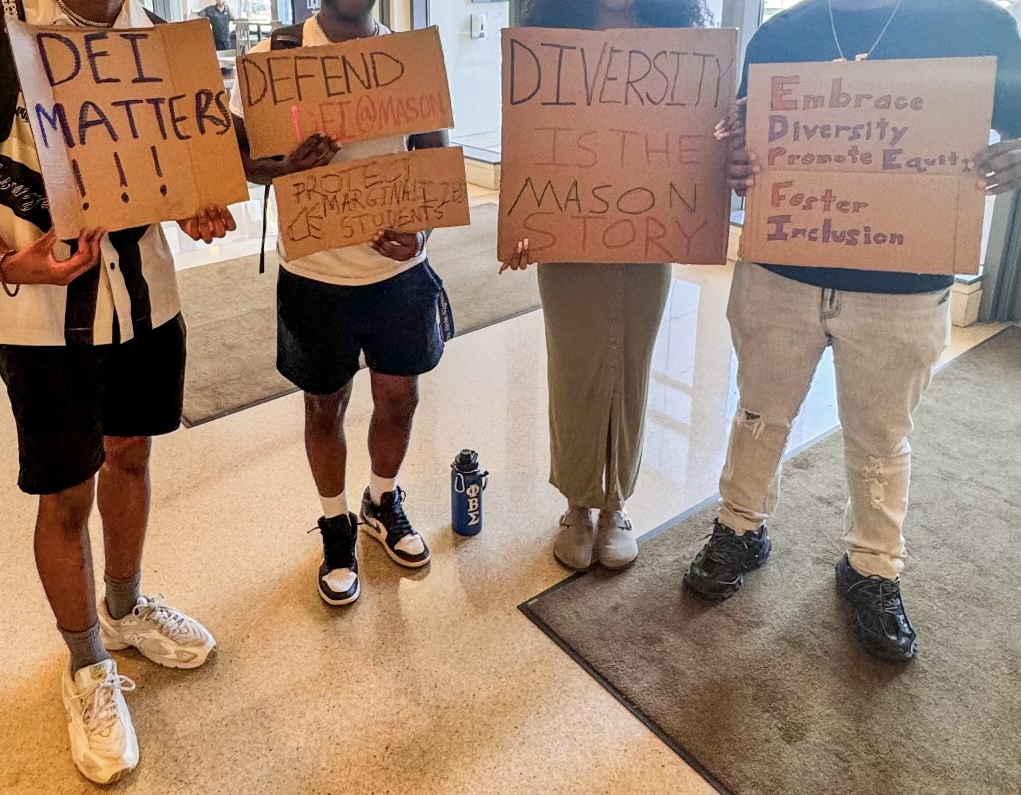
During the session, members of the gallery attended with cardboard protest signs. “Defend DEI @ Mason”, “Protect marginalized students”, “Diversity is the Mason story”, they said.
An “Achieving Inclusive Excellence, The Mason Way” presentation was given by Visitor Michael Meese and Visitor Bob Witeck to the floor with additional remarks from Vice President of University Life Rose Pascarell, Vice President for Diversity, Equity and Inclusion Sharnnia Artis and Faculty Representative Melissa A. Broeckelman-Post on research surrounding DEI and the Just Societies Initiative. The BOV would be given a board action item to approve the recommendations in the report.
“Our students have been asking for coursework focused on understanding diversity for more than a decade… all of Mason’s top employers have DEI statements and they tell us that Mason’s diversity and our students experience working with others from a variety of backgrounds, is one of the primary reasons that they recruit our students,” Broeckelman-Post said.
“Our DEI philosophy is unique to Mason and fits our values. It’s what unites our community of scholars, our students and staff, and we heard this loud and clear from almost every source… We believe that academic freedom goes hand in hand with an enriched, diverse and meaningful selection of Mason scholarship and course offerings. More is better, not less,” Witeck said.
The session then went into discussion and debate, with Visitors Reginald Brown, Horace Blackman, Jeff Rosen, Robert Frank Pence and Lindsey Burke challenging the initiative.
Brown shared that he was concerned the Just Societies initiative would be a mandate for students. “[If] our students want to take them… they’ll sign up… I agree that diversity is the Mason story… It has occurred so far organically without a mandate… I do not believe that SCHEV, our accreditors, or a single major employer in this region requires that students who are at work there have taken a DEI class or a Just Societies Class,” Brown said.
Alacbay suggested that having a large amount of options to take for a Just Societies requirement may make people take classes they are comfortable with instead of exploring new areas. “The problem I have with Just Societies as it is currently constructed, is that you have all these different formulations of justice that you can take in all these different departments. [You can] self select, according to where you’re comfortable… I ironically think that there is no better way to exacerbate the problem of people talking past each other,” Alacbay said.
One Visitor, Robert Pence accused President Dr. Gregory Washington of “Inherent racism” in his remarks, causing a reaction from the floor. This followed a comment from Dr. Washington that diverse education can reduce “inherent bias” in workforces.
“There’s a reason why when children go to the ER, white children are three times more likely to get treated for pain than black children are. I want the doctors who come from programs, who come from Mason, to have had a cultural understanding that keeps them from having that inherent bias in their thinking. You don’t get that by just being in a room with people, you actually get it through education and training. And that education and training comes through mechanisms like this,” Dr. Washington said.
“Mr. President, I’m saddened by you feeling the necessity to talk about white people in a hospital ignoring or not treating on a timely basis, Black people. I think to bring that up as an excuse or in support of this program is really demeaning to this program,” Pence said.
Pence also listed a number of concerns he had with Just Societies as a DEI initiative, and that it could mandate the views of students.
“People have had this indoctrination [DEI initiatives], and that’s hurting our country…
Freedom of speech, freedom of learning, freedom of thought and I haven’t found it in here… I’ll guarantee you in a week, the next week [or] the week after, I’m going to find that paragraph and I’ll show it to you. [It will say] we need to teach the students what to think. Not how to think… I’ll bet you [it’ll say] ‘Mickey D’s number one,’” Pence said.
In response to the visitors comments, Broeckelman-Post explained that the Just Societies Initiative and Mason Core requirements come from extensive research including information from SCHEV, the ACLU and “campus-wide conversations”.
Witeck responded to a concerns of a mandate, explaining that having a variety of classes with the Just Societies flag will offer a freedom of choice for what students may take.
During the last BOV meeting on April 2, GMU AAUP President and Associate Professor Timothy Gibson presented the organization’s petition to “Tell the BOV that Mason faculty, not BOV members, must set the curriculum and evaluate the value of faculty research. Help us protect Mason’s faculty, students, and our institution of higher education from political interference.” The petition said, which currently has at least 300 signatures from the Mason community including faculty and students.
ALLEGED “POLITICAL INTERFERENCE”
The AAUP’s accusations of political interference stem from Visitors’ conservative relationships, large donations to political campaigns, and experience working under the George W. Bush and Donald Trump administrations.
Since 2005, Brown donated $303,200 to campaigns for 12 democrats, six political action committees and 21 republicans including $55,000 to Gov. Youngkin two years prior to his appointment by Gov. Youngkin. According to Blackstone, Brown worked as associate White House Counsel and special assistant to the President under Republican George W. Bush from 2003 to 2005.
Fourth Estate could not locate prior direct work experience in the education field from Brown.
Since 1996, Pence donated $834,625 majorly to republicans including $50,000 to Gov. Youngkin one year prior to his appointment by Gov. Youngkin. Since 2013, his company, The Pence Group Inc. donated $13,500 majorly to republicans.
According to his 2018 nomination letter, Pence, who is not related to Mike Pence, was “selected” by former President Donald Trump to serve as the ambassador to Finland.
Fourth Estate could not locate prior direct work experience in the education field from Pence.
Rosen is publicly affiliated with the Republican party. According to the Department of Justice, from 2003-2006, he worked under the George W. Bush administration as General Counsel of the United States Department of Transportation. From 2017-2021, he worked under the Trump administration as the 12th United States Deputy Secretary of Transportation, the 38th United States Deputy Attorney General and the United States Attorney General.
Rosen has prior experience as an adjunct professor at Georgetown University Law Center.
Lindsey Burke, who was appointed by Gov. Youngkin, is the Director of the Center for Education Policy at The Heritage Foundation which has a self-proclaimed mission to promote conservative public policies.
Burke has made numerous publications for Heritage Foundation including The Consequences of Unchecked Illegal Immigration on America’s Public Schools, Protecting American Universities from Undue Foreign Influence and DeSantis Tackles Divisive “Diversity, Equity, and Inclusion” Programs on College Campuses.
“DEI programs push divisive identity politics as well as distorted narratives about American history… Florida is leading the way in weakening the Left’s capture of education institutions,” Burke said in her Desantis-DEI article.
Burke also has an active X page. “DEI doesn’t stand for ‘diversity, equity, and inclusion,’ @GovRonDeSantis explains @Heritage 50th. DEI stands for ‘discrimination, exclusion, and indoctrination,’” Burke said in a Tweet.
Fourth Estate could not locate prior direct work experience in the education field from Burke.
Last June, Alacbay wrote an article for Heritage Foundation with Burke. In the article, it said “All-or-nothing Title IV Federal Student Aid eligibility gives institutions no incentive for stepwise improvement.” and “Congress should directly prohibit accreditors from instituting diversity, equity, and inclusion (DEI) requirements for colleges and universities or interference in governance.”
Fourth Estate could not locate prior direct work experience in the education field from Alacbay.
Visitor Jon M. Peterson was appointed by former Gov. Northam starting July 2020. Prior to his appointment, Peterson donated $912,659 to 10 political action committees and campaigns for 56 republicans, three independents and 20 democrats including $35,000 to former Gov. Ralph Northam in 2017 and 2019 before his appointment by Gov. Northam in 2020.
Peterson is the Chief Executive Officer of Peterson Companies. Peterson Companies also made donations totaling $138,158 since 1998. Of the total amount, $100,000 was recently donated to the Republican Commonwealth Leadership PAC in 2021.
Peterson also donated $37,500 to Gov. Youngkin through Spirit of Virginia in 2022. Peterson’s term will expire in June 30, 2024 and is eligible for reappointment by Gov. Youngkin.
Fourth Estate could not locate prior direct work experience in the education field from Peterson.
Since 2015, Blackman donated $10,500 majorly to democrats.
Fourth Estate could not locate prior direct work experience in the education field from Blackman.
Biographies from the Board of Visitors, including their major work experiences can be viewed on their Board Membership page.
Fourth Estate/ Viviana Smith
Mason’s student radio hosts their first concert presenting local bandsBY VIVIANA SMITH, MANAGING EDITOR
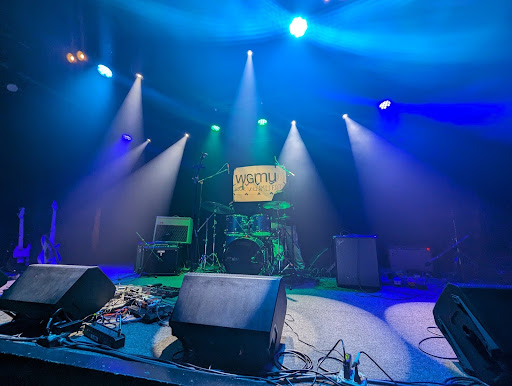
On April 17, Mason’s WGMU hosted Amplifest, a concert featuring several DMV local band performances at Jammin’ Java.
According to junior Ashlyn Cole, WGMU’s General Manager, this year’s Amplifest was the first time WGMU has held a concert-like event. “I thought previously that WGMU had done this sort of event with Jammin’ Java in the past… come to find out WGMU has never done something like this before.”
Amplifest featured four local bands: Aminori, Breakneck, The Knuckleheads and Argo & The Violet Queens. Throughout the night, the bands performed original songs and covers of popular songs, such as “I Will Survive” by Gloria Gaynor and “I Want It That Way” by The Backstreet Boys.
Many members of the various bands are college students at universities such as Mason, American University and Northern Virginia Community College.
Lead guitarist and vocalist for the band Aminori, sophomore Emmy Gladden, is a DJ for Basement Rock, a radio show on WGMU. “I’ve basically been begging WGMU to do events for like ever… And they finally set up a show.”
The night was filled with lively music, a wide selection of food and drink options and a large community showing out to support local bands and college radio.
The bands recounted their experience at WGMU’s Amplifest and how events like this can support local bands and connect the community.
Aminori’s Gladden said that this was the band’s first concert and it couldn’t have been a better experience for them. “Honestly, there could not have been a better crowd.”
Mason senior and lead guitarist of Breakneck, who declined to provide their name, said he was pleased his band was recognized for this opportunity from the school. “It was nice to see representation from… us getting picked up by GMU official channels… we haven’t gotten a lot of attention from the actual school… so it was nice to get recognized.”
Mason sophomore Sam Tyson, drummer for Argo and The Violet Queens, helped the band get booked for Amplifest, according to guitarist and vocalist Arve Goswami, who is an American University freshman.
Goswami credited the support of this event to his own experience within college radio. “I’m a part of WVAU, so I knew… they would probably do something similar to what we do… it’s a cool circuit that we have with all the college radios. Supporting college radio,” Goswami said.
Freshman Demian Osorio, a bassist and vocalist for The Knuckleheads, believes the best part about local bands is the community it fosters. “It builds the most beautiful community ever…We’re sharing a beautiful form of art and everyone’s just here to have fun.”
According to sophomore Amal Qazi, WGMU’s local music director, Amplifest has been a long-awaited event and is the culmination of WGMU’s work to build a music community across the DMV.
“I’m lucky enough to already know some pretty awesome musicians and Mason’s swarming with great talent anyways, so we booked the four that played and made sure we had a date set,” Qazi said. Long story short I got in contact with the venue, booked the bands with Kylie, took care of the behind-the-scenes stuff with Ashlyn, and watched the four amazing bands perform their hearts out.”
WGMU’s staff hopes to hold more events similar to Amplifest in the future to further build the local community music scene.
“We would love to do future events like this because then people start to reach out to us more… and then we build up a really special bond with a very cool community,” Cole said.
“I saw a lot of people that aren’t involved in radio and a lot of people that wouldn’t typically go out to small concerts like this… We would love to have the station consistently be a source of support and new fans for student bands, and I think this was a great first step,” Qazi said.
Fourth Estate/ Viviana Smith
Discover the challenges, triumphs and contributions of women of color in STEMBY JAMIE GHOLSON, STAFF WRITER
In 2021, the U.S. National Science Foundation (NSF) stated that women are underrepresented minorities in the STEM workforce, consisting of 35% of the related occupations. Of the 35%, the underrepresented minorities, Hispanics and Latinos, Blacks and Alaska Natives comprise 24% of the STEM field. Women in STEM majors at Mason dedicate long and hard working hours towards their degrees to increase those odds.
Women of color in STEM face challenges when working in a male-dominated field. According to The Education Trust, Black and Latino STEM students and professionals often experience workplace discrimination, unequal pay and harassment. Men sometimes undermine a woman’s capabilities to perform under pressure which can lead to them being put in a box.
“It can sometimes feel like you’re talking to a wall because they don’t value your opinions as much,” said sophomore Shriya Pasyavala. Pasyavala is a Risk Management member of Theta Tau and the Secretary of Women in Cybersecurity in the Mason chapter.
Women can feel discouraged when being in a male-dominated field, but it is important to find a community where you feel welcomed and accepted.
Mason offers interest meetings for women interested in the tech industry called Break Through Tech. Junior Joanne Romo, the community outreach chair for Women of Color in STEM, said that one of the women at Break Through Tech was inspiring because she got to see another woman of color in the tech industry.
Mason offers several clubs to help encourage women in STEM-related fields such as Women of Color in STEM, STEMinists and Women in Cybersecurity. These clubs help women connect by relating similar struggles and experiences with other women of color. It is also a great way to connect and create new learning opportunities. These clubs help women build their confidence and encourage them to continue in STEM.
“It’s easy to be discouraged at the beginning of college and that is how I found WOC in STEM my first year of college… I was able to find my support system which helped me relate to a lot of the other women’s experiences,” junior Aniyah Syl said, president of Women of Color in STEM.
Working together can break down barriers to create more opportunities for underrepresented groups in STEM.
“Any woman in tech or STEM has honestly been an inspiration because it takes a lot to break that barrier in the all-boys club,” said Pasyavala.
Highlighting the achievements of women of color in STEM can help to break the stereotypes and demonstrate that women are just as capable as men in STEM fields. Celebrating these successes can also inspire women in the future to pursue a career in this area.
Creating a more inclusive and supportive environment for women of color in STEM requires a collective effort from universities, companies and individuals.
Fourth Estate/ Mary Demarco
New tech student organization at Mason has a successful first yearBY MARY DEMARCO, STAFF WRITER
“When I was a freshman, I really wanted to get involved with some cool [computer engineering] projects with people. There [were] some clubs out there, but I [felt] like they’re not really accessible, or they’re not real for me,” President of Tech4Good Arman Mahjoor said.
Sophomore Arman Mahjoor wanted to get involved with computer engineering projects when he first arrived at Mason. So, he founded and became the president of his own club, Tech4Good (T4G) during his freshman year. Two semesters later, the club gained over 130 members.
T4G uses technology to address issues ranging from sustainability and healthcare to social change and equity. It provides Mason students the opportunity to grow in their craft while also helping their surroundings.
Mahjoor managed to create and expand on a collaborative group that focuses on computer-based building projects. While there are many different tech clubs at Mason, Mahjoor noticed that most were career-oriented instead of skill-oriented.
“It’s all about being able to have a supportive space, to just work on the project, and also collaborate with other students there and get mentoring,” Mahjoor said.
From this idea, T4G started hosting many different events and projects such as weekly “Let’s Lunch” meetings, Hackathons and a program called Explore where students are given a space to work and collaborate on projects with other students.
T4G has attended three Hackathons over the last year. “I feel like Hackathons have a stigma that if you’re not a really good coder, you can’t go. But… you’ll see other [T4G] members in Discord really encourage them to come,” Mahjoor said. “It’s really cool to see people just welcome [others] into this space of building projects.”
Outside of Hackathon, Mahjoor has set up “general social events” throughout the year with the goal of the club members connecting and forming friendships.
“That’s been the biggest achievement is the community aspect of it, the cultural community aspect of our club,” Mahjoor said.
I set myself the goal of meeting people and making friends,” Junming Chen, PhD student said. “I enjoyed it immensely and was glad to see others share my feelings.”
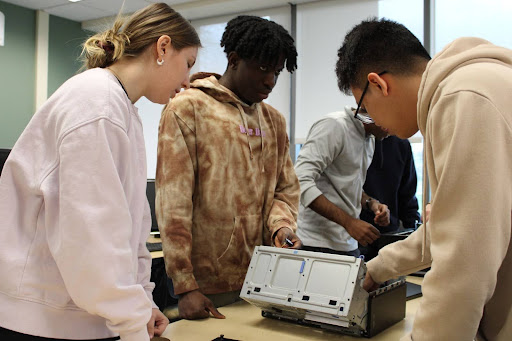
T4G partnered with a local nonprofit, Communitech. Every other Friday, T4G members meet with two members from Communitech to refurbish hardware and reduce e-waste which is then donated to those in need.
T4G has also partnered with Maintain Mason to reduce waste. In the last year, T4G members have already picked up 180 pounds of trash, according to Mahjoor. There is so much going for this club, and they are just beginning.
“There’s definitely a community of leaders in our club that’s able to support what we’re doing,” Mahjoor said. “But I’m hoping that next semester, some of the members in the program will be inspired to take on that leadership there.”
For those interested in connecting with T4G, visit the club’s Mason 360.
Fourth Estate/ Valentina Fala
The World Citizen Club gives students the chance to volunteer and make an impactBY VALENTINA FALA, STAFF WRITER
Nowadays many people feel scared and powerless in front of the tragedies happening all around the world. One may want to make a change, but does not have the resources, time or confidence to take action. At Mason, students are encouraged to accept diversity and multiculturalism by joining student organizations that give them the tools to be active participants and leaders of society for a better future.
The World Citizen Club is one of many student organizations at Mason, but it goes beyond creating networking connections. This club seeks to make a difference in today’s society by actively supporting universal rights and the concept of world citizenship.
The World Citizen Club was created with world citizenship in mind, which connects every citizen of the world together under the same philosophy. Lisette Osei-Kufuor, the club officer in charge of advocacy and asynchronous events, said “world citizenship is the idea that although we have borders that separate us, we are still human and we all have duties as humans to uplift and support each other.”
Having previously contributed to the UNITE campaign from the United Nations, this student organization at Mason was conceptualized in the summer 2022 and now has six officers on the executive board.
The World Citizen Clubs gives students the resources to participate in activism. Students who join the organization promote togetherness with the help of globalization and advocate others on global issues that deal with international law and human rights.
The Word Citizen Club holds regular events for club members and volunteers to engage in their local communities. The most recent event involved recycling cobalt mostly mined from Congo. Osei-Kufuor created a Google Form where students can find accessible and easy ways to dispose of electronics such as cell phones and computers that contain cobalt. Instead of becoming technological waste, they will be recycled.
Members can get involved both in-person and asynchronous. Past events of the club include volunteering at the World Culture Festival in DC for sustainability, making cards for senior homes and virtually raising awareness on violence against women and children.
To learn more about how you can get involved with World Citizen Club, join their GroupMe to and visit their Instagram.
Fourth Estate/Saahiti Kiran Chamala
Discover authentic Thai cuisine and cozy vibes just minutes from campusBY SAAHITI KIRAN CHAMALA, ASSISTANT CULTURE EDITOR
Sisters Thai, a beloved eatery frequented by Mason students, offers an array of tantalizing dishes that cater to various preferences. From their renowned drunken noodles to a delightful selection of Thai curries, the restaurant ensures there is something for everyone including vegetarian, tofu or one of many meat selections such as chicken, pork, beef, shrimp and seafood. This place also lets patrons choose a preferred level of spice for their dish.
As one satisfied patron, Samri Tesfayi said, “I’m drunk in love with their drunken noodles,” while highlighting the chicken wontons as her favorite appetizer.
According to Mason sophomore Sthuthi Chakravarthy, the cuisine strikes a perfect balance between spice and flavor, providing a refreshing departure from typical Southside dining experiences. Complementing the culinary delights is the cozy ambiance that Mason freshman Maya Griffin, describes as emitting “cozy library cafe vibes.”
Conveniently situated in close proximity to Mason, reaching Sisters Thai is a breeze, whether opting for an 18-minute stroll or a brief 10-minute bus ride. For those opting for public transport, the Green 1, Green 2 or Gold 2 buses followed by a short 5-minute walk are recommended routes, with the Transloc app offering seamless navigation of Mason shuttles. If driving there, parking in Old Town Fairfax can be difficult, so arrive early to have plenty of time to find a parking spot.
Affordability is another highlight, with Griffin noting that the cost mirrors that of a Chipotle bowl with steak and guacamole but offers a healthier, superior alternative. Sisters Thai attracts a steady stream of Mason students and residents of Fairfax.
The restaurant’s curry dishes along with their pad thai and drunken noodles garner notable praise. Poon, the seasoned restaurant manager, emphasizes the enduring appeal of Thai cuisine, contrasting it with the monotony of hamburgers and pizzas. He said, “You can get tired of hamburgers and pizzas, but for me personally, I can have Thai food everyday and never get bored.”
Despite its modest size, Sisters Thai can quickly fill up, prompting a recommendation to call ahead and secure a reservation, especially for larger groups.
In Thai, they say, “กินให้อร่อย,” which translates to “eat well.” Sisters Thai ensures just that, inviting patrons to savor a delectable culinary journey that embodies both quality and affordability.
Fourth Estate/Madalyn Godfrey
Fourth Estate conducts a poll regarding quality of Mason Dining, 97 of 149 students report receiving undercooked meat during academic school yearBY ERICA MUNISAR, EDITOR-IN-CHIEF
Fourth Estate surveyed students on the quality of Mason Dining halls, specifically regarding undercooked meat consumption during the 2023-2024 academic year.
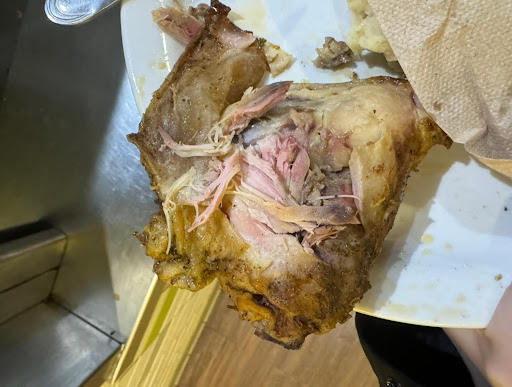
Out of 149 verified respondents, 97 reported receiving undercooked meat while 52 did not.
68 comments were given to Fourth Estate. Of the total comments, 49 cited complaints towards Mason Dining while 19 were positive or neutral.
“I have gotten bloody chicken multiple times at the dining hall. If the food isn’t raw, it is chewy or dry to the point [where] it feels like sandpaper,” Junior Grace Davis said.
“The food is hit or miss everywhere, but that’s understandable for a college dining hall. It is just really upsetting getting served raw meat because then I have to waste it,” Freshman Connor Patterson
“Me and my roommate have had food poisoning at least twice from southside,” Freshman Mikenna Leithren said.
“Ike’s chicken is always undercooked and I have gotten food poisoning from it a couple times,” Freshman Karissa Thanyachareon said.
“Got food poisoning first day here,” Freshman Auburn Rafferty said.
Students were also asked to rate their favorite dining halls, cleanliness and food quality.
On a scale of one to five regarding cleanliness, students reported an average score of 2.97.
“The employees in the dining halls usually seem rather tired, and I don’t blame them… I see heaps upon heaps of stolen, broken dining hall dishes outdoors. It is ridiculous. It feels as if the student body does not have respect for the establishments, especially at Ike’s,” Freshman Yusef Shehata said.
“All of the food is really mediocre, and sometimes undercooked and everything is not properly cleaned,” Freshman Quinn Eyman said.
“There are flies everywhere. I’ve been served severely undercooked chicken, moldy ingredients at the sandwich bar. I’ve seen workers open mouth cough on plates of food before handing it to students and pick dropped food off the floor and serve it… I would love to see George Mason leadership try to eat at only the dining halls for a week and see the job Sodexo is doing,” Junior Jaye Conn said.
On a scale of one to five regarding food taste, quality and freshness, students reported an average score of 2.96.
“Food quality is poor and is very inconsistent with some days having worse quality than others,” said Sophomore Austin Diaz.
“I’m not a picky eater at all but sometimes the food makes me nauseous,” Freshman Quannee Robinson said.
“My experience was overall great and the food was delicious over by the Ike’s and the Southside. My favorite was the pizza and ice cream in the Ike’s. My favorite from the southside was the tiramisu and drinks,” Junior Daniella Ordonez said.
“I love ikes! 24/7 for the win.” Junior Daniel Lee said.
From the most favorite to least favorite dining hall, Southside received first place, Ike’s received second place, The Globe received third place and The Spot received fourth place.
In the academic year of 2022-2023, Fourth Estate reported individual student complaints of raw meat, including a response from Mason Dining.
Mason Dining General Manager Jenita Thurston provided a response to the recent survey findings on April 25.
“Mason Dining regrets any instances of undercooked food and encourages immediate reporting to address these issues. We adhere to strict food safety procedures, including temperature monitoring, and provide ongoing staff training. Students can report concerns via MyDtxt or speak directly with our team on site for immediate resolution. Regarding undercooked meat, it’s important to note that color isn’t always a direct indicator of doneness. Chicken thighs, for instance, may appear pink even when fully cooked. We ensure proper cooking temperatures and provide regular staff training on food safety protocols.
We value student feedback and acknowledge areas for improvement, including cleanliness and food quality. We partner with Job Discovery for cleaning services and will explore enhancements. We also continuously refine cooking techniques to enhance dining experiences. While it’s encouraging to see Southside as the top choice, understanding the reasons behind students’ preferences can help replicate successful practices across all dining facilities. The feedback that we collect daily from students through our HappyorNot terminals has consistently rated The Spot with a 95% satisfaction score.
Our commitment to listening and acting on student feedback ensures an exceptional dining experience. We appreciate the opportunity to address concerns and strive for continuous improvement,” Thurston said.
Fourth Estate/Brandyn Fragosa
The Mason community reacts to new logoBY BRANDYN FRAGOSA, SENIOR NEWS REPORTER
Editor’s Note: The full statements from Vice President and Chief Brand Officer Paul Allvin and Students Against Logo Tragedy to Fourth Estate can be viewed below.
The article has been updated for clarity.
Following the reveal of George Mason University’s new logo, the Mason community reacted with a mixed reception.
Vice President and Chief Brand Officer Paul Allvin, University President Dr. Gregory Washington and Assistant Vice President and Director of Intercollegiate Athletics Marvin Lewis explain the meaning behind the logo change.
The new Mason logo is revealed to the university community
On April 25, the Office of University Branding revealed the new Mason logo to “begin the next leg of our journey to overhaul and modernize George Mason University’s brand identity.”
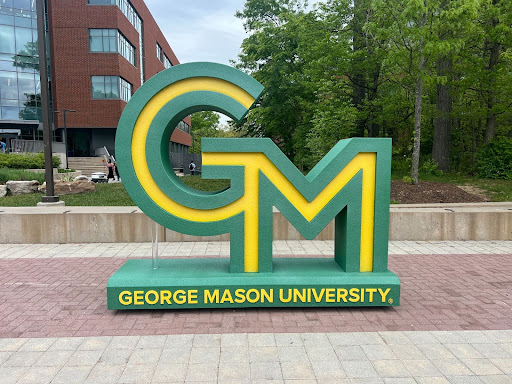
The logo includes a modernized yellow G and M outlined in green. “The new look features clean lines and open ends, symbolizing multiple entry points and pathways to success,” Mason said in an article.
“The ‘GM’ monogram distinguishes the university as the world’s only university to use those initials in its logo and recognizes that the broader community commonly refers to the university as ‘George Mason,’ not just ‘Mason’ and no longer ‘GMU,’” Mason said.
Ologie, a branding and marketing agency in Columbus, Ohio, helped to create the logo.
In a post on X, Ologie said, “We were honored to partner with GMU to establish this work, the architecture strategy, and the visual platform as part of their three-year-long comprehensive rebrand.”
The plan to create a new logo started as an ongoing project in 2021.
However, on Tuesday, April 23, the Mason Cable Network (MCN), revealed a black-and-white rendering of the new logo, two days earlier than Mason’s scheduled reveal, on a live taping of their show.
MCN retrieved the logo from the United States Patent and Trademark Office, which states that the logo had been trademarked since Mar. 8, 2024.
Vice President and Chief Brand Officer Paul Allvin said that the Office of University Branding was unaware of MCN’s plan to reveal the new George Mason logo on April 23.
“We advised them that the image they had was not accurate – it appears it was taken from our trademark filing – so it caused a lot of needless frustration to the public because they were reacting all day to a black-and-white rendering of part of the logo, with no context or explanation,” Allvin said.
Allvin added, “Our planning has always called for a Thursday public release and a Friday focus on the university. Today [April 25] we just focused more on social media and news outlets.
Tomorrow [April 26] we will turn our focus inward, with merchandise debuting in the bookstore and a meeting with communications and marketing staffers from around the university to orient them on the new brand guides.”
Paul Allvin and Athletics Director Marvin Lewis led the new logo change
According to an article by Scott Allen from the Washington Post, Allvin worked alongside Assistant Vice President and Director of Intercollegiate Athletics Marvin Lewis in creating the new logo.
“Lewis had experience with redesigns at several of his previous stops, including Brown [University], where he led a brand and visual identity refresh in 2022,” Allvin said in the article.
In a conversation between Lewis and Allen, Lewis said in the article, “This is an opportunity to truly galvanize and unify the campus community… Instead of athletics having a separate identity, I felt like it was imperative for us to maintain the university’s identity.”
President Dr. Gregory Washington released a letter the day of the official reveal stating that the Mason Athletic Department was involved in the logo change.
“The new logo system unifies the university under a single look, which now includes athletics,” Dr. Washington said.
Allvin added to Fourth Estate, “It was simply a strategic decision made in collaboration with Intercollegiate Athletics. [Branding’s] best practice at leading universities is to operate under a unified logo so you don’t present competing symbols to the public…
We simply needed to arrive at a design that met both the more academic/administrative needs and the needs of athletics.”
Initial reactions to the new logo
MCN posted on Instagram on April 23 showcasing the new logo, which received 95 comments of mixed feedback from the Mason community as of April 28.
On April 24, MCN Alum Tyler Byrum confirmed on X that the logo would replace Mason’s Athletic Department shooting star-featured logo, with his tweet collecting 334,200 views, 74 comments, 16 reposts and 245 quotes as of April 28, featuring thoughts on the new design.
Allvin replied to various tweets critiquing the logo, referring to MCN’s reveal as an “erroneous leak from trademark filings” on several occasions, directing users to read Mason’s article about the logo reveal.
In response to the reactions to the logo, Dr. Washington said in his letter, “New logos are often an acquired taste—it’s human nature to view changes like these with a certain amount of reluctance. I encourage everyone to give yourselves time to acclimate to this new look…
It maintains our historic green and gold colors, but in bolder, more confident hues. And its design tells the story of George Mason as it is now: a university with multiple entry points and pathways for student success…,” Dr. Washington said.
Petitions and Instagram account made over the new logo, Paul Allvin responds
Following the reveal, an Instagram account and petition were made against the new logo.
A team of anonymous Mason students created an Instagram page called Students Against Logo Tragedy (SALT) on April 25, with an initiative to “spread info abt @georgemasonu’s rebranding that wasted student/taxpayer/staff $$$ & time.”
In an Instagram post, SALT said, “Here’s Mason’s grand reveal of the new University logo. We believe they failed to transparently & publicly consult enough stakeholders, especially students, on the final design, demonstrated by the vocal & overwhelmingly negative response.”
In Dr. Washington’s letter, he said that “extensive stakeholder engagements” were held with 1,500 members of the Mason community on the logo change starting in 2021.
However, SALT claims fewer than 250 stakeholders were involved in finalizing the logo design, with two-thirds of those involved wanting “either no or a small change,” and, “That consultation was ‘not about design at all’ according to University VP & Chief Branding Officer Paul Allvin, just finding the ‘Mason story’.”
SALT also claims, “Neither the Student Senate, Faculty Senate, or Staff Senate were asked for feedback on the rebranding, despite representing the most important parts of the Mason community.”
Allvin responded to both claims saying, “Not true. Many facts conflated and mixed together.”
In his statement to Fourth Estate, Allvin provided, “a run-down of every student touch-point over the three-year brand redevelopment process,” which reflected that 1,500 stakeholders were involved including the Student Senate, Faculty Senate and Staff Senate.
SALT also had concerns regarding increases in student tuition in their statement to Fourth Estate:
“In a time where cost of living is skyrocketing… our University is in a deficit leading to tuition & student fees maybe being raised, departments and offices like University Life to IT Services to Title IX face staff shortages, and members of the Mason community face not only the crushing weight of student debt but homelessness and hunger, spending this money on rebranding goes against the values that George Mason University stands for.”
SALT’s concern about the allocation of funds for the logo follows the Mason Administration’s proposal to increase student tuition by 3% for in-state tuition for the 2025 and 2026 fiscal years due to funding shortfalls.
A Change.org petition was also filed on April 25 titled, “Reject the New GMU Logo!” In the petition, written by “A concerned GMU Student”, they requested “that this new logo is either completely scrapped or changed into one that keeps the spirit of the old one.”
The Mason student added, “With the rising costs of secondary education and the growing burden on the students to fund university endeavors, it is disappointing to see George Mason Funds being used to rebrand the school logo into one that is lifeless.
This rebranding under the guise of ‘modernity’ strips away the school spirit of the old one and spits in the face of crucial design elements. The new logo reeks of conformity rather than the individuality. This is especially disheartening as individuality is a driving force in so much of what the university stands for,” the Concerned GMU Student said in the petition, which currently has 335 signatures as of April 28.
Allvin responded to the petition saying, “A logo is not just an aesthetic flourish on the campus with a composition that can be crowd-sourced. It is a marketing tool that we use in the most competitive higher education market in the nation…
Crafting such a thing is deeply technical and complicated, and it is properly done by subject matter professionals – with proper stakeholder input at the proper times, which we went to great lengths to include,” Allvin said.
The full statements, including the run-down from Allvin and SALT to Fourth Estate, can be viewed below.
How the new logo will be implemented
As Mason transitions to the new logo, “the Office of University Branding will guide the university on a gradual, two-year transition into the new look… because this is designed as a budget-neutral project,” Dr. Washington said in his letter.
Allvin explained the budget-neutral method: “It means we are not using new money to transition into the new look. This means it will take us a bit longer, but that’s not a problem.
Transition first happens with digital properties, which do not require budget. Then it moves to the materials that naturally run out or need to be replaced periodically anyway. Finally, the permanent signs, like external campus signs will need funding to pay for, and those will come from budget reallocations within the Office of University Branding over the current and next two fiscal years.
For this year, we have reduced institutional brand advertising and other promotional expenses by $500,000 to cover this year’s implementation costs. We estimate it will cost about that much each year for FY25 and FY26, and our brand marketing will remain lowered by that much to cover those costs. It spreads conversation over two calendar years and three fiscal years, but it means no new dollars are required to complete the switch,” Allvin said.
Branding’s reception to the community reaction
In response to the overall reception to the new Mason logo, Allvin said, “I am genuinely thrilled.”
“…Initial opposition to a new visual brand is a universal and unavoidable part of this process. It is human nature to resist the change at first, but as use and familiarity grow, so do acceptance and affinity. We are seeing that process happen very rapidly just in this first day.
As an example, we have been following social media sentiment throughout the day. In the 24 hours ending 9 am this morning [April 25], sentiment was running 90.8% negative, 5.3% neutral, and 3.9 percent positive.
By 3 pm, the 24-hour rolling rate had shifted to 39.3% positive, 34.9% negative, and 25.7% neutral. That’s remarkable progress in just six hours by any measure,” said Allvin.
During a Student Senate meeting held on April 25, Allvin answered several questions from student senators about the new logo. He shared with the floor that “[For] the students who are graduating… we are not putting the new branding in the commencement.
The branding that these guys, who went through college about to graduate from, is going to be what you see at commencement, your commencement.
We’ll start new with new student orientation, that’s when new things start to cycle in,” Allvin said.
With the Quill M and shooting-star branded university logos being around for 20 years, this year marks a new era for the university.
In the letter regarding the logo change, Dr. Washington says, “New logos are often an acquired taste – it’s human nature to view changes like these with a certain amount of reluctance. I encourage everyone to give yourselves time to acclimate to this new look, and help integrate it into our operations by adopting it as soon as you practically can.”
STATEMENT FROM VICE PRESIDENT AND CHIEF BRAND OFFICER PAUL ALLVIN ON NEW MASON LOGO TO FOURTH ESTATEINTERVIEW BY BRANDYN FRAGOSA, SENIOR NEWS REPORTER ON APRIL 25
Why was the logo revealed a day earlier than planned?
“It wasn’t a day early. Our planning has always called for a Thursday public release and a Friday focus on the university. Today we just focused more on social media and news outlets. Tomorrow we will turn our focus inward, with merchandise debuting in the bookstore and a meeting with communications and marketing staffers from around the university to orient them on the new brand guides. The first unit logos outside of the general university logo will be distributed.”
Did anyone apart of the Office of University Branding know that the Mason Cable Network was going to reveal the new George Mason logo on Tuesday?
“Not that I know of. We advised them that the image they had was not accurate – it appears it was taken from our trademark filing – so it caused a lot of needless frustration to the public because they were reacting all day to a black-and-white rendering of part of the logo, with no context or explanation.”
What has been the office’s reaction to the overall reception made by the reveal?
“I am genuinely thrilled. In my career I have overseen three previous major rebrands – Make-A-Wish worldwide, the USO worldwide, and the DC-based nonprofit America’s Promise Alliance. Initial opposition to a new visual brand is a universal and unavoidable part of this process. It is human nature to resist the change at first, but as use and familiarity grow, so do acceptance and affinity. We are seeing that process happen very rapidly just in this first day. As an example, we have been following social media sentiment throughout the day. In the 24 hours ending 9 am this morning, sentiment was running 90.8% negative, 5.3% neutral, and 3.9 percent positive. By 3 pm, the 24-hour rolling rate had shifted to 39.3% positive, 34.9% negative, and 25.7% neutral. That’s remarkable progress in just six hours by any measure.”
We are aware that athletics had a different logo from the main universities, and this project changed both to one logo, the Fourth Estate was wondering if this is a new requirement listed in Policy 1111?
“No. It was simply a strategic decision made in collaboration with Intercollegiate Athletics. Branding best practice at leading universities is to operate under a unified logo so you don’t present competing symbols to the public when you’re really talking about just one university. We all grow our brands together and don’t compete against one another. It’s a basic brand principle that we’re now following. We simply needed to arrive at a design that met both the more academic/administrative needs and the needs of athletics.”
What does a budget-neutral transition mean?
“It means we are not using new money to transition into the new look. This means it will take us a bit longer, but that’s not a problem. Transition first happens with digital properties, which do not require budget. Then it moves to the materials that naturally run out or need to be replaced periodically anyway. Finally, the permanent signs, like external campus signs will need funding to pay for, and those will come from budget reallocations within the Office of University Branding over the current and next two fiscal years. For this year, we have reduced institutional brand advertising and other promotional expenses by $500,000 to cover this year’s implementation costs. We estimate it will cost about that much each year for FY25 and FY26, and our brand marketing will remain lowered by that much to cover those costs. It spreads conversation over two calendar years and three fiscal years, but it means no new dollars are required to complete the switch.”
When the logo was revealed, University President Gregory Washington sent an email saying that the project, “involved nearly 1,500 students, parents, faculty, staff, alumni, donors, and community supporters.” However, the Instagram account, also known as SALT, claims, “the only mass consultation on the logo asked under 250 people on December 7, 2023. Of that, 2/3 wanted either no or a small change…,” is this true?
“Not true. Many facts conflated and mixed together. Here is a run-down of every student touch-point over the three-year brand redevelopment process:
Organization of the brand renewal effort
2021 President’s Brand Advisory Council:
Baseline research, for both narrative brand update and ultimately to inform visual brand update
2021 Qualitative research – 117 indepth interviews (76 individual and 41 focus group participants):
2022 Quantitative survey (1,469 responses across 7 stakeholder groups)
Leadership engagement for visual brand
2022 Brand Advisory Council work session on visual brand update exploration
Logo concept finalist review
Final logo concept
How were the people involved in this project selected and what did these stakeholder meetings look like?
“In all cases, we consulted University Life to help source student participants.
Brand Advisory Council – Active early in the process, this leadership council was appointed by President Washington. Student body president was appointed.
Stakeholder interviews – This was the preparatory work for the full project, with the results informing the 2022 rhetorical rebrand (“All Together Different” narrative framework) and the 2024 visual brand (what we just released). We worked from a list generated by University Life to to conduct outreach to students to participate. The list was much longer than the eventual 17 students who gave 1:1 indepth interviews, because we had a hard time finding students interested in participating. We conducted 1 stakeholder interview per group (i.e. one with faculty, one with alumni, etc.), except for students, for whom we conducted two. Between the two, seven students showed. There was simply very little student interest in engagement among those whose contact information we were given.
Quantitative survey – Working from a list generated for us, we reached out to thousands of stakeholders, including students, inviting participation in the online survey. Outreach included repeated follow-up, as we had to work extensively to generate enough interest to obtain a critical number of responses from each stakeholder group to have a good enough feel for the collective stakeholder sentiment. In the end, we received 223 student responses.”
The Instagram account [SALT] also claims, “neither the Student Senate, Faculty Senate, or Staff Senate were asked for feedback on the rebranding,” is this true?
“No, as you can see from prior answers.”
Could you comment on the claims made by the Instagram account and the concerns raised in the petition?
“It’s not worth responding to – individual are entitled to their perspectives and feelings. It is a common part of a rebrand to experience stakeholder opposition when a new visual identity is introduced, especially if it is a complete departure from what exists.
A logo is not just an aesthetic flourish on the campus with a composition that can be crowd-sourced. It is a marketing tool that we use in the most competitive higher education market in the nation, where the 50-mile radius wherein we attract 85 percent of our student body is also home to 140-plus other college campuses, all trying to lure students, faculty, staff, and resources away. Our logo must perform against defined competitors, carry commercial appeal, stand out from the competition, and tell our story without using words or sounds. Crafting such a thing is deeply technical and complicated, and it is properly done by subject matter professionals – with proper stakeholder input at the proper times, which we went to great lengths to include.
Just as we would not crowd-source the architectural design of a building, or the financial strategy of university finances, we also don’t simply crowd-source the development of a critical tool in our marketing arsenal.
Our marketing strategy has worked amazingly well. Between 2018 and 2023, our national name identification has increased significantly, from just 12 percent of the public knowing or even having heard of George Mason to 52 percent. The perception of quality, accessibility and flexibility has established George Mason’s as one of Virginia’s three top universities, along with the University of Virginia and Virginia Tech. This logo design is simply the next step in a long, comprehensive strategy to get its brand identity to catch up with its actual quality.
All of the research we did on the visual brand to determine whether we should even make the change at all pointed to an enthusiasm by university stakeholders to make a change. People are very comfortable with the idea of change, but the comfort level drops when they are presented with an actual example of change, which is what happened yesterday. Throughout the process, we have balanced the need to address very technical marketing considerations with the need to gather stakeholder feedback at appropriate intervals.
We’ll keep listening and taking public feedback into account – along with the anticipated initial opposition has been a significant amount of stakeholder applause for the new look, so we take all input into account.”
STATEMENT FROM “STUDENTS AGAINST LOGO TRAGEDY” TO FOURTH ESTATEBY “STUDENTS AGAINST LOGO TRAGEDY”
Good afternoon,
The Students Against Logo Tragedy (SALT) is a group of students dedicated to spreading awareness about the recent rebranding process at George Mason University and advocating to make sure the Mason community is effectively included in decisions like these. We believe the logo process has been a tragedy because an identity-changing project with a $500k price tag lacked meaningful, transparent, and public consultation of the Mason community as an integral part of the process.
We believe the rebranding process failed to meaningfully include and consult enough of the George Mason community. In the words of the University’s Chief Brand Officer, the initial survey of around 1,500 stakeholders was “not about design at all” and only received 223 responses from students. Other early outreach focused on “patterns in rhetoric” rather than ask about design input. Later, after outside contractors and the Office of University Branding had two finalists, a closed-door event with less than 250 people (no count of how many were students was made) was held on December 7, during Finals seasons & when students had already started leaving for break. Roughly 2/3 voted for either a small change (“stylized look at the Quill”) or neither option, rather than the one ultimately chosen. In the past, it was students that voted to have green and gold as our colors, but this rebranding process chose to not publicly and transparently consult the entire Mason community about something affecting it, such as through our Faculty, Student, and Staff Senates. This is what our concern is; not the specific design of the new logo, but the failure of the consultation process to meaningfully include all stakeholders in the George Mason community.
Second, we believe that the half-a-million-dollar cost makes this consultation even more critical. We do appreciate the overall strategy that the Office of University Branding is using with the $500k for this process, by focusing on gradual replenishment for items, but some of this will be used on not-regular spending, such as signage, or on logo-specific promotion, like the display on Wilkin’s Plaza, not to mentioned that employees are of course paid for time spent on the changeover. Additionally, this is being cut from other marketing spending that could be producing revenue. This half a million was from “one time dollars” surpluses from Covid-era savings, meaning it could have been a one-time investment into other budgets as well. In a time where cost of living is skyrocketing for our staff, faculty, and students, our University is in a deficit leading to tuition & student fees maybe being raised, departments and offices like University Life to IT Services to Title IX face staff shortages, and members of the Mason community face not only the crushing weight of student debt but homelessness and hunger, spending this money on rebranding goes against the values that George Mason University stands for. That’s the Mason story we could’ve told, even as one-time investments. The rebranding process wants to tell the Mason story, but doesn’t live up to the Mason promise.
Students graduating this year have voiced that they feel disrespected that the logo was changed without being fully asked or even told in advance. How many future alumni and potential donors will have their last memory of George Mason be a sudden & costly change to our identity that didn’t bother to ask them, yet spent the money they’d paid over years of hard work & study? That could’ve been avoided if consultation was public and meaningful, including details like the cost to implement as well as what are the best branding practices.
Overall, our goal isn’t necessarily to ‘go back’ to the old logo, especially if that won’t save students’ and taxpayers’ money by this point. It’s to have the University and Office of University Branding commit to any future major changes like this go through a process of meaningful, public, and transparent consultation with the Mason community. Our Faculty, Staff, and Student Senates are examples of places to do this, or the recent listening session that University leadership organized on DEI and the ‘Just Societies’ curriculum change, or even setting up a dedicated Student Advisory Council that design changes must at least go through that art/design/business or any students can join, both to provide community input and build students’ experiential learning with marketing. If we had these steps, and the logo, price tag, and timeline ended up being exactly the same, this wouldn’t be the issue it is today. We are very thankful for the Office of University Branding’s leadership for being willing to talk transparently and directly to students about this after the logo was released, and are grateful for being able to have constructive dialogues with each other. We know there may be feelings of disrespect on all sides, but it is true that at the heart of the Mason story we are “All Together Different” and can come together, disagree and debate, and walk away with positive changes for the entire Mason community.
Thank you.
Fourth Estate/Andani Munkaila
Students who attend career fair almost join Vector Marketing, citing concerns with company’s presenceBY ERICA MUNISAR, EDITOR-IN-CHIEF
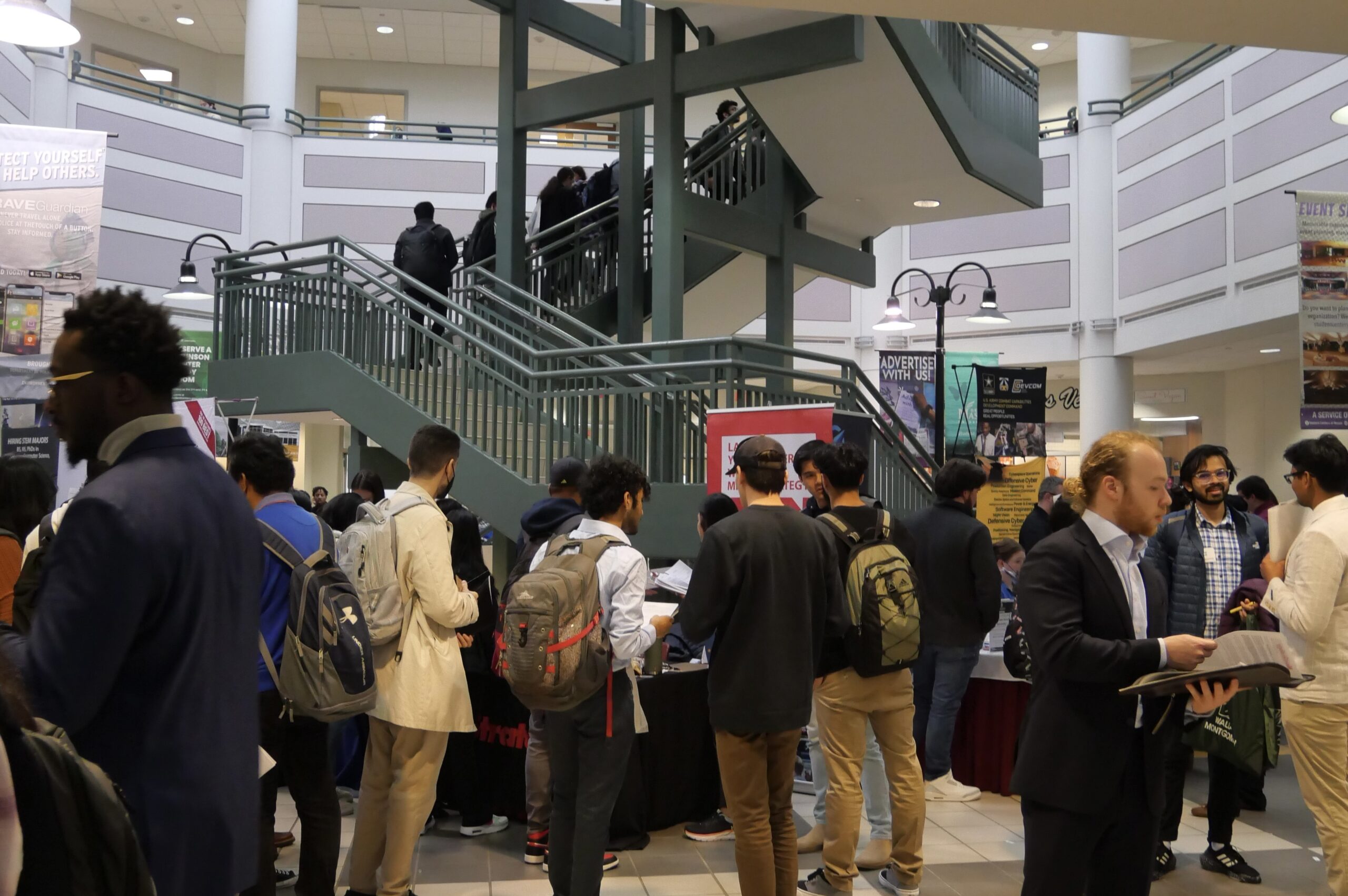
During the recent Spring Career Fair, Vector Marketing, which has been sued several times in the past, was present at the event to recruit students seeking jobs. The career fair was hosted by University Career Services on Feb. 22 in Dewberry Hall where students shared that they almost joined the company after attending.
Vector Marketing has been present at Mason career fairs in the past and tabled at the Johnson Center in 2023. They also have an official presence on Handshake. According to posts on Reddit, Vector Marketing has been seen leaving various business cards around campus.
According to Saskia Campbell, Executive Director of University Career Services, “Measures are in place to verify that an employer is a bonafide business before they are approved to participate in career fairs or other events hosted by University Career Services,” Campbell said.
University Career Services allows Vector Marketing at career fairs, saying that they are a legal business. “Vector Marketing is a legal business classified as a direct selling company (not a pyramid scheme or multi-level marketing company),” Campbell said.
“The purpose of career fairs is to provide Mason students with broad exposure to a variety of employers, career options and job opportunities. Career fairs are a great place to compare and contrast different employment options. Vector Marketing was just one of over 200 employers on campus for the Spring Career Fair,” Campbell said.
According to Vector Marketing, 85% of their “sales reps” are made up of college students. Students at Mason reported almost signing up to work at Vector Marketing after receiving interviews and fliers before soon withdrawing their application upon further research of the company.
Students offered anonymous interviews to Fourth Estate under the use of pseudonyms.
Student Jane Doe shared that she found Vector Marketing on Handshake and the recent career fair. “I had briefly seen [Vector Marketing] on the Handshake site. So when I went to their booth, they had mentioned how their schedules were really flexible and the pay was good. That’s what initially interested me,” Doe said.
“The guy who we spoke with then gave me a paper to fill out and gave me a day and time to have an interview. Initially I didn’t realize how this was a very rushed process and he hadn’t even asked for resumes. It wasn’t until after I left the fair with my friend that [they] pointed out how they didn’t mention what they did as a company. We were both in doubt… and realized Vector was an multi-level marketing company,” Doe said.
Vector Marketing officially denies that they are a multi-level marketing company. Fourth Estate does not endorse the claim that Vector Marketing is a multi-marketing company. However, sources such as Dictionary.com refer to Vector Marketing as a multi-marketing level company, alleging several flaws of Vector Marketing.
Another student, Emma Brown, shared that she almost joined Vector Marketing when they were at another career fair in 2023. “It was fall of 2023 when I came across them at a career fair. The guy there, I won’t mention his name, somehow convinced me that [they were] an amazing marketing company and I would be a great fit without really explaining what exactly they do,” Brown said.
Unlike Doe, Brown stayed up until the company’s training session. “I got interviewed and was offered a job right away. I went [to] my first training session when I realized they are literally just abusing the young kids into thinking they are doing great, but it’s just a multi-level marketing scheme where they are being forced to call hundreds of people to land a potential client,” Brown said.
“It’s such a painful process just to sell knives for their company and nothing else. They show it’s such a great growing opportunity, but for me personally it hinders your growth. Maybe for some people it’s a great way to earn sales experience, [but] for me personally it was a torture. Plus, I felt like the way they hid [information] about their actual company at [the] career fair, they were hiding many other lies. I was smart enough to realize at that training session something [was] very fishy so I left,” Brown said.
Both Brown and Doe shared wishes to students to research companies before they join them, citing grievances with the career fair.
“I honestly dont think they should be present [at the career fair] because they are not honest about their company and values,” Brown said. “Know what [Vector Marketing] does very thoroughly before even thinking to drop your resume. Think it through deeply, and please dont trust a word that comes out of their mouths. Do your research yourself if you want that job so badly.”
“It makes me lose trust in the other companies that were there. I didn’t know George Mason just let any company in the career fair. It makes me question if they actually care for our futures and success,” Doe said. “Please make sure to look into any companies that you plan to pursue for any job positions or internships. It’s best to avoid Vector if they continue to be at the fairs.”
University Career Services encourages students to research companies at the career fairs before joining them. “Not every opportunity is for every student,” Campbell said. “University Career Services encourages students to conduct research on employers in advance of an interview and definitely before accepting a job offer.”
Fourth Estate/ Viviana Smith
Mason’s pending construction on West campus raises concerns of congestion within the communityBY GABRIEL KING, SPORTS EDITOR AND VIVIANA SMITH, MANAGING EDITOR
Mason announced its plans to build a new multi-purpose stadium on West Campus near Braddock Road. The stadium is expected to be the new home of Mason baseball, while also hosting cricket matches and other events. The construction has been paused as of Mar. 1.
The stadium was proposed by Washington Freedom Cricket team owner Sanjay Govil, and was approved by the Board of Visitors.
According to an Executive Committee meeting with the BOV on Nov. 30, 2023, they addressed a public contract about the potential stadium in a closed session within the meeting.
Following the meeting, George Mason University held a virtual townhall on Jan. 29 to allow the community to provide feedback and ask questions about the project.
Mason administrative and athletic staff informed the surrounding community on major development plans, the partnership of Washington Freedom and Mason, and the benefits of the stadium’s addition to West Campus.
“The West Campus development allows us to make great progress,” Jackie Ferree, senior vice president of operations and business services, said. “It will allow us to improve student engagement, grow our research… expand our partnerships… as well as community outreach.”
During the question and answer portion of the meeting, Senior Associate Athletics Director Andrew Lieber directs questions regarding an estimate of spectators towards Govil.
“We have about 7,000 to 10,000 spectators who are going to be coming to see these matches,” Govil said. “In line with what we have at EagleBank Arena, so we are not making it… out of whack”
The community has voiced a lot of pushback against the project, resulting in a petition started on Feb. 5 by “Concerned Resident.” The purpose of the petition is to “halt the Construction of a Cricket Stadium.”
“This large sports complex would fundamentally alter the character of our area, bringing with it increased noise, trash, parking congestion, and traffic,” the petition said.
On Feb. 5, a public Facebook group called Concerned Neighbors of Washington Freedom Stadium project @GMU West Campus was created to track project updates and express their concerns.
According to a statement on the page, “We, the community around GMU’s West Campus, have repeatedly asked to be included in these development discussions to express our concerns and get clarity on the plans…We are the taxpayers who will be burdened with the infrastructure, traffic and community costs….”
Additionally, students have joined the conversation, claiming the decision to construct the stadium is not in the interest of the Mason community.
According to an Instagram post by Student B4 Stadiums GMU, “students were never asked about the project or were able to give ideas [about] what the land could be used for… students demand a say.”
On Feb. 14, Mason’s Office of the President shared President Washington’s open letter addressing the community’s concerns of the pending construction.
“We continue to consider the impact development of the West Campus will have on surrounding traffic, environment, and quality of life, including the many substantial benefits it would bring,” Washington said.
Washington claims that the current fields are due for renovation and the new stadium could help fix some of the existing issues.
Spuhler Field was built in 1986 and it does not have a video scoreboard or stadium lights, which prohibits the team from playing home games at night. “Our baseball field is not up to standard for intercollegiate play. Our students and their fans deserve better,” Washington said.
“George Mason University exists to serve the Northern Virginia community,” Washington said. Our hope with this project is to improve the community along with our university”
On Mar. 1, Washington and Govil released an update on the construction of the stadium stating that construction will be paused until the university has further discussions with the surrounding community.
“We hear and respect your questions and concerns about the timing of the project and whether neighbors will have the opportunity to be heard up front. We assure you that you will,” Washington and Govil said.
The project is currently in the planning stage. Mason provides updates regarding West Campus developments on their construction website.
Fourth Estate/Valentina Fala
Mason students and alumni meet employers in-person at the 2024 Spring Career FairBY VALENTINA FALA, STAFF WRITER
Students and attendees came prepared in their best business attire with their resume in hand to score themselves potential job opportunities at Mason’s 2024 Spring Career Fair.
On Feb. 21 and 22, Mason students and alumni seeking career opportunities attended the university’s 2024 Spring Career Fair at Dewberry Hall in the Johnson Center.
The two-day event featured more than 200 employers from a variety of industries. Attendees were able to ask career-related questions, establish professional relationships and discuss potential employment opportunities. Those who came from any background and with a vast range of interests, majors, minors and extracurriculars were invited to check out the fair.
Mary Claire Kraft, Senior Manager at the University Career Services, has been involved in organizing the career fair for six years, this year having one of the largest participation rates, according to Kraft. “The spring career fair…is the place to be. Thousands of students stream in employers from all across the country. It’s really very exciting.”
Saskia Campbell, Executive Director of University Career Services, explained that the career fair offers students the opportunity for internships and full-time or part-time jobs. “We are encouraging students to get six to 12 months of relevant experience before they graduate. So finding an internship or a part time job to build the resume and to build skills is really critical,” Campbell said.
Each year, alumni that have been hired by the companies at previous career fairs return to Mason to provide guidance on pursuing professional connections. “One of the benefits of the fairs is that we have a lot of Mason alumni returning and so they’re designated with an alumni ribbon,” Campbell said.
Jesse Pulliam, Camp Director at Calleva, attended the fair to recruit students to work at their organization. “We’ve been to George Mason in the past and have worked with a lot of students from Mason. They’ve been excellent and that has brought us back to hire.”
Students like Senior Maaz Abbasi were prepared to impress employers. “It was a great experience because it was good to be reassured by employers that you might not have the necessary degree, but you could still have the necessary skill set. So I highly recommend everyone to come to the career fair.”
Virtual career fairs were held for students who were unable to attend the in-person career fair. This allowed students to meet with employers and seek career opportunities over Zoom.
The next big event for University Career Services was the Education Recruitment Day on Mar. 13. Employers will be reviewing resumes and selecting candidates to interview them on site. “Students could walk away at the end of the day with a job offer,” Campbell said.
Fourth Estate/Viviana Smith
All wins were deserved… except oneBY VIVIANA SMITH, MANAGING EDITOR
There were some big wins at the 2024 Anime Awards on Mar. 2 in Tokyo, Japan.
At the event, there was a spectacular lineup of talent, including Japanese singer/songwriter LiSA, American filmmaker duo Phil Lord and Chris Miller, and American rapper Megan Thee Stallion, who donned a Bruno Bucciarti-inspired outfit.
The 2024 Anime Awards were held to award the best animes of 2023. With animes such as “Spy x Family”, “One Piece” and “Zom 100: Bucket List of the Dead” in the list of nominees, fans were anxious to see which animes would receive the number one spot in the various categories, especially Anime of The Year.
“Jujutsu Kaisen” swept the competition and went home with nine wins, including Anime of the Year and wins in both arcs of season 2, “Hidden Inventory/Premature Death” and “Shibuya Incident.”
It came with little surprise that “Jujutsu Kaisen” won Anime of the Year, as few of the nominees had given this season a run for its money. In my opinion, the closest competitors in this category were “Vinland Saga season 2” and “Chainsaw Man.”
“Jujutsu Kaisen” is a phenomenal anime with interesting characters, nail-biting arcs and spectacular voice acting in subbed and dubbed audio. Additionally, the anime has a large fanbase that appreciates the good and bad of the series.
However… It did not deserve Best Opening Sequence.
The first opening for season two of “Jujutsu Kaisen’”, “Where Our Blue Is” by Tatsuya Kitani, is a pretty good song; I even have this in my playlist! The visuals in the opening sequence are amazing and playful, reminding us of Suguru Geto and Satoru Gojo’s goofy friendship at the start of each episode. However it does not deserve this win.
This win was taken from “KICK BACK,” the season one opening sequence for “Chainsaw Man.”
“KICK BACK” by Kenshi Yonezu is an upbeat song that plays during the first opening sequence in “Chainsaw Man.” This song perfectly illustrates the raw craziness that is this show. Additionally, the visuals align with the intense J-rock song, with psychedelic visuals and lots of action.
One of the best aspects of this opening are the references to other films. The characters are seen recreating scenes from various films, such as “The Texas Chainsaw Massacre,” “Pulp Fiction” and “The Big Lebowski.”
This opening took the internet by storm after its release, with TikToks posted by various users, such as recreating the opening and remixing the song.
With all the attention “KICK BACK” garnered, I was disappointed that this song was not the winner in the category of Best Opening Sequence. I was sure “KICK BACK” would have won due to its outreach outside of the anime’s fanbase.
“Jujutsu Kaisen” proved to be an amazing anime by winning in nine different categories but its opening is a bit generic compared to the opening for “Chainsaw Man.”
I hope that this doesn’t happen again at the 2025 Anime Awards. Unless another banger drops this year, I anticipate that the “Mashle: Magic and Muscles” season two opening will most likely win Best Opening in the 2025 Anime Awards.
Fourth Estate/Madalyn Godfrey
The conference may look to expand following the departure of UMassBY GABRIEL KING, SPORTS EDITOR
The University of Massachusetts will leave the Atlantic 10 for the Mid-American Conference, or MAC, starting in the 2025-26 academic year, the school announced Thursday. UMass will join the MAC in all sports except men’s lacrosse, but the move was made to improve the status of the football program.
“This news does not alter the mission of the A-10 as a nationally relevant successful basketball-centric conference with a robust Olympic sports platform also built for success,” Atlantic 10 commissioner Bernadette V. McGlade said in a statement.
With conference realignment becoming a focal point in college athletics, the A-10 may be forced to expand in order to avoid losing more members. The conference added Loyola Chicago prior to the 2022-23 academic year. With the loss of UMass, the A-10 is down to 14 full members.
While I do not advocate for it, the A-10 could consider expanding to 15 or 16 members, in order to keep up. Here are my top five candidates for expansion:
Charleston is currently a member of the Coastal Athletic Association, the same conference that Mason and VCU were in prior to joining the A-10. Adding Charleston would expand the A-10’s geographical footprint further south and give the conference another school with established basketball success. The Cougars do not sponsor football, which could help avoid another situation similar to what happened with UMass.
Located in Des Moines, Iowa, Drake is the second-longest tenured member of the Missouri Valley Conference. Drake is another school with a history of success in men’s and women’s basketball. The Bulldogs have made six appearances in the men’s NCAA tournament and 14 in the women’s.
Drake would also help continue the conference’s westward expansion as they would be a natural rival for Saint Louis, Loyola Chicago and Dayton. The school does sponsor football but this would not be an issue as they play in the Pioneer League, a football-only conference, so there would be no conflict with the A-10.
Monmouth is another member of the CAA that could seek an upgrade. The Hawks are one of the newest members of the CAA, but they have the facilities and success to make another quick move. While Monmouth has not made a men’s NCAA tournament since 2006, they have been consistently competitive.
The Hawks played Mason tough earlier this season, so it is clear they can adjust at the A-10 level. Adding Monmouth would also continue the A-10’s Mid-Atlantic expansion.
These last two are tied together, in that they are largely unrealistic. Temple was a long-time member of the A-10 before leaving for the American Athletic Conference. The move has not worked for the Owls, as they have no geographical rivals and their performance has faltered. They are unlikely to leave the AAC because of football but a return to the A-10 would be mutually beneficial.
This is even more outlandish but would be loads of fun for the conference. DePaul will not leave the Big East nor will the Big East let go of the Chicago market. However, the Blue Demons have struggled mightily since becoming a high-major and could benefit from a step down. Plus, they would have a crosstown rivalry with Loyola Chicago if they joined the A-10.
Fourth Estate/Madalyn Godfrey
Three ways to help grow confidence in saying ‘no’BY MADALYN GODFREY, OPINION EDITOR
We have all been there. It doesn’t matter who we are or what type of person we are; we have all been in a situation where we want to say “no” so badly but have difficulty saying it.
Why is that?
Maybe it’s from the struggle of wanting to fit in, wanting to avoid confrontation or we don’t want to be seen as disrespectful. We live in a society that favors people-pleasing, and a “no” can lead to us losing romantic, platonic and professional relationships.
Whatever that reason may be, here are three recommended ways to help you grow confidence in saying this underused word:
1. Practice, Practice, Practice
The easiest way to get better at doing something, or saying something for this matter, is by practicing. Luckily, you can easily practice alone in your home or dorm room. There are two exercises that I highly suggest that are a surefire way to increase your confidence.
The first exercise is what I like to call “Mirror Talk.”
It’s simple! All you do is stand in front of the mirror and repeat the word “no.” The more times you say it, the more you are comfortable using it. Comfortability is vital to feeling confident.
The second exercise is called “Jot it Down, Talk it Out.”
On paper, write out simple scenarios that would cause you to say “no.” After writing out each scenario, try reading them out loud and respond with a “no.” Similar to the first exercise, continue to practice until you feel comfortable.
2. Talk with a Trusted Friend
You are rarely alone in your desire to say “no.” You may often find that your friends have the same desires and difficulties.
Talking with a trusted friend who understands can help you build confidence in saying “no” beyond the safety net of your home or dorm. In addition, you will have a partner that holds you accountable and supports you.
3. Understanding Your Right
The last and key way of building confidence in saying “no” is understanding your right to say it. It is not rude or mean to say “no.” You should not have to avoid saying “no” because it makes other people feel bad. It is reasonable to put yourself first. Once you realize this, you can confidently say “no” whenever needed.
Using these three simple ways to grow confidence, you will see the difference in your life when you start saying “no.” This difference could make you much happier and freer than you can ever believe.
Fourth Estate/Mitchell Richtmyre
The Patriots will travel to play Penn State in the opening roundBY GABRIEL KING, SPORTS EDITOR
Mason women’s basketball earned a bid to the 2024 Women’s Basketball Invitation Tournament (WBIT), the NCAA announced Sunday. The Patriots (23-7, 14-4 Atlantic 10) will travel to State College, Pa. to play top-seeded Penn State (19-12, 9-9 Big Ten) on Thursday, Mar. 21.
The inaugural WBIT features a 32-team field, with the higher seeds hosting the first three rounds of the tournament. The semifinals and championship game will be held in Indianapolis at Hinkle Fieldhouse on Apr. 1 and 3.
As the first four teams left out of the NCAA Tournament, Miami, Washington State, Villanova and Penn State earned the top seeds and home-court advantage until the semifinals. Miami declined the WBIT invitation, allowing James Madison to take their spot as the fourth top seed.
Along with Mason, Saint Joseph’s and VCU will represent the A-10 in the WBIT. With Richmond earning a bid to the NCAA Tournament, the top four teams in the A-10 each earned bids to postseason tournaments.
This is Mason’s first postseason appearance since the 2018 Women’s National Invitation Tournament, when they defeated Stephen F. Austin before falling to eventual runner-up Virginia Tech in the second round. Penn State is also making their first postseason appearance since the 2018 WNIT.
After tying the program record for regular season wins, the Patriots will be looking for their second postseason win in program history.
Mason and Penn State will match up for the first time since November 2019. Both teams were eliminated in the quarterfinals of their conference tournaments, with the Patriots falling to Duquesne in the A-10 and the Lady Lions losing to No. 2 Iowa in the Big Ten.
The Lady Lions rank 27th in the NET rankings, the highest of any team left out of the NCAA Tournament. They are led by former Maryland and Virginia Tech guard Ashley Owusu. Owusu averaged 17.7 points per game during the regular season and earned a spot on the All-Big Ten second-team.
The Patriots come in at 63rd in the NET rankings. In January, Mason reached 48th in the rankings, their highest in program history. Two Patriots earned individual accolades after the regular season, with sophomore Zahirah Walton earning A-10 Rookie of the Year and senior Sonia Smith winning A-10 Most Improved Player. Freshman Kennedy Harris also earned a spot on the A-10 All-Rookie team.
Tip-off between Mason and Penn State is set for 6 p.m. on Thursday. The winner will advance to play either Belmont or fourth-seeded Ball State in the second round. Every WBIT game will be available on the ESPN platforms, with all first round games streaming exclusively on ESPN+. The second round will begin on Sunday, Mar. 24.
The Fourth Estate
BY ALI ALI, NEWS EDITOR
Sunday, Feb. 25
Case 24-002201 / Hit and Run / Damage/Destruction/Vandalism of Property: Complainant (GMU) reported a hit and run of a vehicle. (Location: Field House Parking)
Case 24-002192 / Larceny: Complainant (GMU) reported the theft of a scooter. (Location: Outside of Manhattan Pizza)
Case 24-002179 / Drunkenness / Medical Assist. Complainant (GMU) reported a highly intoxicated Subject (Non-GMU) in public. (Location: Piedmont Hall Front Desk)
Monday, Feb. 26
Case 24-002225 / Use of profane, threatening, or indecent language over public airways or by other methods / Ring to Annoy: Complainant (GMU) reported unknown Subject repeatedly called department phone number. (Location: Aquatic Fitness Center)
Case 24-002224 / Stalking: Complainant (GMU) reported being followed by a known Subject (GMU) on multiple occasions. (Location: Fairfax Campus)
Case 24-002207 / Drug Law Violations / Liquor Law Violations: Subject (GMU) was referred to Office of Student Conduct (OSC) for possessing marijuana while under age 21. (Location: Washington Hall)
Tuesday, Feb. 27
Case 24-002274 / Larceny: Complainant (GMU) reported the theft of a secured bicycle from a bike rack. (Location: Outside of Harrison Hall)
Wednesday, Feb. 28
Case 24-002335 / Larceny: Complainant (GMU) reported the theft of unattended property from an unsecured location. (Location: Rappahannock Parking Deck)
Case 24-002333 / Damage / Destruction / Vandalism of Property: Subject (GMU) was issued a releasable summons for destruction of property. (Location: Fairfax Campus)
Case 24-002329 / Theft From Building / Credit Card Fraud: Complainant (GMU) reported unauthorized charges on stolen credit cards. (Location: Buchanan Hall)
Case 24-002320 / Theft From Building / Credit Card Fraud: Complainant (GMU) reported unauthorized charges on stolen credit cards. (Location: College Hall)
Case 24-002300 / Damage / Destruction / Vandalism of Property: Complainant (GMU) reported vandalism to a restroom. (Location: Planetary Hall)
Thursday, Feb. 29
Case 24-002363 / Theft From Building: Complainant (GMU) reported the theft of property from an unsecured location. (Location: Johnson Center)
Case 24-002361 / Disorderly Conduct / Simple Assault: Complainant (GMU) reported a disorderly subject (GMU). (Location: Johnson Center)
Case 24-002355 / Weapons Law Violation / Intimidation: Complainant (GMU) reported being threatened by a known Subject (GMU). (Location: Ox Road)
Case 24-002553 / Stalking: Complainant (GMU) reported receiving unwanted contacts from a known Subject (GMU) on multiple occasions. (Location: Fairfax Campus)
Friday, Mar. 1
Case 24-002404 / Damage / Destruction / Vandalism of Property: Complainant (GMU) reported vandalism in a restroom. (Location: Van Metre Hall (Mason Square))
Case 24-002393 / Larceny: Complainant (GMU) reported the theft of a secured bicycle from a bike rack. (Location: Outside of Potomac Heights)
Case 24-002383 / Disorderly Conduct: Complainant (GMU) reported a disorderly subject (Non- GMU). (Location: Peterson Health Building)
Saturday, Mar. 2
Case 24-002459 / Sexual Assault / Rape / Fondling / Dating Violence: Complainant (GMU) reported being sexually assaulted by an intimate partner (GMU). (Location: Liberty Square)
Sunday, Mar. 3
Case 24-002476 / Theft From Building / Credit Card Fraud: Complainant (GMU) reported unauthorized charges on stolen credit cards. (Location: Aquatic and Fitness Center (Men’s Locker Room))
Monday, Mar. 4
Case 24-002514 / Use of profane, threatening, or indecent language over public airways or by other methods / Ring to Annoy: Complainant (GMU) reported unknown Subject repeatedly called department phone number. (Location: Aquatic Fitness Center)
Tuesday, Mar. 5
Case 24-002542 / Credit Card Fraud: Complainant (GMU) reported potential fraud. (Location: Fairfax Campus/Online)
Wednesday, Mar. 6
Case 24-002596 / Trespassing: Subject (Non-GMU) was arrested and transported to Fairfax County Adult Detention Center for trespassing. (Location: Merten Hall)
Case 24-002589 / Damage / Destruction / Vandalism of Property: Complainant (GMU) reported destruction of property. (Location: Horizon Hall)
Thursday, Mar. 7
Case 24-002635 / Damage / Destruction / Vandalism of Property / Littering: Complainant (GMU) reported vandalism and littering (stickers). (Location: Art and Design Building)
Case CSA Report #030724-2 / Stalking: Mandatory reporter notified GMUPD that a Complainant (GMU) disclosed receiving unwanted contacts from a known Subject (GMU) on multiple occasions. Due to confidentiality of reporting, limited information is available regarding this incident. (Location: Fairfax Campus/Student Housing Facility)
Case CSA Report #030724 / Stalking: Mandatory reporter notified GMUPD that a Complainant (GMU) disclosed receiving unwanted contacts from a known Subject (GMU) on multiple occasions. Due to confidentiality of reporting, limited information is available regarding this incident. (Location: Fairfax Campus)
Friday, Mar. 8
Case 24-002678 / Theft From Building: Complainant (GMU) reported the theft of property from an unsecured location. (Location: Northern Neck Hall)
Case 24-002658 / Damage/Destruction/Vandalism of Property: Complainant (GMU) reported vandalism (graffiti). (Location: Patriot Circle)
Case 24-002653 / Damage/Destruction/Vandalism of Property / Littering: Complainant (GMU) reported vandalism and littering (stickers). (Location: Art and Design Building)
Saturday, Mar. 9
Case 24-002713 / Theft From Building: Complainant (GMU) reported the theft of property from an unsecured location. (Location: Johnson Center)
This information was retrieved from the George Mason University Department of Police and Public Safety Daily Crime and Fire Log.
Fourth Estate/Mitchell Richtmyre
The Patriots’ late comeback fell short at the A-10 TournamentBY GABRIEL KING, SPORTS EDITOR
Mason men’s basketball lost to Saint Joseph’s 64-57 in the second round of the Atlantic 10 Tournament in Brooklyn, N.Y. on Wednesday. The Hawks (20-12, 9-9 Atlantic 10) began the game on an 11-2 run which proved too much for the Patriots (20-12, 9-9 Atlantic 10) to overcome.
Ninth-seeded Saint Joseph’s extended their lead to 18 in the second half. Mason closed the gap to three with 1:25 remaining, but a costly turnover halted the comeback. The Patriots were led by a career-high 22 points from freshman Baraka Okojie, who earned a spot on the A-10 All-Rookie Team.
“They got going pretty early, and we got down pretty early,” Head Coach Tony Skinn said. “Total team effort by [Saint Joseph’s]. I give them credit.” Four Hawks scored in double figures, including a team-high 16 points from Cameron Brown.
Mason shot 1-13 from 3-point range, while Saint Joseph’s shot 10-27 from deep. “It’s hard to win a basketball game when the other team is making shots and you’re not,” Skinn said. The Patriots ended their season with 218 3-pointers made, ranking 13th in the A-10.
Senior Darius Maddox, Mason’s leading 3-point shooter, went 1-2 on 3-pointers in the game. His two attempts tied a season-low in attempts for Maddox. “I thought the defense, for 40 minutes, [and] the intentionality on Maddox was as good as we’ve done on an individually-scouted player all season long,” Saint Joseph’s Head Coach Billy Lange said.
Sophomore Keyshawn Hall was limited to four minutes in his return from an ankle injury. Hall last played on Feb. 27 against Fordham. “Tonight, when he was in, he didn’t do anything wrong, but just from a rhythm standpoint, it just wasn’t there,” Skinn said.
Despite the offensive struggles, Okojie’s performance kept the Patriots in the game. Okojie scored 16 points and shot 7-10 from the field in the second half, including eight consecutive points to cut Mason’s deficit to three. “I told myself I was going to give it all for the last 20 [minutes],” Okojie said.
With the loss, Mason failed to qualify for the A-10 semifinals for the 11th consecutive season.
In their first year under Skinn, the Patriots recorded 20 regular season wins for the first time since the 2011-12 campaign. “Overall, I’m proud of these guys and I just look forward to what we have to do to just get better as a team and as a program,” Skinn said.
Saint Joseph’s advanced to play top-seeded Richmond in the quarterfinals on Thursday, Mar. 14.
Fourth Estate/Mitchell Richtmyre
The Patriots fell in controversial fashion at the A-10 TournamentBY GABRIEL KING, SPORTS EDITOR
Mason women’s basketball fell to Duquesne 63-62 in the quarterfinals of the Atlantic 10 Tournament on Friday. The Patriots (23-7, 14-4 Atlantic 10) had a chance to tie the game on their final possession, but the fifth-seeded Dukes (20-12, 13-5) made a late defensive stand.
Mason trailed by 14 points in the first half, but came back to take the lead in the third quarter. There were six lead changes in the fourth quarter before Precious Johnson made the game-winning layup for Duquesne with 44 seconds remaining.
Senior Sonia Smith led the Patriots with 24 points. The game was Smith’s eighth of the season with at least 20 points. Junior Paula Suárez was the only other Patriot to score in double figures, as she scored a season-high of 17 points on 7-14 shooting.
“It was a very good game, a game we couldn’t wait to play tonight after a really good season by these young women. It just didn’t end the way we felt it should,” Head Coach Vanessa Blair-Lewis said. Sophomore Zahirah Walton was awarded two free throws with less than one second remaining, but the call was overturned, leading to the Patriots’ loss.
The late call sparked controversy throughout the Atlantic 10. “The decision made by the crew to reverse a call made at .5 seconds remaining in the game was not permitted within the rules,” the Atlantic 10 said in a statement Saturday. “The league office and coordinator of officials has addressed the issue, took appropriate action and pledges to do better in the future.”
With the loss, Mason is a longshot to qualify for the NCAA Tournament. “We hope that the committees making the call for postseason play will consider our overall body of work and will not … end their careers on an incorrect call,” Blair-Lewis said in a statement.
Despite a quarterfinal exit, the Patriots had one of the best regular seasons in program history. “We still got in the top 50 [of the] NET this season. We just made [the] top four in the conference, we haven’t done that in a long time. I’m just really proud of this team,” Smith said.
If the Patriots are not selected for the NCAA Tournament, they could still earn a bid to the inaugural Women’s Basketball Invitation Tournament.
Duquesne went on to lose to Richmond 80-66 in the semifinals on Saturday. Richmond then defeated Rhode Island 65-51 in the championship game on Sunday to earn the A-10’s automatic bid.
Mason will find out their postseason selection on Mar. 17. The NCAA Tournament Selection Show is set for 8 p.m. and will be televised on ESPN.