

Fourth Estate
Members of Mason Student Government lead a student body president coalition in hopes of re-opening conversations about DEIBY VIVIANA SMITH, CO-EDITOR-IN-CHIEF
On Oct. 22, Mason student leaders, alongside the student body representatives of nine public universities throughout the Commonwealth of Virginia, signed and sent a letter to Gov. Glenn Youngkin regarding “the longevity of Diversity, Equity, and Inclusion [DEI] programs at our public institutions.” According to the letter, the 10 student leaders represent a collective of 180,000 students across the Commonwealth.
The letter follows developing conversations regarding DEI in higher education and policies enacted by Youngkin, including Executive Order 1, which stops the use of “inherently divisive concepts” in K-12 public schools.
According to Secretary of Public Relations for the Cuesta-McAulay Administration Jackson McAfee, the letter aims to express the necessity of DEI programs within higher education and the importance of having students’ voices in conversations surrounding their curriculum.
“Despite divisive rhetoric about DEI, students from Fairfax to Charlottesville, from Harrisonburg to Richmond, and from Norfolk to Blacksburg, students stand united in their support for these programs,” McAfee said. “This letter represents a collective voice of the student communities of major Virginia Public Universities…a collective voice that believes state education policy can not be adequately developed without the input and consideration of student experiences.”
The coalition, kick-started by Student Body President Maria Cuesta, Secretary of Government & Community Relations for the Cuesta-McAulay Administration Liam Keene and McAfee, is comprised of student leaders from James Madison University, Longwood University, University of Mary Washington, Virginia Tech University, Virginia Commonwealth University, University of Virginia, Norfolk State University, College of William & Mary and Christopher Newport University.
“Each student body president’s motivations for signing are unique,” McAfee said. “This coalition gave many of us the chance to hear from other student communities and form a mutual understanding that unity amongst our universities was the way we get heard.”
The coalition was sparked by growing concerns for the future of DEI, including the rejection of various programs suggested by Virginia universities. “Just Societies and VCU had racial literacy courses. VCU’s Board voted to reject this curriculum. Mason’s Board halted instituting those courses despite students and faculty supporting it using rhetoric about completely removing DEI principles from classrooms ‘root to branch’.”
During a BOV session in Spring 2024, people in the gallery, including students, faculty and staff expressed their defense of the maintenance of DEI within Mason’s curriculum, while multiple visitors disagreed, advocating for its removal.
In a 2023 report by The Heritage Foundation, DEI staff are claimed to be “wasteful, associated with worse campus climates, and are found at universities that promote radical ideologies.” In September 2023, President Gregory Washington responded by stating the report was “problematic” and contained inaccurate information. “Unfortunately this report – sloppy, methodologically questionable, and simply inaccurate as it is – not only falls short of something we can take seriously, it does damage to our capacity to have such a serious conversation…This university deserves better.”
McAfee emphasized that the intention of the letter is not to discuss morals but rather to open discussion between government officials and the collective student body of multiple public universities regarding the future of DEI.
“This is a request for a reorientation,” McAfee said. “If we want to get back to placing student’s well-being and academic success at the center of education policy discussions, students have got to be there and they’ve got to have an audience willing to listen.”
“We know that for many, these programs are a large part of their everyday student experience…The benefits of DEI offices are clear and the impact they have on us every day is real, and politically appointed officials do not get to make that any less of a fact,” McAfee said. “We hope that the governor is enlightened from this collective effort and will meet with us to discuss our student experiences and center those in his education policy.”
Nylah Mitchell/ Fourth Estate
Local library partners with Mason libraries for a screening of Academy Award-nominated film, “If Beale Street Could Talk“BY NYLAH MITCHELL, STAFF WRITER
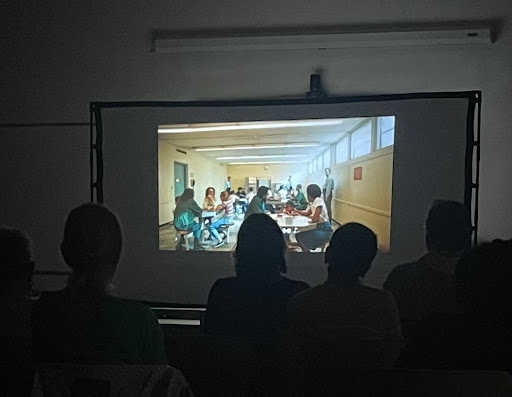
Early in the fall 2024 semester, The City of Fairfax Regional Library and Mason University Libraries co-hosted a screening of the film “If Beale Street Could Talk” (2018), followed by a Q&A discussion with a guest panel moderated by Adult Services Outreach Coordinator William Osborne. The panelists were Mason Professor Helon Habila, Mason film student Erika Timmons and Mason civil engineering student Shane Stevenson.
The screening was part of Fairfax County Public Library’s annual event series, All Fairfax Reads. This year’s event focused on civil rights activist and world-renowned writer James Baldwin.
The film, directed by Barry Jenkins, is a screenplay adaptation of Baldwin’s 1974 novel, “If Beale Street Could Talk.” The novel and film examines a young Black couple, Tish and Fonny, in Harlem, New York City. Their relationship is tested when Fonny is falsely arrested for allegedly sexually assaulting a woman. Jenkins and Baldwin delve into how Black Americans incarcerated within the criminal justice system face unprecedented levels of discrimination and racism.
Jenkins dramatizes the film from Tish’s point of view as she tells the story of Fonny and his end road in prison. The cinematography and the mid-century jazz score romanticize the life shared between Tish and Fonny, disrupted when a revenge-harboring street cop arrests Fonny for a crime he didn’t commit. The film uncovers the never-ending cycle of over-policing in Black neighborhoods, leading to mass incarceration and delayed justice within the system.
To the panelists, it’s a story that still resonates today.
“A lot of these questions still go unanswered so our solution for a lot of these things still hold so much trauma that’s being unpacked,” Timmons said.
“It’s a love story. For me, that’s one of the things that will never age,” Habila said. “The story of young love in a harsh world is always going to be relevant because we understand it.”
The discussion covered another theme shown throughout the film: the injustice of the prison-industrial complex, specifically its treatment of Black Americans. The prison-industrial complex refers to the relation between corporations and criminal institutions that privatize prisons for profit and political influence.
What does the film and James Baldwin himself have to say about [the prison industrial complex]?
Habila: James Baldwin is always on point in his books and he touches the pulse of what’s important in the community… Whether it’s prison, it’s gay love and all these things. He’s never afraid of speaking up.
Stevenson: I don’t think that [Baldwin] feels like there’s anything in place for us. For even just people like us to really change what’s set in place in the system. In the prison-industrial complex, it’s not so much that ‘it’s just taking people and it’s not going to change,’ it’s also saying that in this change, in this stagnation of the rules, it is still drilling deep in these communities and effectively working hard against it.
Does the romanticization of the cinematography in the film still drive home Baldwin’s point on being Black in America?
Habila: I think it does. Love and romance are metaphors here used to represent innocence and beauty and fragility and also resilience. The beautiful cinematography and the concept of artistic imagination and dreaming are all used to show the need for dreaming of a better tomorrow, at least with justice and equality.
Timmons: As much as I may respect and find this cinematic world fluid and beautiful, it fails at showing the voyeur the same world created by Baldwin in the novel, which is more in tune with the struggles of Black people as we face down the systemic caste and racist police and judicial systems in this country.
What are the biggest things viewers of If Beale Street Could Talk can take away with them?
Habila: The carceral system is as virulent as ever, racism is alive and thriving, police injustice is also doing quite well. But at the heart of it, ‘If Beale Street Could Talk; is a love story, albeit love in a very challenging milieu, that is a positive.
Timmons: Above all the concepts and harsh reality to be observed in this film, I hope that people to breathe in the love story that leads this story. Two young lovers forced to fight a society poised to harm them at every turn, determined to blossom despite the struggles they are forced to face. That love, above all other emotions, is the only one that can save society.
Learn more about the upcoming All Fairfax Reads events here.
Photo Courtesy of Won Jun Choi
President of Mason’s Korean student association shares his journey as a Korean AmericanBY PHILLIP KIM, STAFF WRITER
Editor’s note: This interview was initially conducted in spring 2024.
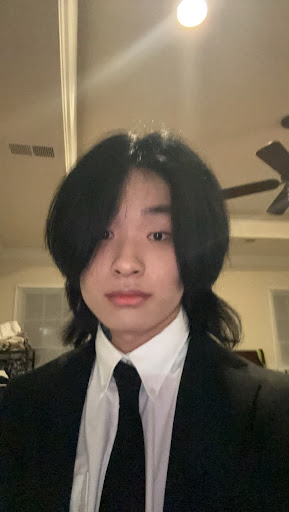
Junior Won Jun Choi was in the first grade of elementary school when his family immigrated from South Korea to the United States. For years, he struggled with language, cultural barriers and racism. Offhand derogatory remarks were not uncommon.
“My high school did not have that many Asian students,” Choi said. “We had 1,300 students and only maybe 10 of them were Asians. When you grow up in that sort of environment, you sort of lose your identity. You are not proud of who you are. You are not unapologetically you.”
That changed when Choi enrolled at Mason as a computer science major, around the time the pandemic broke out. During lockdown, he studied Korean history and culture, learning to embrace both sides of himself.
Choi soon joined Mason’s Korean International Students Association (KISA), and has been the president since fall 2023. KISA’s mission is to provide information about Korean culture to all students who are interested and to connect Korean students on campus to embrace Korean culture. He had never held a leadership position before, but he is passionate about helping other Korean students adjust to new life in America.
“This semester, we were able to serve more people, give them job opportunities that are good for them and connect them with Korean students within the Washington, Maryland and Virginia area right here,” Choi said. “Every time we coordinate with the [Korean] embassy to help Korean students get jobs or just host a networking event, that’s when I’m the most proud of myself and the group.”
Organizing events is not an easy task, according to Choi. First, KISA leadership determines who the event is for. Then, it must figure out the date and time that most target individuals would be free by. Finally, the organization must contact said students to invite them using various means, ranging from direct messaging via social media to handing out pamphlets. Choi shared that nothing beats the rewarding catharsis of moments when events are successfully held.
Growing up as a Korean American in Annandale, Va. was a challenge for young Choi. Now, he chooses to use his experience to help others at Mason going through what he once did.
“I can equally think I’m a Korean and I’m an American,” Choi said. “My ultimate goal is to provide a bridge between Korean Americans and Koreans, for them to understand each other more and make connections with each other in the area.”
Saahiti Chamala/ Fourth Estate
Fourth Estate culture editor shares plan and hopes for the fall 2024 semesterBY SAAHITI CHAMALA, CULTURE EDITOR
My name is Saahiti Kiran Chamala, a sophomore majoring in Finance on a pre-Law track, and I’m thrilled to be the Culture Editor for Fourth Estate this semester!
When I first walked into the student media office, I was just looking for something fun to keep me busy—honestly, I was tired of gatekeeping all the amazing, affordable food spots I’d been hitting up. I pitched a food series for the Culture Section and now here I am with my very own food series on the Fourth Estate website and, somehow, the Culture Editor gig. Life comes at you fast, right?
I couldn’t be more excited. Being part of Fourth Estate has taught me what it really takes to be a journalist—how to bring a little “flavor” to a story (pun fully intended), edit like a pro and work with an awesome, tight-knit team that’s passionate about making things happen. I’ve learned a lot and I’m thrilled for what’s ahead.
With the biggest freshman class in Mason history rolling in, campus is about to be buzzing with activity. It’s the perfect time to dive into all the unique stories that need to be told. We’ve got an incredible team of editors. Together, we’re committed to bringing you stories that matter while keeping things fun and fresh.
So what’s the Culture Section all about? It’s about people, experiences and all the little things that make life at Mason interesting. Whether it’s spotlighting student clubs, covering on-campus events or exploring the hidden gems around the DMV area, we’re here to tell the stories that connect us all. Honestly, the Culture Section is only limited by your imagination. If you’ve got a passion—whether it’s food (like me), fashion or something different—let’s get it in print!
Got a story idea? Or just want to chat about all things culture? Feel free to contact me at the email provided below. I’m here to help you brainstorm, guide your creative process and share a few laughs along the way.
One last thing—if you’ve been thinking about joining the Fourth Estate, now’s your chance! Culture is the perfect place to start writing, no matter your major or experience level. Trust me, you won’t regret it.
Let’s make this semester one to remember!
Saahiti Kiran Chamala, ‘27
Your friendly neighborhood Culture Editor
schamala@gmu.edu
Viviana Smith/Fourth Estate
A list of concerts, shows and more coming to the EagleBank Arena this fallBY VIVIANA SMITH, CO-EDITOR-IN-CHIEF
Did you know that Mason students, staff, faculty and retirees are eligible for special discounts at the EagleBank Arena? With a valid Mason ID, up to four tickets can be purchased at a discounted rate. For Mason sports games, tickets are free for students through Mason 360.
For a full list of home games, visit the 2024-25 schedule on Mason Athletics’ website.
If you are looking for entertainment on campus, there are many events hosted at EagleBank Arena the Mason Community can enjoy. From now until the end of the fall 2024 semester, here is a lineup of upcoming events.
for King + Country: Unsung Hero Tour 2024– Oct. 27
This Christian pop duo comes to Fairfax, Va. on their Unsung Hero Tour featuring music from their “UNSUNG HERO Inspired By” soundtrack, according to EagleBank’s webpage.
According to the official for King + Country website, the GRAMMY-award winning duo gained inspiration from other country, pop and gospel artists such as Kirk Franklin, Dolly Parton, Tori Kelly and more.
The event starts at 7 p.m., with doors opening at 5:30 p.m.
Don Toliver: Psycho Tour– Nov. 8
“After Party” artist Don Toliver is bringing his newest album, “Hardstone Psycho,” on tour. According to the event details, the Psycho Tour is his “biggest North American headlining tour to date.”
American rapper and singer-songwriter Monaleo will be opening for Toliver, with special guest Teezo Touchdown making an appearance.
The concert is set to start at 8 p.m. with doors opening at 7 p.m.
Jhayco: Vida Rockstar Tour– Nov. 17
Puerto Rican singer-songwriter Jhayco will be coming to EagleBank Arena during his Vida Rockstar Tour.
Originally set to perform March 6, the concert was postponed to Nov. 17. According to event details, those who previously purchased a ticket will have their purchases honored for the new date. Tickets are still available and on sale.
The concert is set to begin at 8 p.m. with doors opening one hour prior.
Pentatonix: Hallelujah! It’s A Christmas Tour– Nov. 21
Referred to as their “holiday tradition,” the Acapella pop group Pentatonix is back with their home with one of their biggest holiday tours, according to the event details. Sing along to holiday classics with this legendary group.
The event is set to start at 7 p.m. with doors opening at 6 p.m.
Blessd and Ryan Castro: !Ay Bendito Ghetto¡ Tour– Nov. 22
Colombian performers Blessd and Ryan Castro come together on stage for their U.S. !Ay Bendito Ghetto¡ Tour. The pair will stop by Fairfax during their 16-date tour in late November.
Doors open at 7 p.m. with a showtime of 8:30 p.m.
Got a thing for R&B music? The R&B Vibe Tour comes to Fairfax in early December, with appearances by Tyrese, Monica, 112, Dru Hill and Next.
The event starts at 7 p.m., with doors opening an hour prior.
El Alfa: El Mejor Del Planeta– Dec. 8
Dominican rapper El Alfa ends the semester off hot with his El Mejor Del Planeta U.S. tour. With Fairfax as his last stop in his 16-date tour, folks can catch “El Jefe” at EagleBank Arena at 8 p.m., with doors opening at 7 p.m.
Mitchell Richtmyre/Fourth Estate
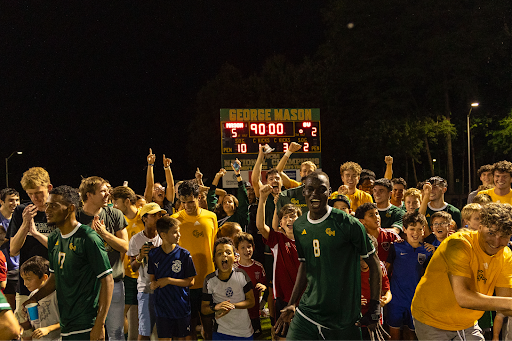
A 10-3 overall record marks the current men’s soccer season as one of the best in recent yearsBY KEVIN BINAJ, SPORTS EDITOR
Mason men’s soccer team has been a force to be reckoned with in the 2024 season. With a 10-3 overall record, including a 4-1 mark in conference play, the team displays exceptional consistency on both sides of the pitch.
This standout season has seen the team balance both conference and non-conference success, building momentum heading into crucial matches.
Whether at home or away, the Patriots have been formidable. Boasting a 6-1 home record, the team has fortified George Mason Stadium, letting it be known that a win won’t be easy for visitors. The team’s first two losses this season came on the road against Old Dominion in a narrow 1-0 defeat and a 2-1 loss at home to Duquesne, which saw the visitors score a 90th-minute goal against the run of play. The third loss came at No. 6 Maryland, as the Patriots fell 2-0.
The Patriots have been clinical in front of the goal, averaging 1.92 goals per game while holding their opponents to just over a single goal per match. With 25 goals scored across 13 matches, the Patriot frontline continues to show no signs of slowing down. The team’s shot accuracy has been impressive with 37% of their shots being on target. In contrast, their opponents have only managed 15 goals from 156 shots, reflecting Mason’s solid defense.
Marek Gonda has led Mason throughout the season, with seven goals and two assists. Gonda has been clinical in front of the goal, showcasing high-level composure and attacking expertise.
Quentin Clain has also contributed significantly with five goals and three assists, while James Eliuda displayed his playmaking ability serving 4 assists.
On the defensive side, goalkeeper Jaume Salvado’s performance stands out. Playing in 12 matches, Salvado has kept his opponents at bay with a 1.16 goals against average and a save percentage of nearly 70%. His leadership at the back resulted in four clean sheets for the team.
With a strong core of players performing at a high level, Mason men’s soccer team is poised for a thrilling conclusion to the season. As they aim to continue their high level of play and maintain their dominant form in conference play, the Patriots hope for a deep postseason run. If their balance between scoring efficiency and defensive solidity continues, the team will be a tough challenge for any opponent in the upcoming matches.
The Patriots’ remarkable journey in the current season showcases not only their individual talent but their collective teamwork and determination, making this season one of the best in recent years for Mason men’s soccer. The Patriots return to action on Oct. 19 with a conference match in Philadelphia against Saint Joseph’s.
Emma Schaible/Fourth Estate
Student Government announces Student Senate election results and holds their first meeting with newest senators.BY EMMA SCHAIBLE, STAFF WRITER
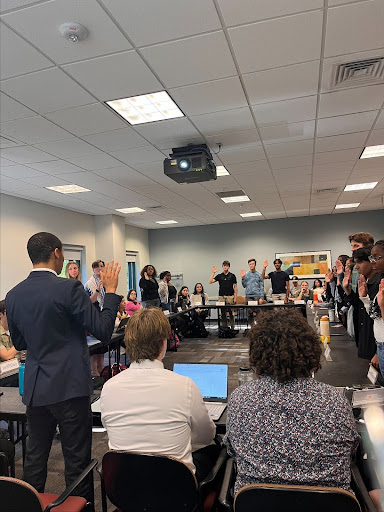
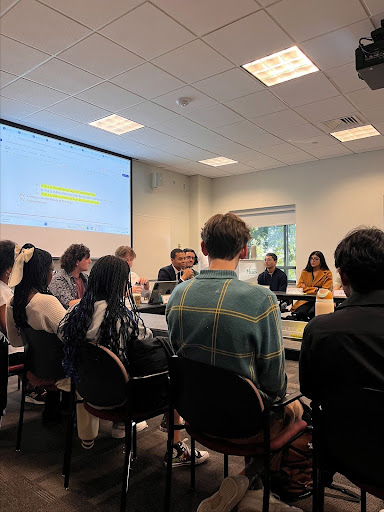
On Oct. 10, 40 new Mason Student Government senators met for the first time in the Johnson Center meeting room G. With the newest student elections, the 45th Student Senate added 20 new student advocates.
SG expressed its excitement about the progress made with the new class and how they can add to the student body’s Mason experience. “Senators, bring your innovative ideas and unique perspectives, and let’s get to work,” writes the official SG Instagram account in their caption.
“Each student election presents itself with a new opportunity to learn from the experiences of the incoming first-year classes,” Jackson McAfee said, the Secretary of Public Relations for the Cuesta-McAulay Administration and greater student government organization.
Each senator went through a required application process including mandatory meetings and campaigning over the month of September. Elections, held on Mason360, officially closed on Oct. 4.
Speaker of the Student Senate senior C. Scott Tatum welcomed every new senator with a smile and encouraging words. After the oath of office, he summarized their role as senators as “putting others’ needs at the top of your mind… we are here to serve the students.”
The senate agenda included a multitude of programs, including more outreach through Registered Student Organizations on campus and with individual students. Their intentions were to work more with the interests of every individual senator and ensure that a wide range of campus organizations are represented in student government.
Emma Schaible/Fourth Estate
The student government is involved in every aspect of student life, from parking services to students’ rights. Topics such as the upcoming general elections and ways on how to better the housing and dining experience have become focuses for SG. These initiatives are deployed through their committees, in which each Senator is required to sit on two.
All meetings are open to the student body at Mason, announced on their Instagram stories, held at 4:30 p.m. on Thursdays in Merten Hall.
“We are equally excited to welcome these new voices to our organizations and learn from their experiences as long-term Mason students,” McAfee said.
Madalyn Godfrey/ Fourth Estate
Mason weighs the pros and cons of the U-Pass system for studentsBY ALEXANDRA HENRIQUES, STAFF WRITER
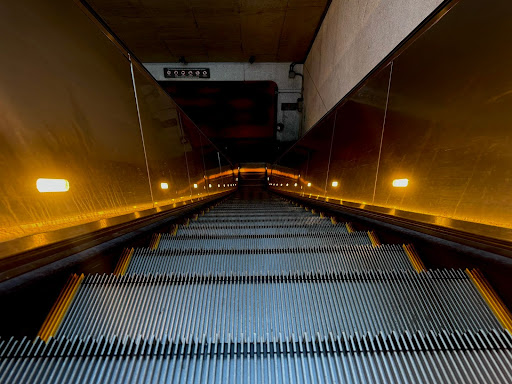
During the 2024 spring semester, Mason students began seeing flyers at campus bus stops attempting to gauge their interest in the U-Pass Initiative. This initiative is a program by the Washington Metropolitan Area Transit Authority (WMATA) granting students unlimited rides throughout Northern Virginia, Washington, D.C. and southern Maryland. With U-Pass, travel on Metrorail and Metrobus would only cost a dollar per day.
Of 28,000 Mason undergraduate students, only 5,858 lived on campus during the 2023-24 academic year. With 21% of the undergraduate population on campus, the remaining 79% were commuters.
Director of Parking and Transportation at Mason Josh Cantor said that the student support for the initiative is split.
“The number one reason we haven’t done [U-Pass] is it’s incredibly expensive for the
University,” Cantor said. ”The way the U-Pass system works is WMATA charges the institution a dollar a day for every student the school has, not every student who uses it. So we have 28,000 full-time students at Mason…that would be $28,000 a day. This one program would be more than our entire transportation budget.”
With no funding for the initiative, a fee would have to be added to student tuition to cover U-Pass for all full-time Mason students. This fee could range anywhere from $200 to $350 annually. American University enacted the U-Pass program in 2016, though it came with a $250 student fee. However, Cantor said that they have easier access to a metro station, whereas the nearest metro station, Vienna/Fairfax-GMU, is 4 miles from Mason’s Fairfax campus.
Cantor said that only 20% of commuter students live in areas with direct metro access, which leaves most students paying for a program that would not benefit their daily transportation needs.
Georgetown University’s pilot program allowed interested students to register for the initiative to receive the benefits of U-Pass. If a similar model is followed, an enrollment-based U-Pass program could curb expenses for both Mason and its students.
A U-Pass program presents another option for students commuting between the Fairfax and Arlington campuses. According to Cantor, a new building is planned to open on the Arlington campus within a year that could increase the number of students traveling between campuses. Cantor acknowledged that when having 50 people traveling at once, trains are more efficient than buses. Once constructed, Mason will assess whether the U-Pass system would be preferred for transportation.
WMATA has encountered economic challenges over the past few years. This includes a projected $750 million budget deficit for Fiscal Year 2025. Problems include low ridership, depletion of federal pandemic relief funds and fare evasion, causing reduction in services provided. Instead of utilizing the metro, Mason’s Department of Transportation is looking at alternatives such as more shuttles, bike-share programs and carpooling.
“In a perfect world, we would be able to throw money at [WMATA] because, from our university’s sustainability perspective, we want students to be able to use transit and not have to drive,” Cantor said.
Madalyn Godfrey/Fourth Estate
The Patriots defeated St. Bonaventure 2-0 on the roadBY CHRISTIAN SEGOVIA, ASSISTANT SPORTS EDITOR
Mason women’s soccer won their first conference game of the season against St. Bonaventure in New York on Oct. 6 with a 2-0 shutout.
Goalkeeper Victoria Coninck entered the game with 38 saves and a 2.20 goals against average (GAA) on 136 shots against for the 2024-25 season.
Early in the game, Mason forward Kiyomi McCausland cut inside the box on the left, passing it to Mason midfielder Molly Starner, with St. Bonaventure goalkeeper Jael Schubert coming out to block the ball. Starner put the ball into the left corner on the rebound, making it 1-0.
In the 27th minute, the Bonnies would clear the ball to give Mason a corner kick. Mason midfielder Rachel Eberly took the corner kick and crossed the ball to Zoe Vidaurre, who passed it to Madyson Taylor, putting Mason up 2-0
At halftime, the Bonnies had more shots than Mason. The Bonnies had 11 total shots with five on target. Mason had four shots with three on target.
Mason committed more fouls than Bonnies; however, Coninck made five saves making sure the Bonnies did not score.
In the second half, the Bonnies continued to control the game in the midfield. St. Bonaventure had a chance at a goal but Victoria Concinck came out and saved it before going in. Other chances would be stopped by Mason’s defense.
Mason also had chances at a goal with their free kicks and corner kicks but would miss outside the goal. Mason continued to dominate their game in defense, preventing the Bonnies from scoring.
At the end of the game, the Bonnies had 15 shots with six on target. Mason had six shots with three on target with Mason having more saves than Bonnies.
Mason had possession of the ball for approximately 41% of the game with most possession coming from their midfield and defense. The Bonnies controlled the ball approximately 59% of the game with most of their possession coming from their midfield and offensive displays.
Masons walked away with a 2-0 win away from home. Victoria Coninck tallied a clean sheet with no goals scored. Mason will return to action on Oct. 17 in Philadelphia against St. Joseph’s.
Madalyn Godfrey/Fourth Estate
Mason swept both series to secure their victoriesBY CHRISTIAN SEGOVIA, ASSISTANT SPORTS EDITOR
Editor’s note: Players will be referred to by their gamer tags.
Mason’s Valorant team defeated Butler University 2-0 in a best-of-three series on Oct. 2. The following day, Mason defeated the University of Central Florida (UCF) Knights 2-0 in a best-of-three series on Oct. 3.
In Mason’s first matchup, the team achieved a lopsided victory winning 13-6 on the Valorant map, Haven, and securing a 13-5 victory on Sunset.
The attacking side’s goal was to get the spike down onto any map sites, while the defending side’s goal was to prevent the spike from being planted on any of the sites. Agents are characters that the players pick to play in the game. The agents’ abilities are used to get into the site to plant the spike, stop the spike from being planted or take down the opponents.
While Butler planted spikes during their attacks on both maps, Mason retook the site with their agents’ abilities.
In round eight, Mason’s Soji got an ace after retaking on B site Haven. He used Neon’s ultimate overdrive ability, zapping lighting out of her finger. In round 10, Soji and Mason’s Blaze retook Heaven site C, clutching a 2v4. In the next round, Soji clutched a 2v1, isolating each fight against Butler.
On Sunset, Blaze got an ace to give Mason a boost. In round six, Blaze got two Butler players in the Sunset market and two in B main. To get his ace, he used Sova’s hunter’s fury ultimate on Butler’s Omen, planting a spike on A site.
Mason beat Butler University 2-0 in the best-of-three series.
Mason hosted a watch party for fans at the Student Involvement Office during their match against UCF, providing free pizza and drinks for Mason fans to enjoy.
In their final match, Mason won 13-1 on Sunset. Mason’s Ktran, who played as Breach, led the way with 16 kills, 4 deaths and 12 assists as Initiator. Alongside Ktran, Mason’s Coco played as Cypher with 15 kills, 3 deaths, and 3 assists as Sentinel.
Mason won 13–3 on Bind. Soji led the way as Raze with 17 kills, 6 deaths and 5 assists as a duelist. Blaze played as Viper and got 16 kills, 7 deaths and 5 assists as a controller. In both games, Mason out-killed UCF 137 to 55.
Mason won their second straight game with a 2-0 victory in the series.
Amelia Jane Sand/Fourth Estate
Students for Justice in Palestine hold a protest on Wilkins Plaza during the “Week of Rage,” noting one year of resistanceBY BARRETT BALZER, STAFF WRITER AND AMELIA JANE SAND, STAFF WRITER
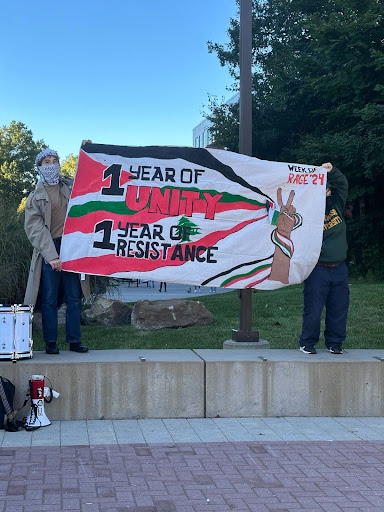
On Oct. 9, Students for Justice in Palestine at Mason held a “1 year of genocide, 1 year of resistance” protest on Wilkins Plaza during their “Week of Rage” events.
In an Instagram post by SJP Mason, the “Week of Rage” is described as a week of demonstrations “against the zionist entity & its brutal genocidal campaign upon Palestinians.” The events, taking place from Oct.7 to Oct. 10, included “art-building, poster making, and reflections & discussion,” a screening of “TRT’s Holy Redemption” and an absentee prayer.
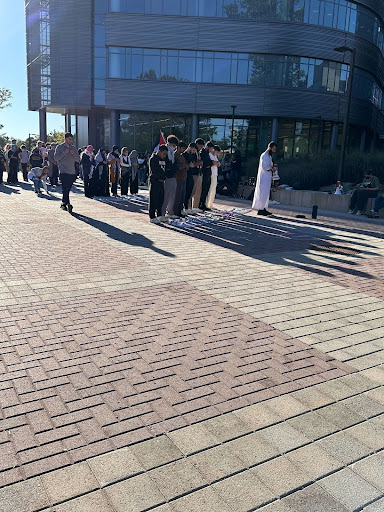
During the protest on Wednesday, organizers started with a prayer, consisting of two rows. The prayer was led by one male organizer, leading both rows of men and women each. All prayed northwest towards Mecca.
Amelia Jane Sand/Fourth Estate
The protest featured heavy chanting, shouting, “we will not be pushed aside, put an end to genocide,” “from the sea to the river, Palestine will live forever,” and “Bil Rouh, Bil dam, nafdika ya falasteen,” which translates to “with our soul and blood we will free Palestine.” Members of SJP took turns beating a drum to the rhythm of the chants.
“I have a message for the leaders of George Mason University. The purpose of a university is to be a champion for the truth, and despite the nonstop barrage of misinformation from Netanyahu and Biden, and despite the shamefully timid coverage in the news industry, we know the truth,” Associate professor Tim Gibson said. “We must stop it now. If you can hear my voice in Horizon Hall, in the Johnson Center, all around campus, join us, do not be afraid of repression.”
Other speakers included members from SJP, as well as one Lebanese speaker, addressing the attacks in Lebanon.
During the protest, two counter-protestors arrived. The pair shouted, “America first,” and played unintelligible music from a JBL speaker. The counter-protestors were quickly told to stop by members of SJP and other protestors. Another individual stepped in and said, “they have a right to be here.” After the exchange, one protester sat down with the pair to hold a private discussion.
In an Instagram post, SJP explained that the efforts of the rage week are to “continue to wield our power within our institution, holding George Mason university accountable.”
“We will not stop, we will not rest,” wrote SJP. “For Gaza, we will continue to rise no matter how long it takes.”
Photo Courtesy of Cuesta-McAulay Press Office
Cuesta-McAulay bridges gap between first-gen students and higher education with a new websiteBY NYLAH MITCHELL, STAFF WRITER
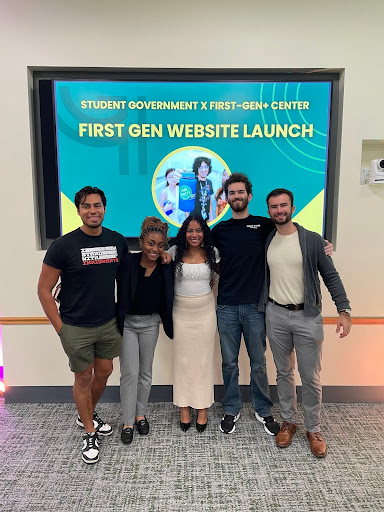
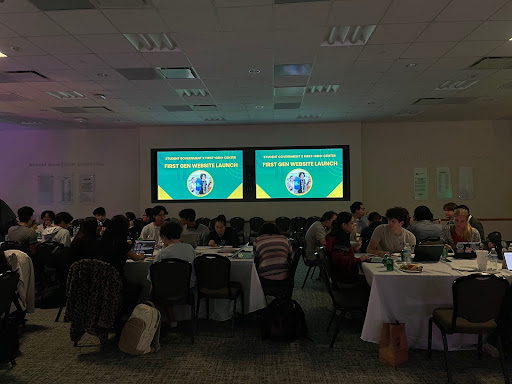
On Thursday, Oct. 3, Student Government collaborated with the First-Gen+ Center to launch a “how-to” website. Catered towards first-generation and migrant-origin students, the site gives a comprehensive guide on navigating college.
The launch kicked off in Merten Hall, with Spanish top hits welcoming attendees. Mason Student Body President Maria Cuesta announced the collaboration with First Gen+ Center Assistant Director Rommel Aguilar. Aguilar shared that the website’s goal is to be “first-gen ready” and “promote undocufriendly spaces.”
The website, “How To Guide: A Navigation Tool for First-Gen College Students and/or Students from Migrant-Origins,” provides various resources such as links to connect with student services, scholarship opportunities and more. Additionally, the website introduces students to the Mason community and provides a list of clubs and organizations surrounding identity and Greek life.
Photo Courtesy of Cuesta-McAulay Press Office
Though it doesn’t include every registered student organization (RSO), Undersecretary of Website Management Jake Dillenburg shared that “the [guide] is updateable. It is a living website.”
The “Tips + Student Testimonials” page offers perspectives from current and alumni Mason students who may have felt “lost” or “uncomfortable” about receiving higher education. “It alleviates the pressure of getting an education,” Cuesta said.
Cuesta was elected as Student Body President in the Spring 2024 election. “On top of being a first-generation, I’m also an international student,” Cuesta said. “At Mason, I understood and saw the need of people being able to understand how to navigate college.”
Cuesta credits her involvement with various student organizations and departments on campus for expanding her view on the different needs within Mason’s community. Cuesta shared that any efforts to enhance the experience of certain communities is an attempt to bring the community together.
“It did start from a first-generation and immigrant background, but it’s not limited to that. It serves all students,” Cuesta added.
Students can access the full guide on the official student government website.
Amelia Jane Sand/ Fourth Estate
Student organizations host Israeli Vigil on October 7, marking one year since the start of the Israel-Hamas war. President Gregory Washington speaks at the event.BY BARRETT BALZER, STAFF WRITER AND AMELIA JANE SAND, STAFF WRITER
Editor’s Note: Fourth Estate uses language in accordance with AP style guidelines. For more information on the use of the “Israel-Hamas war”, please visit the AP Stylebook.
On Oct. 7, students gathered in Wilkins Plaza to attend the Israeli vigil observing the one-year anniversary of the Israel-Hamas war. The remembrance vigil was hosted by students from Mason Chabad, the Israeli Student Association (ISA), Mason Hillel and Students Supporting Israel at GMU.
On Sept. 25, Mason Hillel made an Instagram post inviting the Mason community to the vigil. Described in their caption, the purpose of the vigil was to “mark the first anniversary of October 7th.”
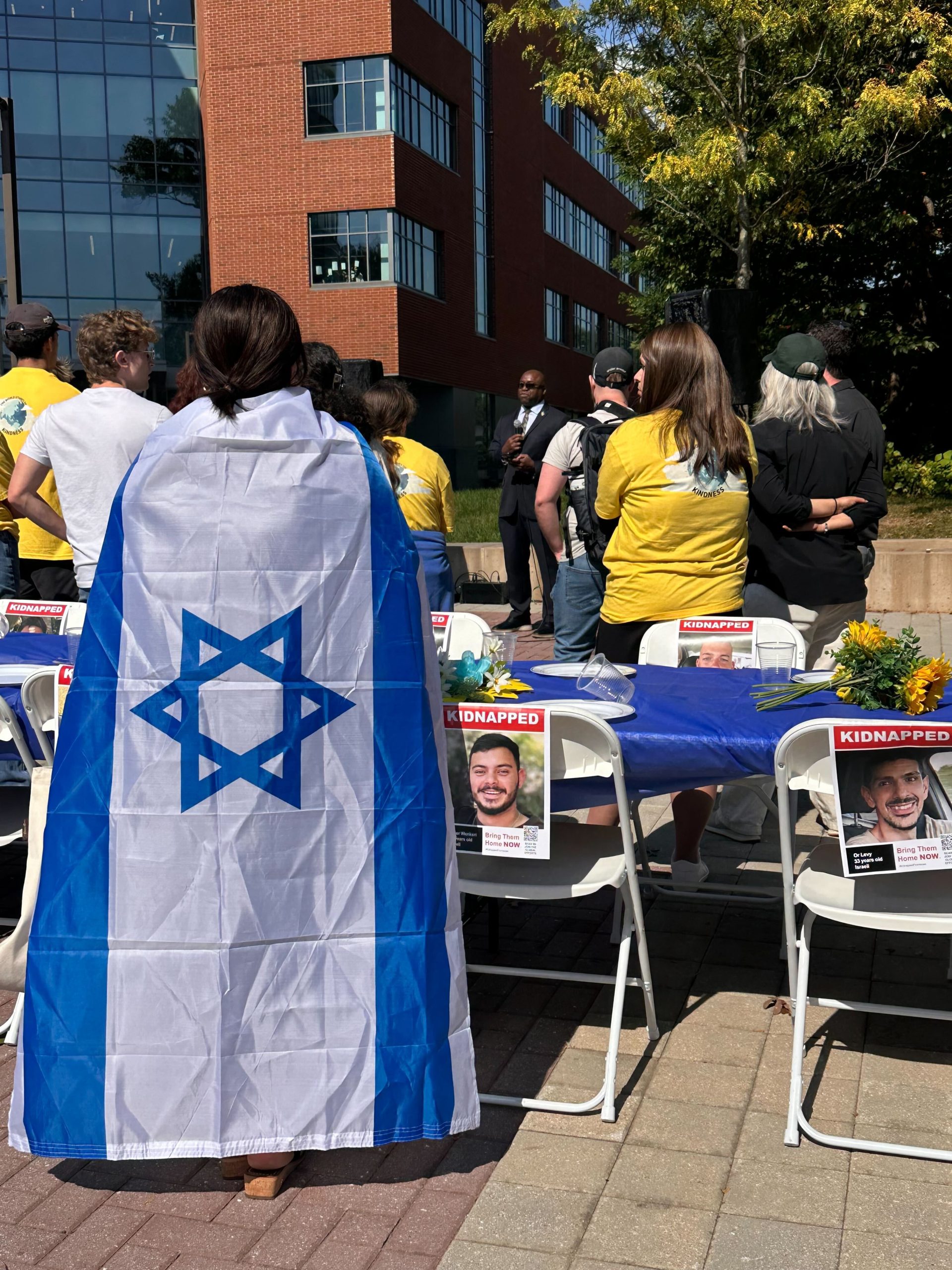
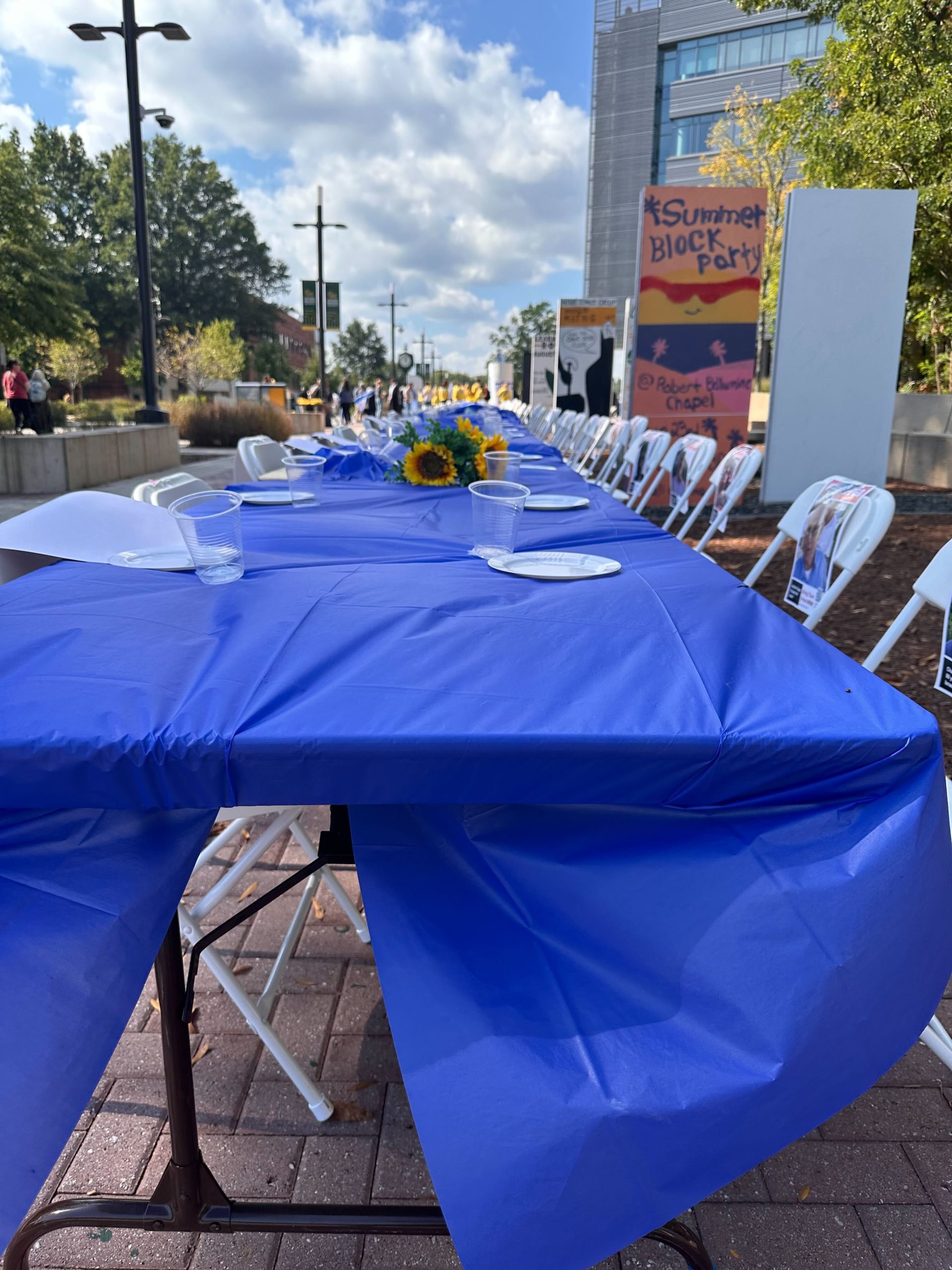
The vigil featured a long table decorated with plates, cups and yellow flowers with chairs holding pictures of the faces of several victims. The photos were accompanied with the names of the individuals and the words “kidnapped” or “murdered.” According to one organizer, the Shabbat table Installation was intended to represent those who were kidnapped, died or both during the first days of the Israel-Hamas war.
Amelia Jane Sand/ Fourth Estate
A giant Tzedakah box was placed at the end of the table nearest to Horizon Hall. The organizers handed out yellow shirts with a heart-shaped earth on them.
Key speakers included Rabbi Daniel Novick and Rabbi Ezra. Additionally, Mason President Gregory Washington gave a speech addressing attendees.
“By the Rev. Martin Luther King, darkness cannot drive out darkness, only light can do that. Hate cannot drive out hate, only love can do that,” Washington said.
When asked about his attendance, Washington said, “I came out because the students asked and because it was a vigil. This was to help students mourn.”
At the end of the vigil, Rabbi Ezra led the group in a song, Psalm 121, and instructed the attendees to cover their eyes with their right hand for the quick prayer. After, attendees passed out small yellow Tzedakah boxes at Wilkins Plaza, from Southside to the statue of George Mason next to the Johnson Center.
Mitchell Richtmyre/Fourth Estate
The Patriots continued their historic start with a win over their rivalsBY CHRISTIAN SEGOVIA, ASSISTANT SPORTS EDITOR
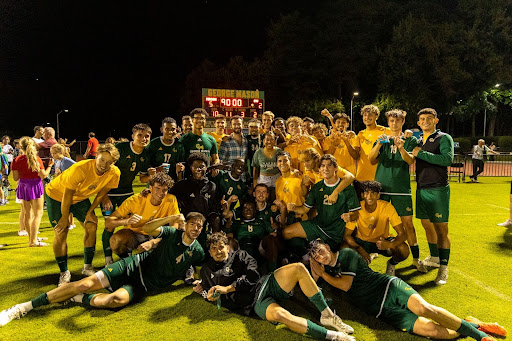
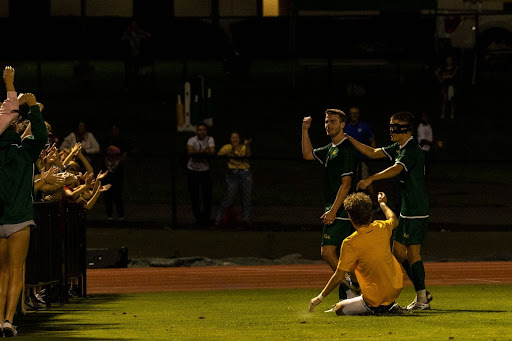
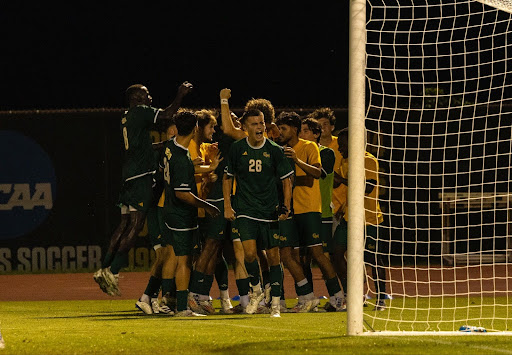
On Sept. 28, Mason men’s soccer dominated George Washington, defeating their rivals 5-2.
Starting the game off with possession, Mason moved the ball around the field showing chances of a breakthrough goal through using corner kicks and free kicks; however, their chances were met with the ball either going over the crossbar or being blocked by George Washington. The Revolutionaries started the scoring with a free kick from Finn Roberts in the 30th minute of the first half.
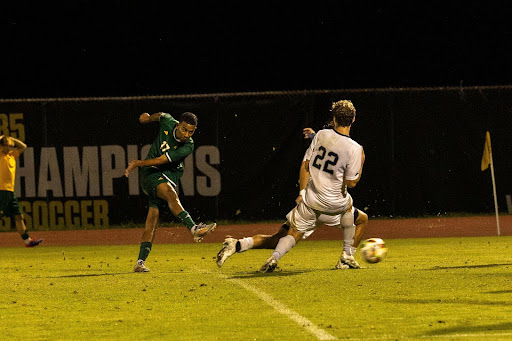
In the 32nd minute, Mason was given a penalty. Forward Marek Gonda took the penalty and kicked the ball down the middle, tying the score 1-1.
In the 42nd minute of the first half, Mason defender Luis Maestre would start his run from the defense side into the midfield, finding Gonda, who would then pass it to forward Abdul Kamara on the right side of the field. Kamara would cross the ball from the right side of the field into the box to midfielder James Eliuda, who passed the ball to midfielder Henry Wachsman. Wachsman scored to put the Patriots up 2-1 at halftime.
Mason continued their possession game as the second half started. In the 50th minute, Gonda dribbled past a defender, having a chance at goal but George Washington goalkeeper Tom Macauley came out and grabbed the ball before he could shoot. From the 50th minute to the 63rd minute, Mason kept possession, passing the ball around and attacking to find any holes in George Washington’s defense.
In the 63rd minute, Mason lost the ball on their defending side to George Washington midfielder Roee Tenne, who passed it inside the box to forward Jaden Dubon. Dubon kicked the ball into the bottom right corner of the goal, forcing a 2-2 tie.
In the 73rd minute, Mason defender Leo Lemoine took a shot outside the box that would go over the crossbar to the left. In the 76th minute, Mason forward Quentin Clain scored on a rebound to put the Patriots in front 3-2.
Mitchell Richtmyre/Fourth Estate
In the 80th minute, Gonda crossed the ball from the right side of the box into Clain with another chance at goal but it was saved by Macauley. In the 83rd minute, Eliuda got the ball in the middle of the field and passed to Clain. Clain knocked in his second goal on a breakaway against Macauley.
Mitchell Richtmyre/Fourth Estate
In the 84th minute, Eliuda shot the ball from outside the box directly at Macauley, who blocked the ball. The ball rolled right to Gonda, who put the ball in the bottom right of the net to clinch a 5-2 win for the Patriots.
Mitchell Richtmyre/Fourth Estate
The Patriots have won three straight and sit atop the A-10 standings
BY GABRIEL KING, CO-EDITOR-IN-CHIEF
Mason men’s soccer earned a national ranking for the first time since September 2014, the United Soccer Coaches announced Tuesday. The Patriots rose to 20th in this week’s United Soccer Coaches poll after receiving votes in last week’s poll.
The Patriots are 8-1-0 to start the season, their best start since 1985. Mason is 2-0 in Atlantic 10 play, with wins over Massachusetts and rival George Washington to begin their conference slate. VCU joined Mason as the only A-10 teams in the poll, sliding in at 23rd. The Patriots will travel to Richmond to face the Rams in the season finale on Nov. 2 in a game that will have national and conference ramifications.
Sophomore midfielder Quentin Clain has guided the Patriots to their historic start with his team-leading five goals and 12 points this season. Clain ranks fourth in A-10 in both categories of goals and points and Mason leads the conference with 68 points as a team. In Saturday’s win over George Washington, Clain and graduate student forward Marek Gonda scored two goals each to help the Patriots pull away from the Revolutionaries.
As a team, the Patriots are averaging 2.2 goals per game, which ranks third in the A-10. In both of its conference wins, Mason struck multiple second-half goals to secure the victories.
Along with their explosive offense, the Patriots’ stellar goalkeeping has led them to their national ranking. Graduate student goalkeeper Jaume Salvado has played every minute this season, allowing one goal per game in nine starts. Mason is third in the A-10 in goals allowed per game and Salvado has held opponents to less than three goals in eight of his nine starts.
Mason will play as a nationally-ranked team for the first time in a decade on Saturday in Philadelphia against La Salle. The Explores are 3-4-3 and 1-0-1 in conference play. The Patriots return to George Mason Stadium on Wednesday, Oct. 9 against Loyola Chicago,
Nawaal Nackerdien/ Fourth Estate
A new restaurant coming soon to SUB 1 in October 2024.BY SAM DOUGLAS, STAFF WRITER
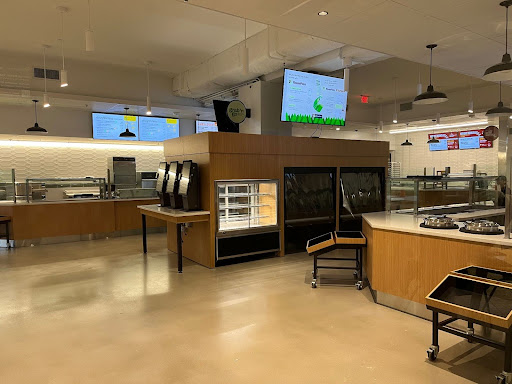
The Eaterie is Mason’s latest food hub, becoming the second newest food option to open on campus this fall semester. Located next to Chick-Fil-A on the ground floor of the SUB 1 building, the new dining option takes over a vacancy left by the Rathskeller in 2019.
Tentatively scheduled to open in October, there will be seven differently themed stations with a variety of foods for students to try. The Eaterie plans to have certain items that are free once a day for specific meal plans. After the dining option opens, students can order ahead in the Starship app. Starship’s robot delivery service will not be available as soon as The Eaterie opens, but is planned to be available in the future.
For students looking for traditional meals such as pizza and sandwiches, they can visit the “Doughlicious” and “Subs & Such” stations. The station “Without Boundations” spotlights food from around the globe. “Dress it Up” and “Sips” are the salad bar and drink stations, respectively. Even “Grab N Go” will move to become a permanent station in the Eaterie. Additionally, vegetarian options can be found at each station.
Also featured as one of the seven stations is “The Mason Mensch,” the first kosher-certified kitchen in Northern Virginia, according to Mason Dining Marketing Director Sofya Vetrova. Originating from a small kosher cart in the Southside dining hall last year, The Mason Mensch has a sealed off kitchen to ensure no cross-contamination and will be supervised by a mashgiach to ensure the food follows the rules of orthodox Jewish cleanliness.
When deciding the dining options on campus, students heavily influence Mason Dining through conducted surveys. The most common feedback Mason Dining receives is requests for more plant-based options on campus. This led to the opening of a completely vegetarian dining hall, The Spot, as well as two vegan restaurants, NuVegan and Sweet Vegan.
The Eaterie takes pride in its environmental sustainability. The dining option will utilize Reuse Pass and partner with the company Topanga to become the first food spot on campus to offer reusable containers.
“It really comes from the student voice,” Vetrova said. “They are the ones who are telling us what is trending… then we investigate and see if there is a right spot for it.”
Brandyn Fragosa/ Fourth Estate
Mason Student Government Vice President Colin McAulay explains how student government will bring student advocacy to the Virginia General AssemblyBY BRANDYN FRAGOSA, SENIOR NEWS REPORTER
On Sept. 25, Mason Student-Body Vice President Colin McAulay and the Government and Community Relations Committee hosted a town hall with Mason student senators to discuss plans for implementing their “Richmond Plan.”
Held in the side pocket at The HUB, the town hall allowed the Mason community to discuss policy proposals they wanted to share with members of student government and the Virginia General Assembly. McAulay shared insight into what this plan looks like and how it will be implemented.
“What we’re trying to do today is gather opinions from the student body about what we can do in Richmond and [the Virginia] General Assembly to support students at Mason,” McAulay said. “We have ideas as student government, as students at this school, about how we can help students with topics like student poverty and hunger, college affordability, diversity, equity and inclusion, accessibility, all types of issues.”
The town hall provided a platform for students to voice their concerns and propose solutions to develop their Richmond Plan. “We can have our opinion, but we’re the representatives of the students, and we want to represent their opinions and not just ours,” McAulay said.
McAulay shared that a student voiced concerns about pursuing a degree in social work, which requires 450 hours of unpaid fieldwork to receive a bachelor’s degree. McAulay and student government senators want to draft a policy proposal for the Virginia General Assembly to make the major more accessible for students to pursue.
This focus on student concerns aligns with McAulay’s broader responsibilities, including his role on the Student Advisory Council of the State Council of Higher Education for Virginia (SCHEV).
Appointed by Mason President Gregory Washington, McAulay and 39 other students from Virginia universities advise SCHEV on higher education administration. Within this role, McAulay focuses on student poverty and hunger, which are concerns he wants to address within the Richmond Plan.
McAulay explained that he wants to support a hunger-free campus bill to “help push dining contractors, for us it’d be Sodexo, to provide more resources to students who are food insecure and trying to eliminate student hunger.”
In addition to addressing hunger on campus, McAulay wants to help alleviate students financially from the rising cost of university tuition.
University tuition cost has been a concern among Mason students with in-state tuition increasing by 3% for the 2024-25 fiscal year. McAulay wants to create policy proposals regarding college affordability, listing ideas such as freezing in-state tuition and student fees to help students with their college tuition.
To facilitate the legislative process for these bills, students are encouraged to actively participate and voice their opinions by submitting concerns directly to the student government.
“These [conversations] can help facilitate [the legislative] process because the Statehouse and the state assembly can be influenced. It is accessible to Virginians and people that go here and bills pass. It’s not as political as Congress,” McAulay said.
Once student concerns are collected and policy proposals are drafted, they will be submitted to Virginia delegates and senators on behalf of the student government in the first week of October. A member of the House of Delegates or Senate of Virginia will then draft legislation to refine the proposals into clear and effective bills. If both chambers of the Virginia General Assembly approve a bill, it is sent to Virginia Governor Glenn Youngkin. Youngkin can then approve, amend or veto the bill.
McAulay advises students to continue to help develop their Richmond Plan by submitting concerns and potential solutions to the student government by directly messaging the official Mason Student Government or Cuesta-McAulay administration Instagram accounts. Students can also submit concerns via the student government email.
Students may also attend the Government and Community Relations Committee meeting every Tuesday at 4:30 p.m. in the Office of Student Involvement for direct input to the Student Government. Students can also attend Student Senate meetings on Thursdays at 4:30 p.m. and Executive Cabinet meetings at 7 p.m. in Merten Hall.
By engaging in these conversations, students can directly influence the student government’s initiatives.
“[We] go to where the students are,” McAulay said. “That’s really what Maria [Cuesta] and I have thrived on within the student government… asking [the community] how Mason’s been. And that kind of conversation can always lead to some form of advocacy or some form of figuring out what those students want and figuring out how we can help them do it.”
Nadine Abdalla/Fourth Estate
Health and fitness advocate Nadine Abdalla reveals how embracing exercise can transform your confidence and mental resilience
BY NADINE ABDALLA, STAFF WRITER
Fitness wasn’t always a part of my life. After moving from Egypt to the U.S. at age 9, I struggled with weight gain and faced relentless bullying. It wasn’t about the physical changes but the emotional toll. My self-worth took a hit and shyness became my shield. It wasn’t until I took control of my life through fitness that I began to experience a profound transformation.
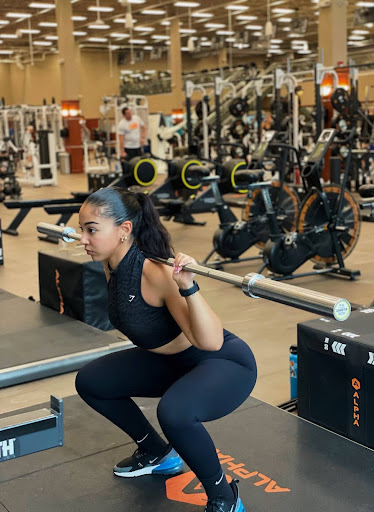
Fitness is more than physical exercise; it’s a powerhouse for self-empowerment. Each drop of sweat and every challenge faced in the gym builds resilience, self-discipline and confidence. Committing to a fitness routine isn’t about working on your body. It’s a journey that strengthens your mind and spirit.
The thrill of surpassing a goal, whether it’s running an extra mile or lifting heavier weights, isn’t only a physical triumph; it’s a testament to your inner strength and a reminder that you’re capable of far more than you once believed.
The mental health benefits of fitness are just as impressive. Regular exercise can work wonders for reducing symptoms of depression and anxiety. For me, it became a healthy outlet for channeling stress and frustrations. Each workout session not only helped me blow off steam but also fostered a positive self-image. The physical changes were noticeable but the boost in confidence and self-esteem was even more remarkable.
For students juggling the pressures of academics, stress or self-doubt, fitness can be a game-changer. Start by setting small, achievable goals, Don’t aim for a marathon right out of the gate! Commit to a few short, regular workouts each week. Find activities that make you feel alive whether it’s jogging, yoga, or a sport, and make them part of your routine.
Use fitness apps like MyFitnessPal or Nike Training Club to keep track and stay motivated. And don’t overlook local gyms or community centers; they often have student discounts or free classes that can help you get started. Full-time Mason students have free access to the three gyms on the Fairfax campus.
Building a support system can also make a huge difference. Exercising with friends or joining a fitness group can keep you motivated and make workouts more fun. If you prefer working out at home, check out YouTube channels, they offer fantastic guidance and variety.
Balancing fitness with your academic life is key. Schedule workouts around your classes and study sessions to keep everything in harmony without adding extra stress. Even a short, 10-minute workout can work wonders for managing stress and boosting focus, especially during those high-pressure exam periods.
So embrace fitness not just as a physical challenge but as a journey of self-discovery and empowerment. Every step, lift and sprint is a testament to your inner strength and resilience. By committing to this journey, you’re not just sculpting a healthier body, you’re unlocking the incredible power within you to achieve greatness in every aspect of your life.
Fitness is about more than changing your body. It’s about empowering your soul and setting the stage for a more confident, fulfilling and empowered life.
Viviana Smith/ Fourth Estate
Fourth Estate sports editors share their plans for the fall 2024 semester, hoping for a deeper look into the world of Mason sportsBY KEVIN BINAJ, SPORTS EDITOR AND CHRISTIAN SEGOVIA, ASSISTANT SPORTS EDITOR
My name is Kevin Binaj, and I am excited to be part of this year’s team as the sports editor. With the start of a new academic year, I am eager to contribute to the paper’s success and bring fresh, dynamic coverage to the sports section.
In the upcoming issues, I plan to explore a diverse range of topics that go beyond just scores and statistics. I want to highlight the stories of our teams, their dedication to the craft and the impact sports has on our community. My goal is to dive deeper into the personal journeys of our athletes, the camaraderie and challenges within teams and how sports shape the overall student experience.
Collaboration is key. I am excited to work with each of you to ensure we produce high-quality content that resonates with our readers. If you have any suggestions, ideas, or feedback on how we can elevate the sports section or if you need any support with your sections, please feel free to reach out. Together, we can continue to make the school paper a platform for compelling storytelling and thought-provoking discussion.
Looking forward to an exciting year ahead.
Best regards,
Kevin Binaj, sports editor
kbinaj@gmu.edu
Christian Segovia/ Fourth Estate
Hello everyone!
My name is Christian Segovia, and I am the assistant Sports Editor working next to Kevin Binaj. I am majoring in Communication with a focus on Journalism and a minor in Sports Communication.
The two goals I have this semester are to dig deeper into the culture of Mason sports and cover Esports for our gamers. The sports section wants sports cards that do a deeper analysis of our players and coaches at Mason.
I am excited to work alongside Kevin, our lead sports editor. We invite all forms of collaboration, story ideas or questions. We look forward to working with all of you throughout the semester.
Students interested in joining Fourth Estate should email us at eic@gmufourthestate.com. If you have an interest in writing sports related content on campus, please reach out to us below.
Best,
Christian Segovia
csegovi@gmu.edu
The Fourth Estate
Recent reports of vandalism on Mason property ahead of career fairBY VIVIANA SMITH, CO-EDITOR-IN-CHIEF AND MADALYN GODFREY, COPY EDITOR
On Wednesday, Sept. 25, at 6:58 a.m., Mason Police Department reported a case of property damage at the Johnson Center. According to the daily crime and fire log, Mason filed a complaint reporting, “intentional vandalism to State property.” The time of the incident is unknown and the status is still pending as of Sept. 25.
An anonymous submission was posted on the Instagram page gmuintifada displaying photos and videos of the incident. Gmuintifada wrote in the caption, “autonomous actors at George Mason university do NOT welcome the genocide profiteering defense companies attending the GMU career fair.”
Fourth Estate has not confirmed the account’s affiliation with the incident besides posting the content.
Mason’s annual fall career fair was scheduled to be held at the Johnson Center from 11 a.m. to 4 p.m. This two-day event hosts various companies on Mason’s campus to assist in new hire recruitments.
In an anonymous photo submission posted by gmuintifada, a banner draped over the balcony of the Johnson Center listed “Lockheed, Gen. Dynamics [and] Leonardo.” Gmuinfitada wrote in the caption, “students in the Johnson Center have raised a banner condemning the genocidal war profiteers present in the GMU career fair.”
Lockheed Martin, General Dynamics and Leonardo DRS were among the over 200 companies in attendance at the fair.
The banner has since been removed from the balcony.
Gmuintifada is a public instagram account created in June 2024. According to their biography, they are self-described as a “direct action pro-resistance network at GMU.” The account accepts and posts content of “GMU actions” obtained by anonymous sources, according to a story post made on Aug. 30.
On Aug. 30, the account addressed Mason directly in a post, writing, “the Student intifada will not halt until all ties with weapon manufacturers and institutions aiding in the genocide of Palestinians are ceased, and the complete and total liberation of Palestine [is] realized.”
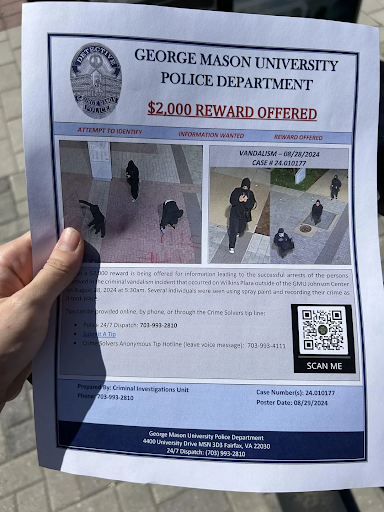
This is not the first report of property damage in a similar nature. On Aug. 28 at 6:26 a.m., Mason PD reported a case of vandalism of property at Wilkins Plaza. According to August’s daily crime and fire log, Mason filed a complaint reporting “graffiti” with status pending as of Aug. 28.
Mason PD issued a $2,000 reward offer “for information leading to the successful arrests of the persons involved in the criminal vandalism incident that occurred on Wilkins Plaza outside of the GMU Johnson Center on August 28, 2024 at 5:30am.” This offer is higher than their Crime Solvers Tips submission where “information reported to the police that leads to an arrest may be eligible for a reward of up to $1,000.”
Anonymous photo submission
On Aug. 30, the gmuintifada Instagram page posted a video of allegedly said report taking place with the following caption:
“We the George Mason University students of conscience, bear witness to the atrocities funded and supplied by our university, and we have chosen to retaliate. During the early hours of Wednesday morning, autonomous students left the imperial George Mason University a message: that the student intifada has been reignited, and that we will honor all the Gazan martyrs who did not live to witness this academic year. University’s administration’s across the nation have convinced themselves that they can suffocate the flames of resistance that have been unleashed since the inception of this genocide. Yet, what they fail to realize is that their every effort to stifle our voices and eradicate our movement for liberation has only provoked an inferno that will engulf all systems of oppression that are upholding the genocide of the steadfast and honorable Palestinians. George Mason University, you will NEVER be able to escape accountability for your role in this genocide. Gaza is our compass and the hear of our noble struggle and the Student Intifada will confront every dousing of our eternal flame of resistance with precision. We will never be extinguished. Resistance until victory, GMU Intifada #escalate4gaza #studentintifada”
As of Sept. 25, Mason PD is still investigating the incident.